
精神益生菌改善外科肿瘤患者的抑郁和焦虑状态:研究结果
Psychobiotics Ameliorate Depression and Anxiety Status in Surgical Oncology Patients: Results from the Study.
作者信息
Tzikos Georgios, Chamalidou Eleni, Christopoulou Dimitra, Apostolopoulou Aikaterini, Gkarmiri Sofia, Pertsikapa Marianthi, Menni Alexandra-Eleftheria, Theodorou Ioannis M, Stavrou George, Doutsini Nektaria-Dimitra, Shrewsbury Anne D, Papavramidis Theodosios, Tsetis Joulia K, Theodorou Helen, Konsta Anastasia, Kotzampassi Katerina
机构信息
Department of Surgery, Aristotle University of Thessaloniki, 54636 Thessaloniki, Greece.
Outpatient Surgical Oncology Unit, Chemotherapy Department, AHEPA University Hospital, Aristotle University of Thessaloniki, 54636 Thessaloniki, Greece.
出版信息
Nutrients. 2025 Feb 28;17(5):857. doi: 10.3390/nu17050857.
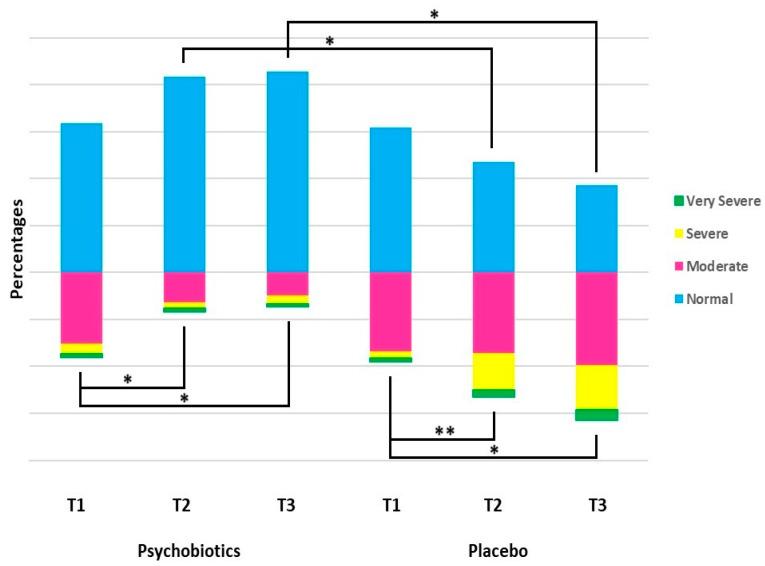
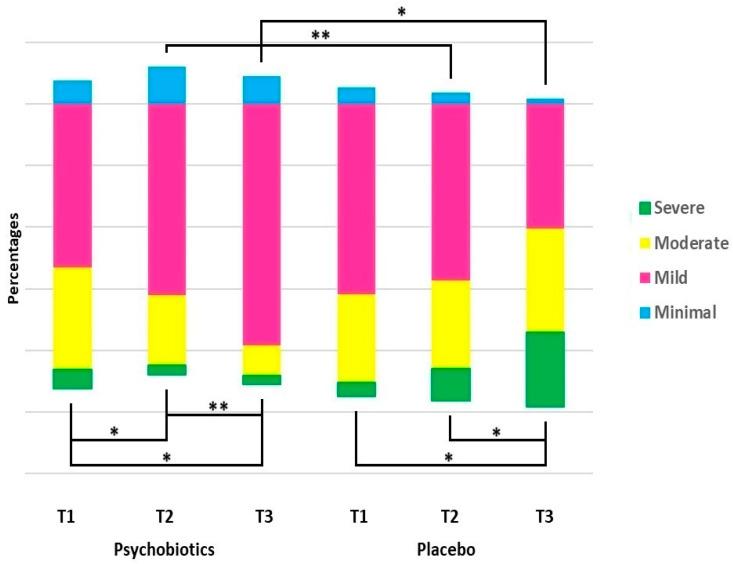
: Psychological disorders are prevalent in patients having undergone gastrointestinal cancer surgery, and their emotional status may further deteriorate during subsequent chemotherapy. Psychobiotics are specific probiotics that have the unique characteristics of producing neuroactive substances that are thought to act on the brain-gut axis. The aim of the present study was to evaluate the benefits of a psychobiotic formula on depression and anxiety status, as well as on perceived stress, versus a placebo in patients on a chemotherapy course following gastrointestinal surgery for cancer. : The enrolled patients, allocated to the psychobiotic and placebo groups, were assessed by means of these psychometric tests: Beck's Depression Inventory and the Hamilton Depression Rating 17-item Scale for depression; the General Anxiety Disorder-7 for anxiety; and the Perceived Stress Scale-14 Item for perceived stress at three time-points: upon allocation [T1], after one month of treatment [T2], and two months thereafter [T3]. : In total, 266 patients were included. One month of psychobiotic treatment improved [i] depression status by 60.4% [48 depressed patients at T1, reduced to 16 at T3]; [ii] anxiety by 57.0% [72 patients at T1, 26 at T3]; and [iii] stress by 60.4% [42 at T1, 14 at T3]. The placebo-treated patients experienced a deterioration in all parameters studied, i.e., depression increased by 62.9%, anxiety by 39.7%, and stress by 142.5%. : Based on these findings, it can be recognized that psychobiotic treatment has great potential for every patient at risk of suffering from depression, anxiety, or stress during the course of surgery/chemotherapy for gastrointestinal cancer.
心理障碍在接受胃肠道癌手术的患者中很普遍,并且他们的情绪状态在后续化疗期间可能会进一步恶化。心理益生菌是具有产生神经活性物质这一独特特性的特定益生菌,这些神经活性物质被认为作用于脑-肠轴。本研究的目的是评估一种心理益生菌配方相对于安慰剂,对接受胃肠道癌手术后化疗疗程的患者的抑郁和焦虑状态以及感知压力的益处。:通过这些心理测量测试对纳入心理益生菌组和安慰剂组的患者进行评估:贝克抑郁量表和汉密尔顿抑郁评定量表17项版用于评估抑郁;广泛性焦虑障碍量表-7用于评估焦虑;感知压力量表-14项用于评估感知压力,在三个时间点进行评估:分配时[T1]、治疗一个月后[T2]以及此后两个月[T3]。:总共纳入了266名患者。一个月的心理益生菌治疗使:[i]抑郁状态改善了60.4%(T1时48名抑郁患者,T3时降至16名);[ii]焦虑改善了57.0%(T1时72名患者,T3时26名);[iii]压力改善了60.4%(T1时42名,T3时14名)。接受安慰剂治疗的患者在所有研究参数上均出现恶化,即抑郁增加了62.9%,焦虑增加了39.7%,压力增加了142.5%。:基于这些发现,可以认识到心理益生菌治疗对于每一位在胃肠道癌手术/化疗过程中有患抑郁、焦虑或压力风险的患者都具有巨大潜力。


 Zotero 插件