
地塞米松与硫酸镁作为辅助剂用于锁骨下臂丛神经阻滞的效果比较:一项前瞻性、双盲随机对照试验
Comparison of the Effects of Dexamethasone and Magnesium Sulfate Used as Adjuvants on Infraclavicular Brachial Plexus Nerve Block: A Prospective, Double-Blinded Randomized Controlled Trial.
作者信息
Güneş Münevver, Güneş Haci Yusuf
机构信息
Department of Anesthesiology and Reanimation, Faculty of Medicine, Van Yuzuncu Yil University, Van, TUR.
出版信息
Cureus. 2025 Feb 9;17(2):e78794. doi: 10.7759/cureus.78794. eCollection 2025 Feb.
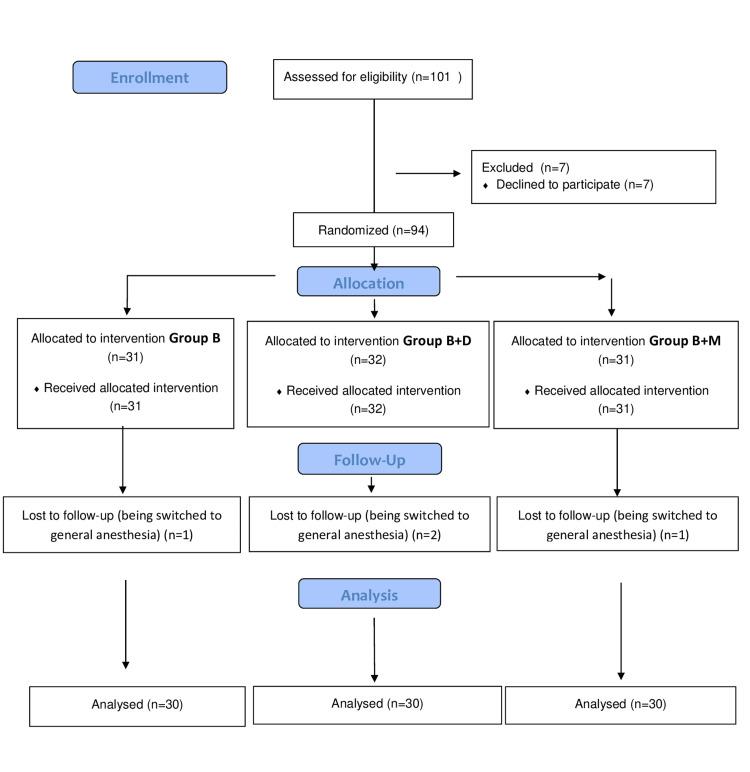
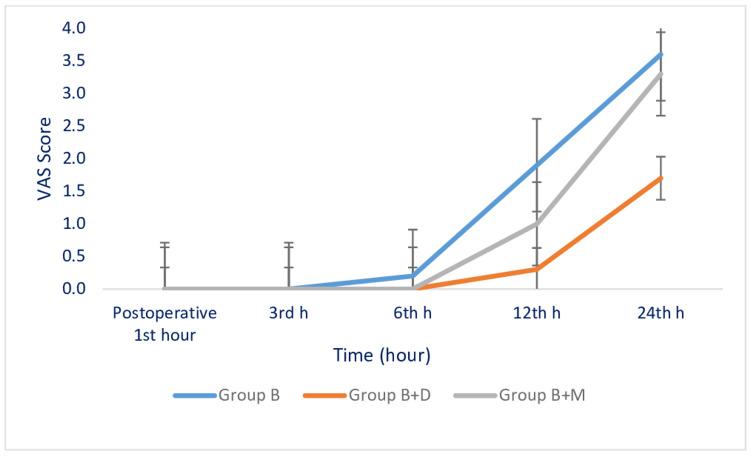
Background This prospective clinical study aims to compare the effectiveness of lower-dose dexamethasone and magnesium sulfate as adjuvants to bupivacaine in ultrasound-guided infraclavicular brachial plexus block for distal upper limb surgery. Materials and methods Ninety patients, aged 18 to 65 years, with American Society of Anesthesiologists (ASA) physical status scores of I or II who underwent distal upper limb surgeries, including the arm, elbow, forearm, and hand surgery under infraclavicular brachial plexus block, were included in the study. The block was performed under ultrasound guidance. Patients were allocated to three groups: Group B received 20 mL of 0.5% bupivacaine combined with 5 mL of 0.9% NaCl; Group B+D received 20 mL of 0.5% bupivacaine combined with 4 mg of dexamethasone and 4 mL of 0.9% NaCl; and Group B+M received 20 mL of 0.5% bupivacaine combined with 150 mg of magnesium sulfate and 4 mL of 0.9% NaCl. Outcomes assessed included sensory and motor block onset times, durations of sensory and motor blocks, duration of analgesia, perioperative hemodynamic parameters, and opioid and non-steroidal anti-inflammatory drug (NSAID) consumption. Results Data from 90 patients were analyzed. Demographic characteristics and ASA scores were comparable across groups (p > 0.05). Group B+D demonstrated significantly longer durations of motor block, sensory block, and analgesia compared to Group B and Group B+M (p = 0.001). Moreover, Group B+D showed significantly shorter motor (p = 0.001) and sensory (p = 0.003) block onset times and reduced postoperative opioid and NSAID analgesic consumption, as well as lower VAS scores at 12 and 24 hours postoperatively (p = 0.001). Conclusion When added as an adjuvant to bupivacaine, dexamethasone resulted in longer durations of motor and sensory block, shorter onset times for both motor and sensory block, and better postoperative analgesia compared to magnesium sulfate. It also reduced opioid and NSAID consumption during the first 24 hours.
背景 这项前瞻性临床研究旨在比较低剂量地塞米松和硫酸镁作为布比卡因辅助剂在超声引导下锁骨下臂丛神经阻滞用于上肢远端手术中的有效性。
材料与方法 本研究纳入了90例年龄在18至65岁之间、美国麻醉医师协会(ASA)身体状况评分为I或II级、接受上肢远端手术(包括手臂、肘部、前臂和手部手术)且采用锁骨下臂丛神经阻滞的患者。阻滞在超声引导下进行。患者被分为三组:B组接受20 mL 0.5%布比卡因与5 mL 0.9%氯化钠混合液;B+D组接受20 mL 0.5%布比卡因与4 mg地塞米松和4 mL 0.9%氯化钠混合液;B+M组接受20 mL 0.5%布比卡因与150 mg硫酸镁和4 mL 0.9%氯化钠混合液。评估的结果包括感觉和运动阻滞起效时间、感觉和运动阻滞持续时间、镇痛持续时间、围手术期血流动力学参数以及阿片类药物和非甾体抗炎药(NSAID)的消耗量。
结果 对90例患者的数据进行了分析。各组间的人口统计学特征和ASA评分具有可比性(p>0.05)。与B组和B+M组相比,B+D组的运动阻滞、感觉阻滞和镇痛持续时间显著更长(p = 0.001)。此外,B+D组的运动(p = 0.001)和感觉(p = 0.003)阻滞起效时间显著更短,术后阿片类药物和NSAID镇痛药物的消耗量减少,且术后12小时和24小时的视觉模拟评分(VAS)更低(p = 0.001)。
结论 与硫酸镁相比,地塞米松作为布比卡因的辅助剂时,可导致更长的运动和感觉阻滞持续时间、更短的运动和感觉阻滞起效时间以及更好的术后镇痛效果。它还减少了术后24小时内阿片类药物和NSAID的消耗量。


 Zotero 插件