
不同剂量冷水浸泡(持续时间和温度变化)对急性运动诱发肌肉损伤恢复的影响:一项网状Meta分析
Impact of different doses of cold water immersion (duration and temperature variations) on recovery from acute exercise-induced muscle damage: a network meta-analysis.
作者信息
Wang Hai, Wang Lu, Pan Yingxu
机构信息
Capital University of Physical Education and Sports, Beijing, China.
出版信息
Front Physiol. 2025 Feb 26;16:1525726. doi: 10.3389/fphys.2025.1525726. eCollection 2025.
OBJECTIVE
This network meta-analysis and systematic review evaluated the recovery impacts of varying cold water immersion (CWI) protocols on acute exercise-induced muscle damage.
METHODS
We searched CNKI, PubMed, Cochrane Library, Web of Science, and Embase from January 2000 to September 2024 for randomized controlled trials examining CWI's recovery effects on acute muscle damage. Data extraction, study screening, and risk of bias assessment were conducted independently by two reviewers. Analyses were performed using Stata 16.0.
RESULTS
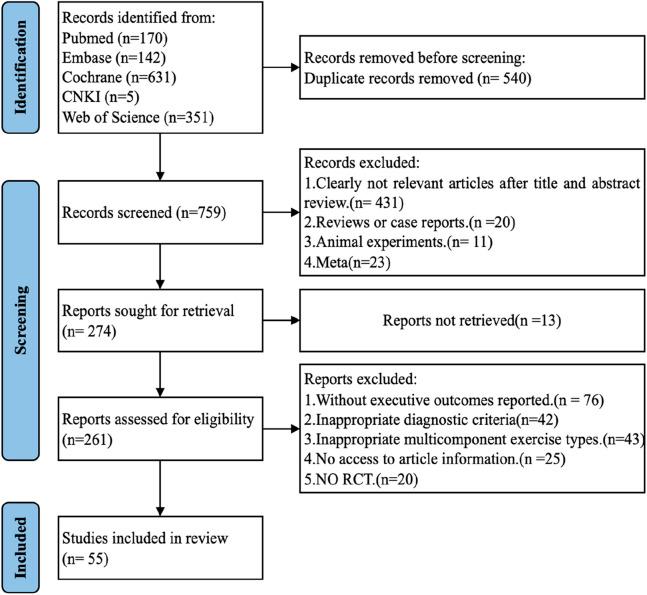
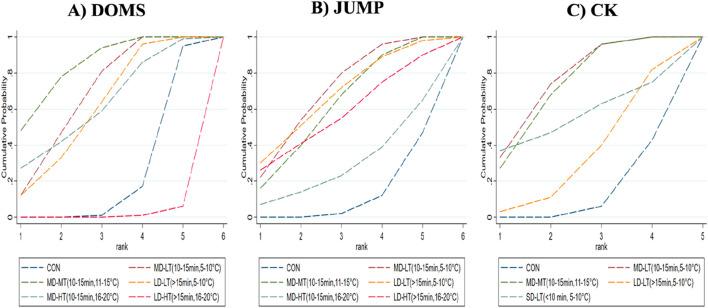
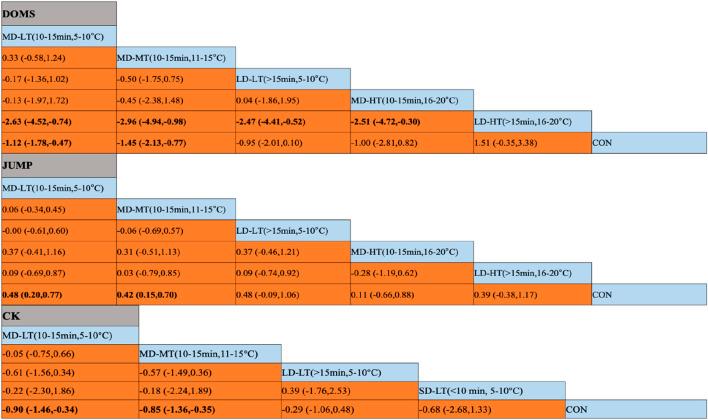
A total of 55 RCTs were included, with 42 reporting delayed onset muscle soreness (DOMS), 36 reporting jump performance (JUMP), and 30 reporting creatine kinase (CK) levels. Network meta-analysis showed that compared with the control group, MD-MT-CWI: Medium-duration medium-temperature cold water immersion (10-15 min, 11°C-15°C) [SMD = -1.45, 95%CI(-2.13, -0.77), P < 0.01] and MD-LT-CWI: Medium-duration low-temperature cold water immersion (10-15 min, 5°C-10°C) [SMD = -1.12, 95%CI(-1.78, -0.47), P = 0.01] significantly reduced DOMS; MD-LT-CWI (10-15 min, 5°C-10°C) [SMD = 0.48, 95%CI(0.20, 0.77), P = 0.01] and MD-MT-CWI (10-15 min, 11°C-15°C) [SMD = 0.42, 95%CI(0.15, 0.70), P = 0.02] significantly improved JUMP; MD-MT-CWI (10-15 min, 11°C-15°C) [SMD = -0.85, 95%CI(-1.36, -0.35), P = 0.01] and MD-LT-CWI (10-15 min, 5°C-10°C) [SMD = -0.90, 95%CI(-1.46, -0.34), P = 0.02] significantly reduced CK. Cumulative probability ranking showed that MD-LT-CWI (10-15 min, 5°C-10°C) was the most effective for improving JUMP and reducing CK, while MD-MT-CWI (10-15 min, 11°C-15°C) was the most effective for reducing DOMS.
CONCLUSION
Different dosages of cold water immersion (varying in duration and temperature) had different effects on recovery from acute exercise-induced muscle damage. We found that MD-LT-CWI (10-15 min, 5°C-10°C) was most effective for improving biochemical markers (CK) and neuromuscular recovery, while MD-MT-CWI (10-15 min, 11°C-15°C) was most effective for reducing muscle soreness. In practice, we recommend using MD-LT-CWI (10-15 min, 5°C-10°C) and MD-MT-CWI (10-15 min, 11°C-15°C) to reduce Exercise-induced muscle damage (EIMD). However, due to the limitations of the included studies, further high-quality studies are needed to verify these conclusions.
SYSTEMATIC REVIEW REGISTRATION
https://www.crd.york.ac.uk/prospero/, identifier CRD42024602359.
目的
本网络荟萃分析和系统评价评估了不同冷水浸泡(CWI)方案对急性运动性肌肉损伤恢复的影响。
方法
我们检索了2000年1月至2024年9月期间的中国知网、PubMed、Cochrane图书馆、科学网和Embase,以查找检验CWI对急性肌肉损伤恢复效果的随机对照试验。两名 reviewers 独立进行数据提取、研究筛选和偏倚风险评估。使用Stata 16.0进行分析。
结果
共纳入55项随机对照试验,其中42项报告了延迟性肌肉酸痛(DOMS),36项报告了跳跃成绩(JUMP),30项报告了肌酸激酶(CK)水平。网络荟萃分析表明,与对照组相比,MD-MT-CWI:中等时长中等温度冷水浸泡(10 - 15分钟,11°C - 15°C)[标准化均数差(SMD)= -1.45,95%置信区间(CI)(-2.13,-0.77),P < 0.01]和MD-LT-CWI:中等时长低温冷水浸泡(10 - 15分钟,5°C - 10°C)[SMD = -1.12,95%CI(-1.78,-0.47),P = 0.01]显著降低了DOMS;MD-LT-CWI(10 - 15分钟,5°C - 10°C)[SMD = 0.48,95%CI(0.20,0.77),P = 0.01]和MD-MT-CWI(10 - 15分钟,11°C - 15°C)[SMD = 0.42,95%CI(0.15,0.70),P = 0.02]显著改善了JUMP;MD-MT-CWI(10 - 15分钟,11°C - 15°C)[SMD = -0.85,95%CI(-1.36,-0.35),P = 0.01]和MD-LT-CWI(10 - 15分钟,5°C - 10°C)[SMD = -0.90,95%CI(-1.46,-0.34),P = 0.02]显著降低了CK。累积概率排序显示,MD-LT-CWI(10 - 15分钟,5°C - 10°C)在改善JUMP和降低CK方面最有效,而MD-MT-CWI(10 - 15分钟,11°C - 15°C)在降低DOMS方面最有效。
结论
不同剂量的冷水浸泡(时长和温度不同)对急性运动性肌肉损伤的恢复有不同影响。我们发现MD-LT-CWI(10 - 15分钟,5°C - 10°C)在改善生化指标(CK)和神经肌肉恢复方面最有效,而MD-MT-CWI(10 - 15分钟,11°C - 15°C)在减轻肌肉酸痛方面最有效。在实践中,我们建议使用MD-LT-CWI(10 - 15分钟,5°C - 10°C)和MD-MT-CWI(10 - 15分钟,11°C - 15°C)来减少运动性肌肉损伤(EIMD)。然而,由于纳入研究的局限性,需要进一步的高质量研究来验证这些结论。
系统评价注册


 Zotero 插件