
美国一家地区性学术医疗中心1型糖尿病患者连续血糖监测使用情况的人口统计学差异:一项2018 - 2021年的回顾性队列研究
Demographic variation in continuous glucose monitoring utilisation among patients with type 1 diabetes from a US regional academic medical centre: a retrospective cohort study, 2018-2021.
作者信息
Atac Omer, Heier Kory R, Moga Daniela, Fowlkes John, Sohn Min-Woong, Kruse-Diehr Aaron J, Waters Teresa M, Lacy Mary E
机构信息
Department of Health Management and Policy, University of Kentucky College of Public Health, Lexington, Kentucky, USA
Department of Public Health, Istanbul Medipol University International School of Medicine, Istanbul, Türkiye.
出版信息
BMJ Open. 2025 Mar 13;15(3):e088785. doi: 10.1136/bmjopen-2024-088785.
OBJECTIVE
While continuous glucose monitoring (CGM) utilisation has been increasing among patients with type 1 diabetes (T1D), few studies have examined patterns of use across age, race/ethnicity and insurance status together. In this study, we examine CGM utilisation among patients with T1D from a regional academic medical centre across all insurance types.
DESIGN AND SETTING
This is a retrospective cohort study including both paediatric and adult patients with T1D who visited a regional academic medical centre between 1 January 2018 and 31 December 2021.
METHODS
Patients were followed from the date of their first T1D encounter during the study period until the first of the following: CGM use was documented, ≥730 days with no encounters at this centre or the end of the study period. We compared CGM use across demographic and clinical characteristics and used logistic regression models to assess the association between demographic variables and CGM utilisation.
RESULTS
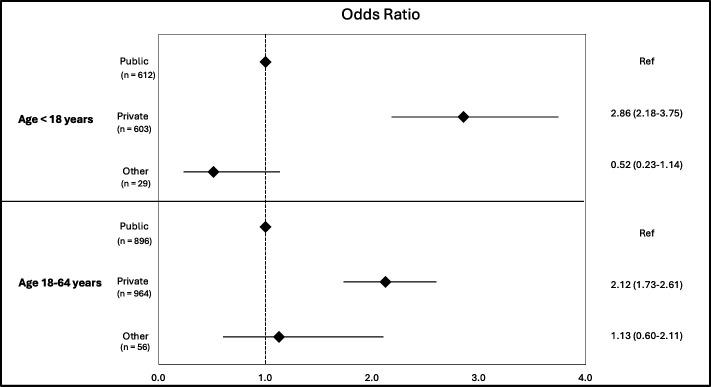
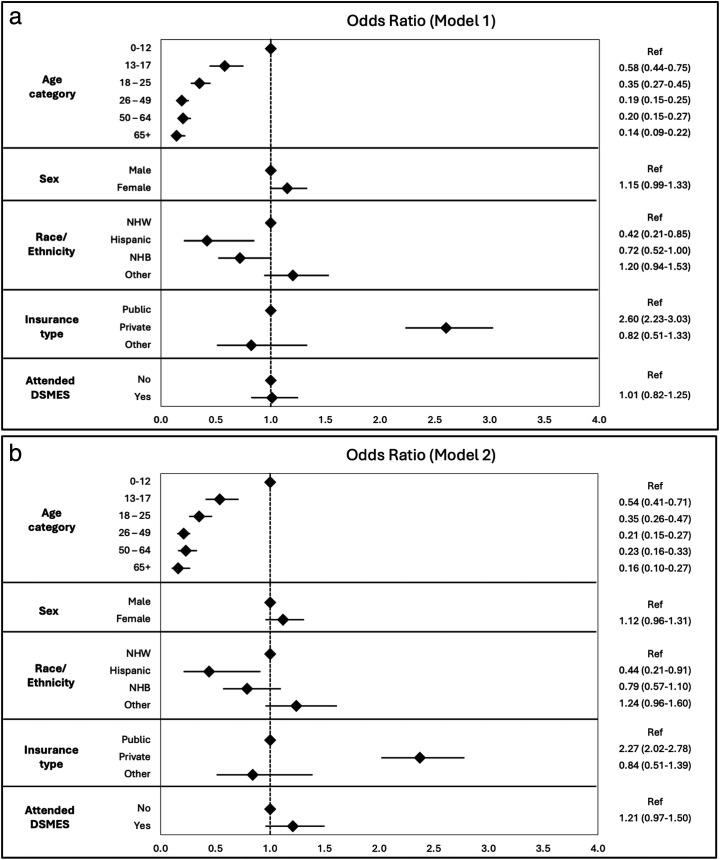
Among 3311 eligible patients with T1D, CGM utilisation was 51.22%. The highest utilisation rates were among patients <18 years old while the lowest rates were among those in the 65+ years age group. Patients with private insurance and those who attended diabetes self-management education and support (DSMES) programmes had significantly higher CGM utilisation than those with public insurance and those who did not attend DSMES, respectively. In models stratified by age, we examined patterns of CGM use across insurance categories and found that CGM rates were persistently low among those with public versus private insurance.
CONCLUSIONS
In this retrospective review of patients with T1D receiving care at a regional academic medical centre from 2018 to 2021, nearly half of our sample used CGM. However, we found substantial variation in CGM utilisation with lower rates among older versus younger adults and individuals covered by public versus private insurance. Enhancing CGM access is important to mitigate diabetes-related complications for all patients with T1D.
目的
虽然1型糖尿病(T1D)患者中持续葡萄糖监测(CGM)的使用一直在增加,但很少有研究同时考察年龄、种族/民族和保险状况的使用模式。在本研究中,我们调查了来自一家地区学术医疗中心的所有保险类型的T1D患者的CGM使用情况。
设计与背景
这是一项回顾性队列研究,纳入了2018年1月1日至2021年12月31日期间就诊于一家地区学术医疗中心的儿科和成人T1D患者。
方法
从研究期间患者首次确诊T1D之日起进行随访,直至出现以下情况之一:记录到CGM使用情况、在该中心连续≥730天无就诊记录或研究期结束。我们比较了不同人口统计学和临床特征的CGM使用情况,并使用逻辑回归模型评估人口统计学变量与CGM使用之间的关联。
结果
在3311例符合条件的T1D患者中,CGM使用率为51.22%。使用率最高的是<18岁的患者,而最低的是65岁及以上年龄组的患者。拥有私人保险的患者以及参加糖尿病自我管理教育与支持(DSMES)项目的患者的CGM使用率分别显著高于拥有公共保险的患者和未参加DSMES的患者。在按年龄分层的模型中,我们研究了不同保险类别的CGM使用模式,发现公共保险患者的CGM使用率持续低于私人保险患者。
结论
在这项对2018年至2021年在一家地区学术医疗中心接受治疗的T1D患者的回顾性研究中,我们样本中近一半的患者使用了CGM。然而,我们发现CGM使用情况存在很大差异,老年人与年轻人以及公共保险与私人保险覆盖的个体之间的使用率较低。提高CGM的可及性对于减轻所有T1D患者的糖尿病相关并发症很重要。
 Zotero 插件