
一项关于一线乐伐替尼联合PD-1抑制剂治疗进展后不可切除肝细胞癌合并食管胃静脉曲张二线治疗疗效的真实世界研究。
A real-world study of the efficacy of second-line treatment of unresectable hepatocellular carcinoma with esophagogastric varices after progression on first-line lenvatinib combined with PD-1 inhibitor.
作者信息
Li Saifeng, Wen Qin, Huang Wenwu, Qiu Zeyu, Feng Long, Yi Fengming
机构信息
Department of Oncology, Second Affiliated Hospital of Nanchang University, Minde Road 1, Nanchang, 330006, P. R. China.
Jiangxi Medical College of Nanchang University, Nanchang, 330006, P. R. China.
出版信息
World J Surg Oncol. 2025 Mar 13;23(1):83. doi: 10.1186/s12957-025-03742-0.
PURPOSE
The incidence and mortality of hepatocellular carcinoma are still high according to National Cancer Center of China. Atezolizumab plus bevacizumab has become one of the standard regimens for the first-line treatment of unresectable hepatocellular carcinoma. However, some patients still use lenvatinib in combination with immunotherapy instead of a standard "atezolizumab-bevacizumab" regimen as a lower risk of bleeding in patients with esophagogastric varices. However, there is no evidence for second-line therapy after progression on lenvatinib combined with PD-1 inhibitor in unresectable hepatocellular carcinoma till now. Herein, we aim to investigate second-line treatment among these patients.
PATIENTS AND METHODS
Thirty-three patients with unresectable hepatocellular carcinoma with esophagogastric varices were admitted to the Second Affiliated Hospital of Nanchang University from January 2019 to December 2023. They were treated with lenvatinib in combination with PD-1 inhibitor as first line. The efficacy was conducted according to the RECIST1.1 criteria. The endpoints included objective response rate (ORR), disease control rate (DCR), median overall survival (OS), and median progression free survival (PFS).
RESULTS
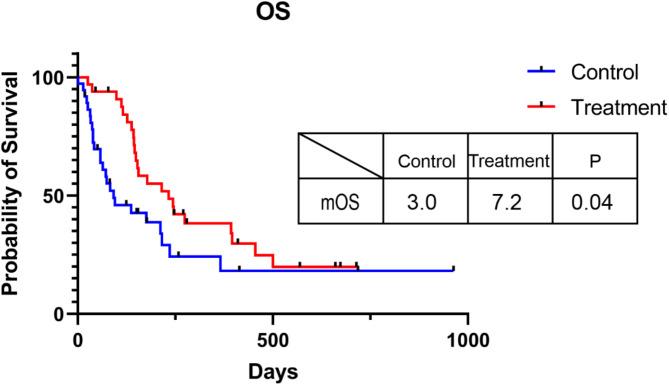
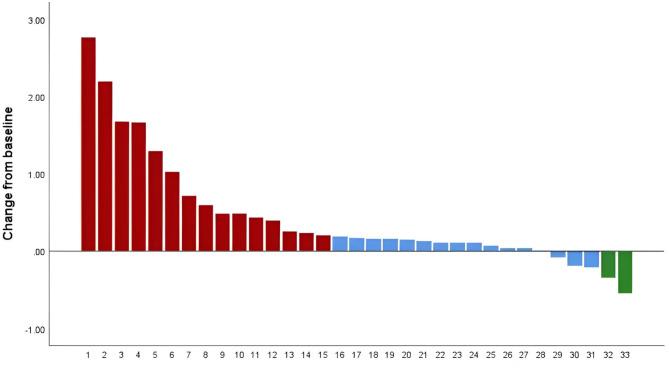
We identified a total of 225 patients with unresectable hepatocellular carcinoma with esophagogastric varices who received first-line lenvatinib in combination with PD-1 inhibitor, of whom 33 (14.7%) received second-line therapy. 21 patients (63.6%) were treated with regorafenib combined with PD-1 inhibitor, 6 patients (18.2%) with apatinib plus PD-1 inhibitor, 4 patients (12.1%) with bevacizumab plus PD-1 inhibitor, and the remaining 2 patients with regorafenib or sorafenib as monotherapy, respectively. Of the 33 patients, 2 (6.1%) were evaluated as partial response (PR), 16 (48.5%) had stable disease (SD), and 15 (45.4%) experienced progression (PD). The ORR was 6.1%, and the DCR was 54.6%. Median PFS was 4.5 months, median OS was 7.2 months, and the 12-month OS rate was 27.3%. Overall survival follow-up was done in 37 patients without second line treatment whose baseline levels were matched with those of the treatment group. The OS was 7.2 months in second line treatment group versus 3.0 months in control group (p = 0.04). As for different treatments in a second line, The ORR of regorafenib in combination with PD-1 inhibitor was 9.5%, the DCR was 47.6%, the median PFS was 4.2 months, and the median OS was 5.9 months. None of the patients treated with apatinib plus PD-1 inhibitor got PR, the DCR was 83.3%, the median PFS was 8.7 months, and the median OS was 9.1 months. None of the patients treated with bevacizumab plus PD-1 inhibitor got PR, the DCR was 25.0%, the median PFS was 2.2 months, and the median OS was 6.0 months.
CONCLUSION
The second-line treatment of unresectable hepatocellular carcinoma with esophagogastric varices after progression on first-line lenvatinib combined with PD-1 inhibitor is effective. Regorafenib or apatinib combined with PD-1 inhibitor might be the preferred options.
目的
根据中国国家癌症中心的数据,肝细胞癌的发病率和死亡率仍然很高。阿替利珠单抗联合贝伐珠单抗已成为不可切除肝细胞癌一线治疗的标准方案之一。然而,一些患者仍使用乐伐替尼联合免疫疗法,而不是标准的“阿替利珠单抗-贝伐珠单抗”方案,因为食管胃静脉曲张患者出血风险较低。然而,迄今为止,对于不可切除肝细胞癌患者在乐伐替尼联合PD-1抑制剂治疗进展后的二线治疗尚无证据。在此,我们旨在研究这些患者的二线治疗。
患者与方法
2019年1月至2023年12月,南昌大学第二附属医院收治了33例伴有食管胃静脉曲张的不可切除肝细胞癌患者。他们接受乐伐替尼联合PD-1抑制剂作为一线治疗。疗效根据RECIST1.1标准进行评估。终点指标包括客观缓解率(ORR)、疾病控制率(DCR)、中位总生存期(OS)和中位无进展生存期(PFS)。
结果
我们共确定了225例伴有食管胃静脉曲张的不可切除肝细胞癌患者接受了一线乐伐替尼联合PD-1抑制剂治疗,其中33例(14.7%)接受了二线治疗。21例(63.6%)患者接受瑞戈非尼联合PD-1抑制剂治疗,6例(18.2%)接受阿帕替尼联合PD-1抑制剂治疗,4例(12.1%)接受贝伐珠单抗联合PD-1抑制剂治疗,其余2例分别接受瑞戈非尼或索拉非尼单药治疗。在这33例患者中,2例(6.1%)被评估为部分缓解(PR),16例(48.5%)疾病稳定(SD),15例(45.4%)病情进展(PD)。ORR为6.1%,DCR为54.6%。中位PFS为4.5个月,中位OS为7.2个月,12个月OS率为27.3%。对37例未接受二线治疗且基线水平与治疗组匹配的患者进行了总生存期随访。二线治疗组的OS为7.2个月,而对照组为3.0个月(p = 0.04)。至于二线治疗中的不同治疗方法,瑞戈非尼联合PD-1抑制剂的ORR为9.5%,DCR为47.6%,中位PFS为4.2个月,中位OS为5.9个月。接受阿帕替尼联合PD-1抑制剂治疗的患者均未获得PR,DCR为83.3%,中位PFS为8.7个月,中位OS为9.1个月。接受贝伐珠单抗联合PD-1抑制剂治疗的患者均未获得PR,DCR为25.0%,中位PFS为2.2个月,中位OS为6.0个月。
结论
一线乐伐替尼联合PD-1抑制剂治疗进展后,伴有食管胃静脉曲张的不可切除肝细胞癌的二线治疗是有效的。瑞戈非尼或阿帕替尼联合PD-1抑制剂可能是首选方案。

 Zotero 插件