
替尔泊肽和司美格鲁肽对美国成年人的终生健康影响及成本效益
Lifetime Health Effects and Cost-Effectiveness of Tirzepatide and Semaglutide in US Adults.
作者信息
Hwang Jennifer H, Laiteerapong Neda, Huang Elbert S, Kim David D
机构信息
Section of General Internal Medicine, Department of Medicine, University of Chicago, Chicago, Illinois.
Department of Psychiatry and Behavioral Neuroscience, University of Chicago, Chicago, Illinois.
出版信息
JAMA Health Forum. 2025 Mar 7;6(3):e245586. doi: 10.1001/jamahealthforum.2024.5586.
IMPORTANCE
Newer antiobesity medications lead to greater weight loss and lower cardiometabolic risks. However, the high costs of these medications have raised policy questions about their value and coverage decisions.
OBJECTIVE
To compare the cost-effectiveness of 4 antiobesity medications with lifestyle modification vs lifestyle modification alone in the US.
DESIGN, SETTING, AND PARTICIPANTS: A lifetime cost-effectiveness analysis was conducted in 2024 using the validated Diabetes, Obesity, Cardiovascular Disease Microsimulation model for US adults. Data were included from the 2017-2020 National Health and Nutrition Examination Survey of 4823 individuals (representing 126 million eligible US adults) aged 20 to 79 years who would meet clinical trial inclusion criteria for antiobesity medications. Individual-level simulations projected long-term cardiometabolic outcomes, quality-adjusted life-years (QALYs), and health care expenditures. Probabilistic sensitivity analyses, subgroup analyses (across body mass index [BMI] categories [≥30 or ≥27 and at least 1 weight-related comorbidity], presence of comorbidities), and multiple scenario analyses (varying treatment discontinuation rates, value-based pricing benchmarks) were conducted. Future costs and QALYs were discounted at 3% annually.
INTERVENTIONS
Lifestyle modification with naltrexone-bupropion, phentermine-topiramate, semaglutide, or tirzepatide vs lifestyle modification alone.
MAIN OUTCOMES AND MEASURES
Obesity, diabetes, and cardiovascular disease cases averted, life-years and QALYs gained, costs incurred (2023 US dollars), and incremental cost-effectiveness ratios.
RESULTS
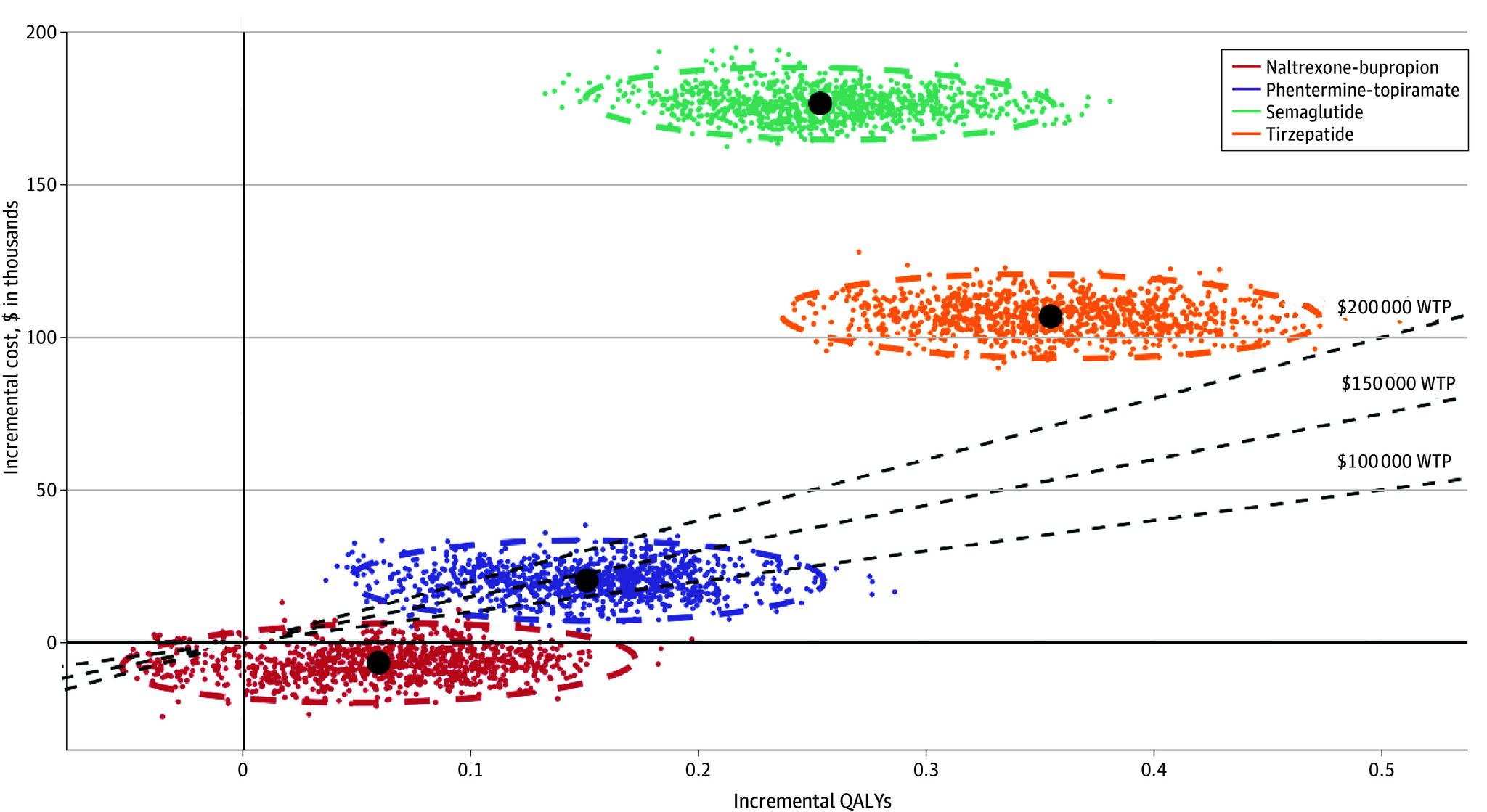
Among the 126 million eligible US adults, the mean age was 48 (SE, 0.5) years; 51% were female; and the initial mean BMI was 34.7 (SE, 0.2); and 85% had at least 1 weight-related comorbidity. Over a lifetime, tirzepatide would avert 45 609 obesity cases (95% uncertainty interval [UI], 45 092-46 126) per 100 000 individuals and semaglutide would avert 32 087 cases (95% UI, 31 292-32 882) per 100 000 individuals. Tirzepatide would reduce 20 854 incident cases of diabetes (95% UI, 19 432-22 276) per 100 000 individuals and semaglutide would reduce 19 211 cases (95% UI, 17 878-20 544) per 100 000 individuals. Tirzepatide would reduce 10 655 cardiovascular disease cases (95% UI, 10 124-11 186) per 100 000 individuals and semaglutide would reduce 8263 cases (95% UI, 7738-8788) per 100 000 individuals. Despite the largest incremental QALY gains of 0.35 for tirzepatide and 0.25 for semaglutide among all antiobesity medications, the incremental cost-effectiveness ratios were $197 023/QALY and 467 676/QALY, respectively. To reach the $100 000/QALY threshold, their prices would require additional discounts by 30.5% for tirzepatide and 81.9% for semaglutide from their current net prices. Naltrexone-bupropion was cost saving due to its lower cost and had an 89.1% probability of being cost-effective at $100 000/QALY, whereas phentermine-topiramate had a 23.5% probability of being cost-effective at $100 000/QALY. Tirzepatide and semaglutide both had a 0% probability across all QALY threshold ranges examined ($100 000-$200 000/QALY).
CONCLUSIONS AND RELEVANCE
This economic evaluation found that although tirzepatide and semaglutide offered substantial long-term health benefits, they were not cost-effective at current net prices. Efforts to reduce the net prices of new antiobesity medications are essential to ensure equitable access to highly effective antiobesity medications.
重要性
新型抗肥胖药物能带来更多体重减轻且降低心血管代谢风险。然而,这些药物的高成本引发了关于其价值和医保覆盖决策的政策问题。
目的
比较4种抗肥胖药物联合生活方式干预与单纯生活方式干预在美国的成本效益。
设计、设置和参与者:2024年使用经过验证的美国成年人糖尿病、肥胖、心血管疾病微观模拟模型进行了一项终身成本效益分析。数据来自2017 - 2020年全国健康和营养检查调查中的4823名年龄在20至79岁的个体(代表1.26亿符合抗肥胖药物临床试验纳入标准的美国成年人)。个体水平模拟预测了长期心血管代谢结局、质量调整生命年(QALY)和医疗保健支出。进行了概率敏感性分析、亚组分析(按体重指数[BMI]类别[≥30或≥27且至少有一种与体重相关的合并症]、合并症的存在情况)以及多情景分析(改变治疗中断率、基于价值的定价基准)。未来成本和QALY按每年3%进行贴现。
干预措施
纳曲酮 - 安非他酮、芬特明 - 托吡酯、司美格鲁肽或替尔泊肽联合生活方式干预与单纯生活方式干预。
主要结局和衡量指标
避免的肥胖、糖尿病和心血管疾病病例数、获得的生命年和QALY、产生的成本(2023美元)以及增量成本效益比。
结果
在1.26亿符合条件的美国成年人中,平均年龄为48(标准误,0.5)岁;51%为女性;初始平均BMI为34.7(标准误,0.2);85%至少有一种与体重相关的合并症。在一生中,每10万人中,替尔泊肽可避免45609例肥胖病例(95%不确定区间[UI],45092 - 46126),司美格鲁肽可避免32087例(95% UI,31292 - 32882)。每10万人中,替尔泊肽可减少20854例糖尿病发病病例(95% UI,19432 - 22276),司美格鲁肽可减少19211例(95% UI,17878 - 20544)。每10万人中,替尔泊肽可减少10655例心血管疾病病例(95% UI,10124 - 11186),司美格鲁肽可减少8263例(95% UI,7738 - 8788)。尽管在所有抗肥胖药物中,替尔泊肽和司美格鲁肽的增量QALY增益最大,分别为0.35和0.25,但增量成本效益比分别为197023美元/QALY和467676美元/QALY。要达到100000美元/QALY的阈值,替尔泊肽和司美格鲁肽的价格相对于当前净价分别需要额外降价30.5%和81.9%。纳曲酮 - 安非他酮因成本较低而具有成本节约效果,在100000美元/QALY时具有成本效益的概率为89.1%,而芬特明 - 托吡酯在100000美元/QALY时具有成本效益的概率为23.5%。在所有检查的QALY阈值范围(100000 - 200000美元/QALY)内,替尔泊肽和司美格鲁肽具有成本效益的概率均为0%。
结论与相关性
这项经济评估发现,尽管替尔泊肽和司美格鲁肽能带来显著的长期健康益处,但按当前净价计算它们并不具有成本效益。降低新型抗肥胖药物的净价对于确保公平获得高效抗肥胖药物至关重要。

 Zotero 插件