
探究多维睡眠特征对心血管疾病的影响及抑郁的中介作用。
Investigating the impact of multidimensional sleep traits on cardiovascular diseases and the mediating role of depression.
作者信息
Zhao Hao, Wang Xiaojie, Guo Lan, Li Xiuwen, Teopiz Kayla M, McIntyre Roger S, Wang Wanxin, Lu Ciyong
机构信息
Department of Medical Statistics and Epidemiology, School of Public Health, Sun Yat-sen University, Guangzhou, China.
Guangdong Provincial Key Laboratory of Food, Nutrition and Health, Sun Yat-Sen University, Guangzhou, China.
出版信息
Open Heart. 2025 Mar 13;12(1):e002866. doi: 10.1136/openhrt-2024-002866.
BACKGROUND
Observational studies have reported that sleep is associated with the risk of major depressive disorder (MDD) and cardiovascular diseases (CVDs). However, the causal relationships among various sleep traits remain contentious, and whether MDD mediates the impact of specific sleep traits on CVDs is unclear.
METHODS
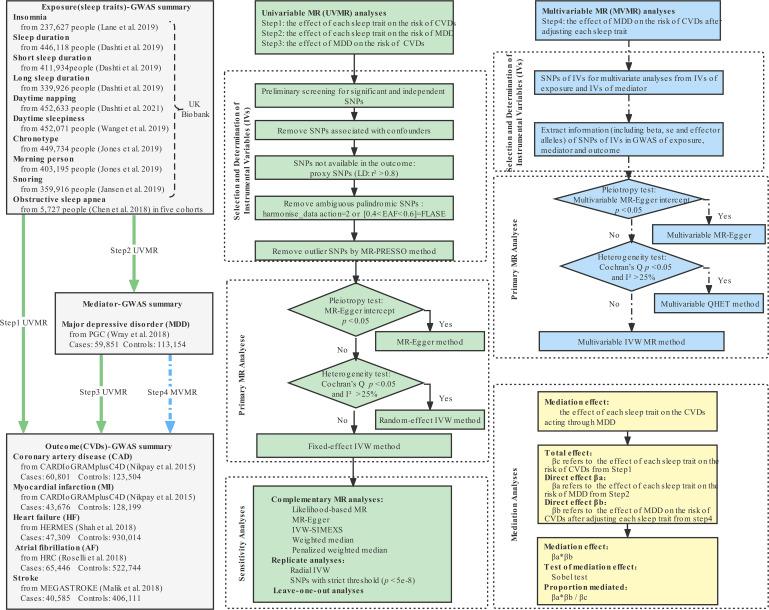
We performed two-sample Mendelian randomisation analyses to explore whether insomnia, sleep time, daytime napping, daytime sleepiness, chronotype, snoring or obstructive sleep apnoea were causally associated with the risk of five CVDs, including coronary artery disease (CAD), myocardial infarction (MI), heart failure (HF), atrial fibrillation and stroke. Mediation analyses were performed to assess the proportion mediated by MDD.
RESULTS
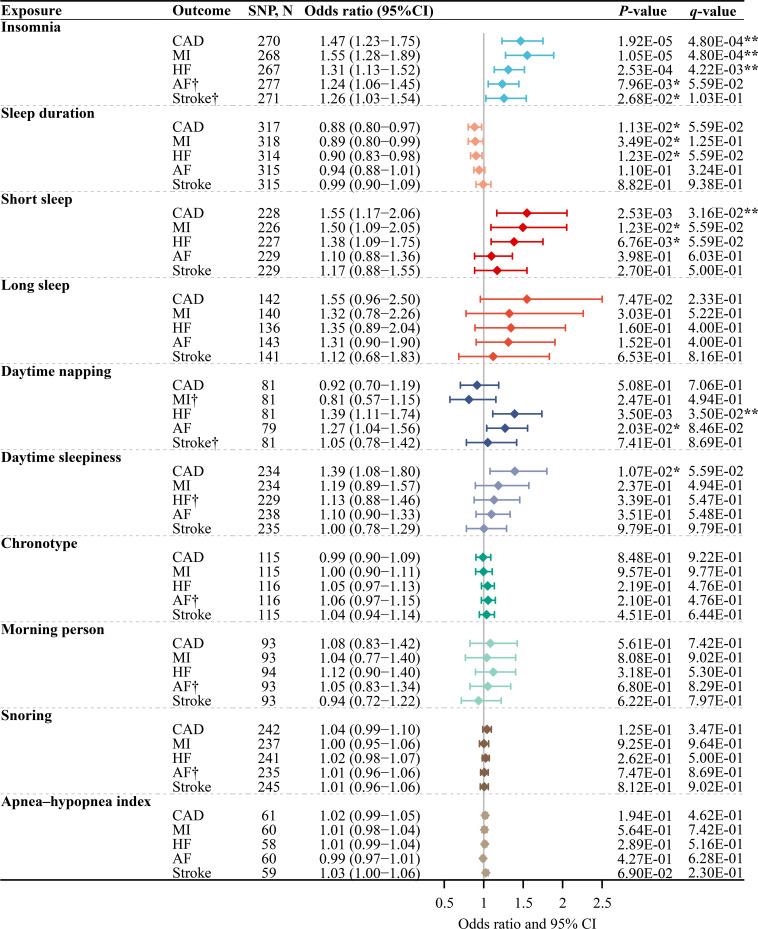
Genetically predicted insomnia, short sleep, daytime napping and daytime sleepiness increased the risk of CVDs, with the OR ranging from 1.24 (95% CI 1.06 to 1.45) for insomnia on stroke to 1.55 (95% CI 1.28 to 1.89) for insomnia on MI. In contrast to short sleep, genetically predicted sleep duration decreased the risk of CAD (OR 0.88 (95% CI 0.80 to 0.97)), MI (OR 0.89 (95% CI 0.80 to 0.99)) and HF (OR 0.90 (95% CI 0.83 to 0.98)). However, we found no significant associations of long sleep, chronotype, snoring and obstructive sleep apnoea with increased risk for any CVD subtype. Additionally, the effect of insomnia was partially mediated by MDD for the risk of CAD (proportion mediated: 8.81% (95% CI 1.20% to 16.43%)), MI (9.17% (95% CI 1.71% to 16.63%)) and HF (14.46% (95% CI 3.48% to 25.45%)). Similarly, the effect of short sleep was partially mediated by MDD for the risk of CAD (8.92% (95% CI 0.87% to 16.97%)), MI (11.43% (95% CI 0.28% to 22.57%)) and HF (12.65% (95% CI 1.35% to 23.96%)). MDD also partially mediated the causal effects of insomnia on stroke, sleep duration on CAD, MI and HF, daytime napping on HF and daytime sleepiness on CAD.
CONCLUSIONS
Our study provides evidence that genetically predicted insomnia, short sleep, frequent daytime napping and sleepiness are associated with a higher risk of certain CVD subtypes, partly mediated by MDD.
背景
观察性研究报告称,睡眠与重度抑郁症(MDD)和心血管疾病(CVD)的风险相关。然而,各种睡眠特征之间的因果关系仍存在争议,且MDD是否介导特定睡眠特征对CVD的影响尚不清楚。
方法
我们进行了两样本孟德尔随机化分析,以探讨失眠、睡眠时间、日间小睡、日间嗜睡、昼夜节律类型、打鼾或阻塞性睡眠呼吸暂停是否与包括冠状动脉疾病(CAD)、心肌梗死(MI)、心力衰竭(HF)、心房颤动和中风在内的五种CVD的风险存在因果关系。进行中介分析以评估MDD介导的比例。
结果
基因预测的失眠、短睡眠、日间小睡和日间嗜睡会增加CVD的风险,中风时失眠的比值比(OR)为1.24(95%置信区间1.06至1.45),心肌梗死时失眠的OR为1.55(95%置信区间1.28至1.89)。与短睡眠相反,基因预测的睡眠时间会降低CAD(OR 0.88(95%置信区间0.80至0.97))、MI(OR 0.89(95%置信区间0.80至0.99))和HF(OR 0.90(95%置信区间0.83至0.98))的风险。然而,我们发现长睡眠、昼夜节律类型、打鼾和阻塞性睡眠呼吸暂停与任何CVD亚型风险增加之间无显著关联。此外,失眠对CAD风险的影响部分由MDD介导(介导比例:8.81%(95%置信区间1.20%至16.43%))、MI(9.17%(95%置信区间1.71%至16.63%))和HF(14.46%(95%置信区间3.48%至25.45%))。同样,短睡眠对CAD风险的影响部分由MDD介导(8.92%(95%置信区间0.87%至16.97%))、MI(11.43%(95%置信区间0.28%至22.57%))和HF(12.65%(95%置信区间1.35%至23.96%))。MDD还部分介导了失眠对中风、睡眠时间对CAD、MI和HF、日间小睡对HF以及日间嗜睡对CAD的因果效应。
结论
我们的研究提供了证据,表明基因预测的失眠、短睡眠、频繁日间小睡和嗜睡与某些CVD亚型的较高风险相关,部分由MDD介导。

 Zotero 插件