
从健康生态学角度看社区多病共存老年人衰弱的相关因素:一项横断面研究
Associated factors of frailty among community-dwelling older adults with multimorbidity from a health ecological perspective: a cross-sectional study.
作者信息
Che Yunqiu, Xin Hanjia, Gu Yingying, Ma Xiuxiu, Xiang Ziying, He Chaozhu
机构信息
School of Nursing, Jiangxi Medical College, Nanchang University, 461 Bayi Street, Nanchang, 330000, China.
出版信息
BMC Geriatr. 2025 Mar 14;25(1):172. doi: 10.1186/s12877-025-05777-0.
BACKGROUND
As the global aging process accelerates, the older population is increasing annually, with the majority suffering from one or more chronic diseases. Due to the influence of chronic disease comorbidity, frailty among the older is widespread. Therefore, early identification of frailty in older adults with comorbidities from a comprehensive perspective, along with proactive measures for prevention and timely intervention, becomes an inevitable requirement for healthy aging. This study aimed to identify the entry point of frailty management in the older with multimorbidity in the community and clarify the focus of frailty management.
METHODS
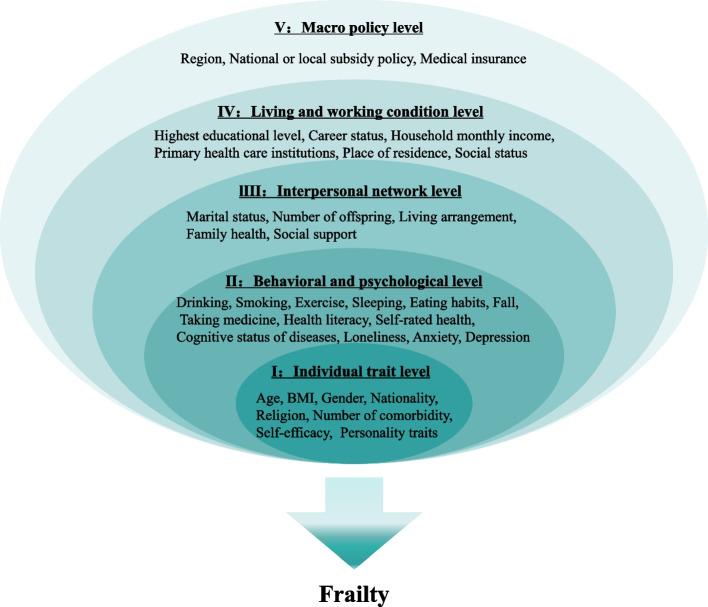
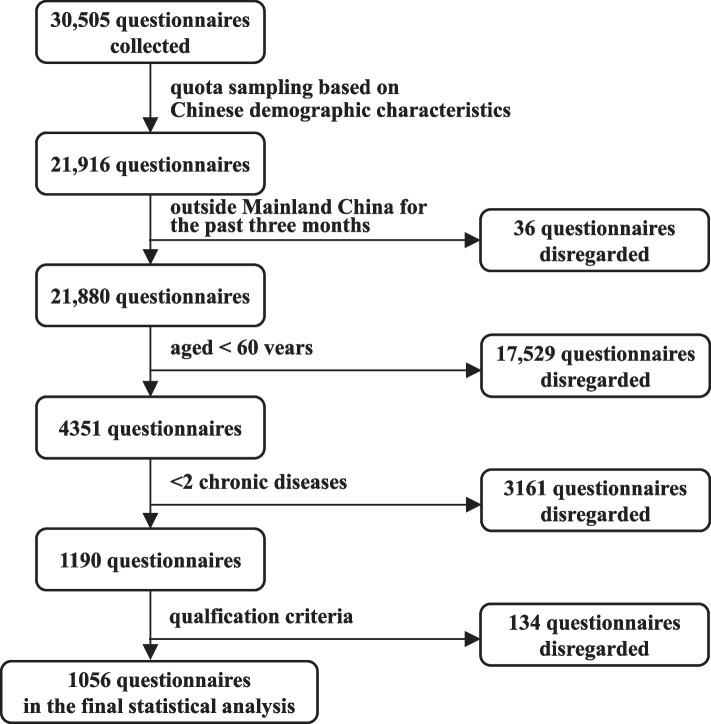
A national cross-sectional survey of 1056 older adults with comorbidities in 148 cities across China was conducted. Frailty was assessed using the Fatigue, Resistance, Ambulation, Illnesses, and Loss of weight (FRAIL) scale. Based on the health ecological model, the factors which may influence frailty were collected from five levels. Univariate and multivariate analysis were utilized to determine the factors influencing frailty. The STROBE checklist was used preparing the manuscript.
RESULTS
A total of 417 patients (39.5%) reported having frailty, while 613 patients (58.0%) were in the pre-frail state. Multivariate logistic regression analysis indicate that compared with robust patients, number of comorbidities, self-efficacy, sleep quality and perceived social support are associated with frailty in older patients with comorbidities (P < 0.05). Compared to pre-frail group, factors such as number of comorbidities, gender (female), cognitive status of diseases, anxiety, having four or more comorbidities, smoking, eating habits, taking three or more different types of medication and perceived social support are associated with frailty (P < 0.05).
CONCLUSIONS
The prevalence of frailty among older adults with comorbidities is exceptionally high, influenced by various dimensions from health ecology perspective. Psychological care and daily behavior management should be strengthened for the frail older with multimorbidity. Precise and individualized care interventions need to be developed to help promote healthy aging.
背景
随着全球老龄化进程加速,老年人口逐年增加,且大多数患有一种或多种慢性病。由于慢性病共病的影响,老年人虚弱现象普遍存在。因此,从综合角度早期识别患有共病的老年人的虚弱状况,并采取积极的预防措施和及时干预,成为健康老龄化的必然要求。本研究旨在确定社区中患有多种疾病的老年人虚弱管理的切入点,并阐明虚弱管理的重点。
方法
对中国148个城市的1056名患有共病的老年人进行了全国性横断面调查。使用疲劳、抵抗力、活动能力、疾病和体重减轻(FRAIL)量表评估虚弱状况。基于健康生态模型,从五个层面收集可能影响虚弱的因素。采用单因素和多因素分析来确定影响虚弱的因素。使用STROBE清单来撰写论文。
结果
共有417名患者(39.5%)报告有虚弱,而613名患者(58.0%)处于虚弱前期状态。多因素逻辑回归分析表明,与健康的患者相比,共病数量、自我效能感、睡眠质量和感知社会支持与患有共病的老年患者的虚弱有关(P < 0.05)。与虚弱前期组相比,共病数量、性别(女性)、疾病认知状态、焦虑、患有四种或更多共病、吸烟、饮食习惯、服用三种或更多不同类型药物以及感知社会支持等因素与虚弱有关(P < 0.05)。
结论
患有共病的老年人中虚弱的患病率极高,从健康生态角度受到多个维度的影响。对于患有多种疾病的虚弱老年人,应加强心理护理和日常行为管理。需要制定精准和个性化的护理干预措施,以促进健康老龄化。
 Zotero 插件