
845万韩国成年人中关节疼痛与癌症的关联:一项全国横断面研究的见解
Association Between Joint Pain and Cancer in 8.45 Million Korean Adults: Insights from a National Cross-Sectional Study.
作者信息
Kim Taewook
机构信息
Department of Orthopedic Surgery, Seoul National University Hospital, Seoul 03080, Republic of Korea.
出版信息
J Clin Med. 2025 Feb 22;14(5):1478. doi: 10.3390/jcm14051478.
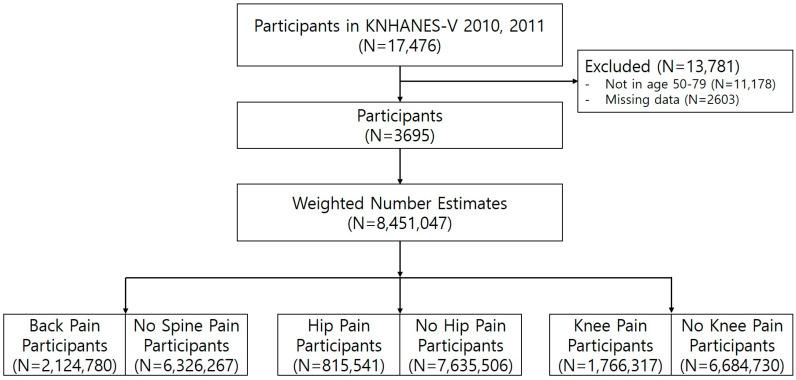
Joint pain, a multifactorial musculoskeletal symptom, is rising globally due to an aging population. Simultaneously, cancer is increasingly considered a chronic condition with growing prevalence and improved survival rates, similar to hypertension and diabetes. Although the association between chronic diseases such as diabetes and joint pain has been well studied, the relationship between cancer and joint pain remains underexplored, especially as cancer's chronic disease status evolves. This study analyzed data from the Korean National Health and Nutrition Examination Survey (KNHANES V) to investigate associations between cancer and joint pain in 8,451,047 individuals, representing Koreans over 50. Descriptive analyses identified demographic characteristics and disparities in joint pain prevalence by age and sex. Multivariate logistic regression analyzed seven common cancers in relation to spine, hip, and knee pain, adjusting for various factors and the Kellgren-Lawrence radiographic grade to pinpoint cancers significantly associated with each joint pain type. Analysis demonstrated significant associations between certain cancers and joint pain. Back pain was linked to gastric, liver, cervical, and lung cancers; hip pain to breast and thyroid cancers; and knee pain to liver cancer. These findings underline complex relationships that suggest further investigation is needed to clarify specific cancer-related joint pain mechanisms. Descriptive and regression analyses highlighted essential demographic factors and significant associations between certain cancers and joint pain types. These insights enhance understanding of cancer's chronic impact on joint pain and underscore the need for further research to refine these associations.
关节疼痛是一种多因素导致的肌肉骨骼症状,由于人口老龄化,其在全球范围内呈上升趋势。与此同时,癌症越来越被视为一种慢性病,其患病率不断上升,生存率也有所提高,这与高血压和糖尿病类似。尽管糖尿病等慢性病与关节疼痛之间的关联已得到充分研究,但癌症与关节疼痛之间的关系仍未得到充分探索,尤其是随着癌症慢性病状态的演变。本研究分析了韩国国家健康与营养检查调查(KNHANES V)的数据,以调查8451047名50岁以上韩国人的癌症与关节疼痛之间的关联。描述性分析确定了按年龄和性别划分的关节疼痛患病率的人口统计学特征和差异。多变量逻辑回归分析了七种常见癌症与脊柱、髋部和膝盖疼痛的关系,并对各种因素和凯尔格伦-劳伦斯放射学分级进行了调整,以确定与每种关节疼痛类型显著相关的癌症。分析表明,某些癌症与关节疼痛之间存在显著关联。背痛与胃癌、肝癌、宫颈癌和肺癌有关;髋部疼痛与乳腺癌和甲状腺癌有关;膝盖疼痛与肝癌有关。这些发现强调了复杂的关系,表明需要进一步研究以阐明特定的癌症相关关节疼痛机制。描述性和回归分析突出了重要的人口统计学因素以及某些癌症与关节疼痛类型之间的显著关联。这些见解增强了对癌症对关节疼痛的慢性影响的理解,并强调需要进一步研究以完善这些关联。
 Zotero 插件