
网络成瘾障碍中静息态网络连接的改变。
Altered resting-state network connectivity in internet gaming disorder.
作者信息
Gao Guoqing, Rong Bei, Huang Junhua, Zhou Mingzhe, Zhao Haomian, Tu Ning, Bu Lihong, Xiao Ling, Wang Gaohua
机构信息
Department of Psychiatry, Renmin Hospital of Wuhan University, Wuhan, Hubei, China.
Institute of Neuropsychiatry, Renmin Hospital of Wuhan University, Wuhan, Hubei, China.
出版信息
Ann Gen Psychiatry. 2025 Mar 17;24(1):14. doi: 10.1186/s12991-025-00553-1.
BACKGROUND
The growing popularity of internet gaming among adolescents and young adults has driven an increase in both casual and excessive gaming behavior. Nevertheless, it remains unclear how progressive increases in internet gaming engagement led to changes within and between brain networks. This study aims to investigate these connectivity alterations across varying levels of gaming involvement.
METHODS
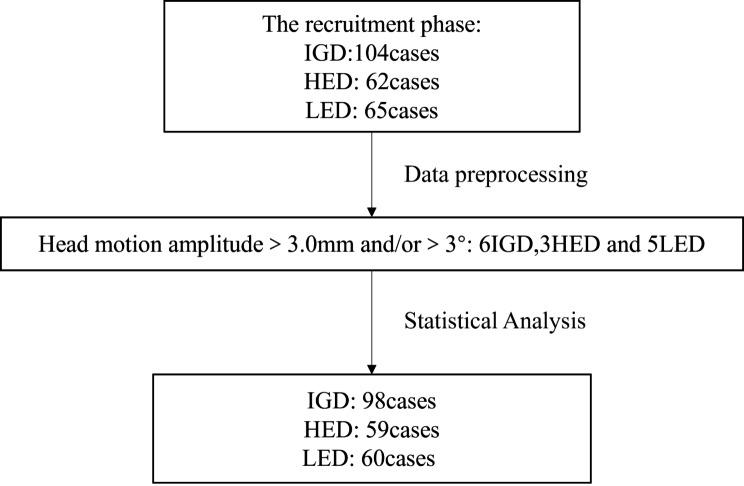
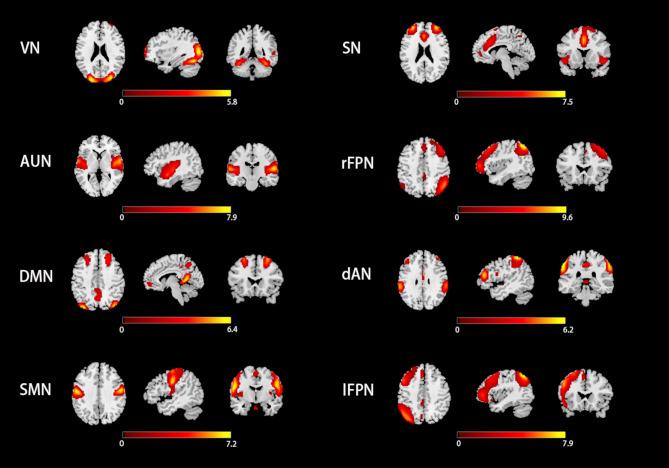
In this cross-sectional study, 231 participants were recruited and classified into three groups according to Diagnostic and Statistical Manual of Mental Disorders (DSM-5) criteria for Internet Gaming Disorder (IGD): IGD group, highly engaged gaming(HEG) group, and lowly engaged gaming (LEG) group. Resting-state fMRI data from 217 participants (143 males, 74 females) were included in the final analysis. Independent component analysis was used to examine differences in intra- and inter-network functional connectivity (FC)across the three groups.
RESULTS
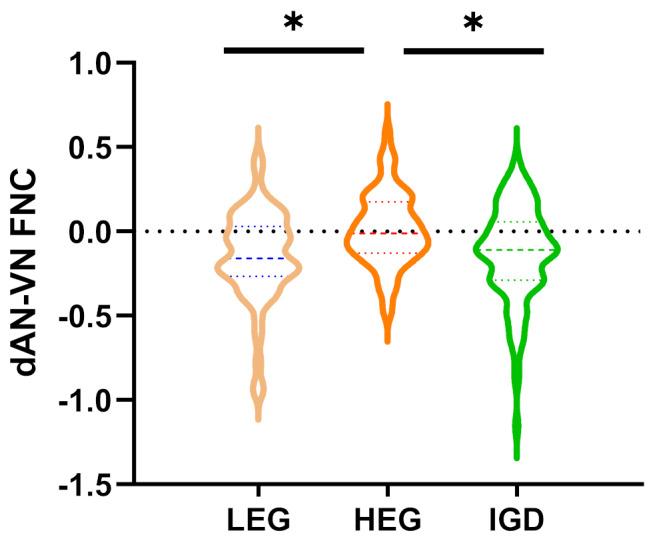
No significant differences were found in intra-network FC across the three groups. However, significant inter-network differences between the dorsal attention network(dAN)and the visual network (VN) among the three groups were observed. The HEG group exhibited significantly higher dAN-VN functional network connectivity (FNC) compared to the LEG group. Linear correlation analyses showed no significant correlation between the dAN-VN FNC values and IGD-20T scores.
CONCLUSION
Throughout the development of IGD, increasing levels of engagement are associated with a rise and subsequent decline in FNC of DAN-VN. This pattern may reflect top-down attentional regulation in the early stages of addiction, followed by attentional bias as addiction progresses.
背景
网络游戏在青少年和年轻人中越来越受欢迎,这导致了随意和过度游戏行为的增加。然而,尚不清楚网络游戏参与度的逐步增加是如何导致大脑网络内部和之间的变化的。本研究旨在调查不同游戏参与水平下的这些连接性改变。
方法
在这项横断面研究中,招募了231名参与者,并根据《精神疾病诊断与统计手册》(DSM-5)中网络游戏障碍(IGD)的标准将其分为三组:IGD组、高游戏参与度(HEG)组和低游戏参与度(LEG)组。最终分析纳入了217名参与者(143名男性,74名女性)的静息态功能磁共振成像(fMRI)数据。使用独立成分分析来检查三组之间网络内和网络间功能连接(FC)的差异。
结果
三组之间在网络内FC方面未发现显著差异。然而,观察到三组之间背侧注意网络(dAN)和视觉网络(VN)之间存在显著的网络间差异。与LEG组相比,HEG组表现出显著更高的dAN-VN功能网络连接性(FNC)。线性相关分析显示dAN-VN FNC值与IGD-20T评分之间无显著相关性。
结论
在IGD的整个发展过程中,参与度的增加与DAN-VN的FNC先升高后下降有关。这种模式可能反映了成瘾早期的自上而下的注意力调节,随后随着成瘾的进展出现注意力偏差。
 Zotero 插件