
tau蛋白过度磷酸化在糖尿病视网膜神经退行性变中的作用
Role of Tau Protein Hyperphosphorylation in Diabetic Retinal Neurodegeneration.
作者信息
Mu Jingyu, Zhang Zengrui, Jiang Chao, Geng Haoming, Duan Junguo
机构信息
Eye School of Chengdu University of TCM, Chengdu, Sichuan, China.
Key Laboratory of Sichuan Province Ophthalmopathy Prevention & Cure and Visual Function Protection with TCM Laboratory, Chengdu, Sichuan, China.
出版信息
J Ophthalmol. 2025 Mar 12;2025:3278794. doi: 10.1155/joph/3278794. eCollection 2025.
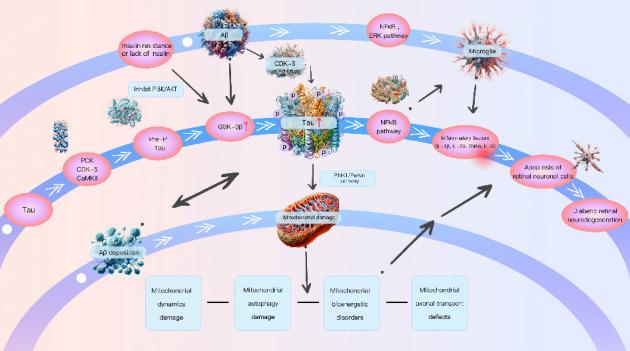
Diabetic retinal neurodegeneration (DRN) is an early manifestation of diabetic retinopathy (DR) characterized by neurodegeneration that precedes microvascular abnormalities in the retina. DRN is characterized by apoptosis of retinal ganglion cells (involves alterations in retinal ganglion cells [RGCs], photoreceptors, amacrine cells and bipolar cells and so on), reactive gliosis, and reduced retinal neuronal function. Tau, a microtubule-associated protein, is a key mediator of neurotoxicity in neurodegenerative diseases, with functions in phosphorylation-dependent microtubule assembly and stabilization, axonal transport, and neurite outgrowth. The hyperphosphorylated tau (p-tau) loses its ability to bind to microtubules and aggregates to form paired helical filaments (PHFs), which further form neurofibrillary tangles (NFTs), leading to abnormal cell scaffolding and cell death. Studies have shown that p-tau can cause degeneration of RGCs in DR, making tau pathology a new pathophysiological model for DR. Here, we review the mechanisms by which p-tau contribute to DRN, including insulin resistance or lack of insulin, mitochondrial damage such as mitophagy impairment, mitochondrial axonal transport defects, mitochondrial bioenergetics dysfunction, and impaired mitochondrial dynamics, Abeta toxicity, and inflammation. Therefore, this article proposes that tau protein hyperphosphorylation plays a crucial role in the pathogenesis of DRN and may serve as a novel therapeutic target for combating DRN.
糖尿病视网膜神经变性(DRN)是糖尿病视网膜病变(DR)的早期表现,其特征是视网膜神经变性先于视网膜微血管异常出现。DRN的特征包括视网膜神经节细胞凋亡(涉及视网膜神经节细胞[RGCs]、光感受器、无长突细胞和双极细胞等的改变)、反应性胶质增生以及视网膜神经元功能减退。Tau蛋白是一种微管相关蛋白,是神经退行性疾病中神经毒性的关键介质,具有磷酸化依赖性微管组装与稳定、轴突运输和神经突生长等功能。过度磷酸化的Tau(p-tau)失去与微管结合的能力并聚集形成双螺旋丝(PHFs),进而形成神经原纤维缠结(NFTs),导致细胞支架异常和细胞死亡。研究表明,p-tau可导致DR中RGCs变性,使Tau病理成为DR的一种新的病理生理模型。在此,我们综述p-tau导致DRN的机制,包括胰岛素抵抗或胰岛素缺乏、线粒体损伤如线粒体自噬受损、线粒体轴突运输缺陷、线粒体生物能量功能障碍以及线粒体动力学受损、β淀粉样蛋白毒性和炎症。因此,本文提出Tau蛋白过度磷酸化在DRN发病机制中起关键作用,可能成为对抗DRN的新型治疗靶点。
 Zotero 插件