
长期暴露于细颗粒物(PM)与心血管疾病发病率之间的关联的区域差异以及该差异的潜在决定因素。
Regional Difference in the Association Between Long-Term PM and Cardiovascular Disease Incidence and Potential Determinants of the Difference.
作者信息
Kim Ok-Jin, Kim Sun-Young
机构信息
Environmental Health Research Department National Institute of Environmental Research Incheon Korea.
Department of Public Health & AI Graduate School of Cancer Science and Policy National Cancer Center Goyang-Si Korea.
出版信息
Geohealth. 2025 Mar 19;9(3):e2024GH001245. doi: 10.1029/2024GH001245. eCollection 2025 Mar.
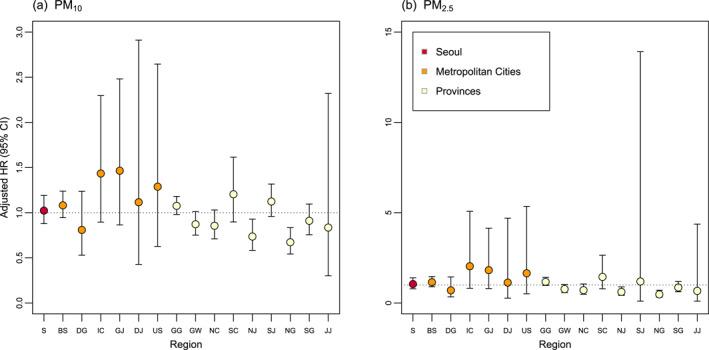
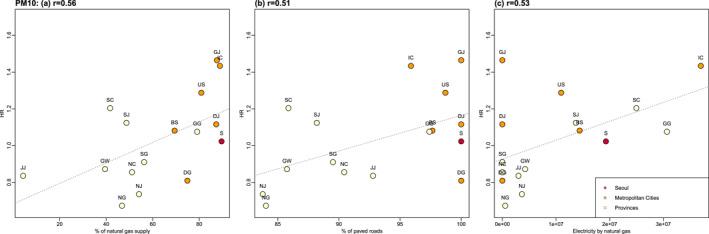
While short-term studies of the adverse effects of air pollution have found regional differences, there has been insufficient evidence from long-term studies. This study investigated the spatial variation of the association between long-term exposure to particulate matter (PM) air pollution and cardiovascular disease (CVD) incidence and their relevant regional characteristics. We selected 155,017 adults who have lived over 13 years in each of the 16 regions of South Korea from the National Health Insurance Service-National Sample Cohort. We assessed the individual long-term exposure as a 5-year average concentration at district-level residential addresses estimated by previously validated exposure prediction models. We applied time-dependent Cox-proportional hazard models to explore the spatial variation of long-term PM exposure's association with CVD incidence. After adjusting for individual-level characteristics, we estimated the region-specific hazard ratios (HRs) of incident CVD per 10 μg/m increase in PM and PM. Then, we calculated the correlation coefficients between region-specific HRs and 80 regional attributes in 13 categories across 16 regions to identify the related regional characteristics. Region-specific HRs of CVD incidence for PM showed considerable variation in magnitude and direction across 16 regions. HRs of PM and PM were higher in major urban areas and lower in rural areas. Urbanicity and emission sources exhibited significant correlations with HRs of overall CVD. Our findings offer an opportunity to explore regional characteristics that derive the difference in air pollution-associated health effects and help us provide guidance to target specific characteristics to avoid the adverse health effects of air pollution.
虽然空气污染不良影响的短期研究发现了区域差异,但长期研究的证据不足。本研究调查了长期暴露于颗粒物(PM)空气污染与心血管疾病(CVD)发病率之间关联的空间变化及其相关区域特征。我们从国民健康保险服务-全国样本队列中选取了155,017名在韩国16个地区中每个地区居住超过13年的成年人。我们将个体长期暴露评估为根据先前验证的暴露预测模型估计的地区级居住地址的5年平均浓度。我们应用时间依赖性Cox比例风险模型来探索长期PM暴露与CVD发病率关联的空间变化。在调整个体水平特征后,我们估计了PM和PM每增加10μg/m时CVD发病的地区特异性风险比(HRs)。然后,我们计算了16个地区13个类别中80个区域属性与地区特异性HRs之间的相关系数,以确定相关的区域特征。PM导致的CVD发病率的地区特异性HRs在16个地区的大小和方向上显示出相当大的差异。PM和PM的HRs在主要城市地区较高,在农村地区较低。城市化程度和排放源与总体CVD的HRs表现出显著相关性。我们的研究结果为探索导致空气污染相关健康影响差异的区域特征提供了机会,并有助于我们针对特定特征提供指导,以避免空气污染对健康的不利影响。

 Zotero 插件