
PDCD5对CD8效应T细胞分化的表观遗传调控
Epigenetic Regulation of CD8 Effector T Cell Differentiation by PDCD5.
作者信息
Jin Lixue, Zhang Xin, Wang Jingyi, Wang Yujia, Wang Ke, Wang Zhuolin, Wang Pingzhang, Sun Xiuyuan, Hao Jie, Jin Rong, Lu Dan, Ge Qing
机构信息
Department of Immunology, School of Basic Medical Sciences, NHC Key Laboratory of Medical Immunology, Beijing Key Laboratory of Tumor Systems Biology, Institute of Systems Biomedicine, Peking University Health Science Center, Peking University, Beijing, China.
Department of Immunology, School of Basic Medical Sciences, NHC Key Laboratory of Medical Immunology, Beijing Key Laboratory of Tumor Systems Biology, Institute of Systems Biomedicine, Peking University Health Science Center, Beijing, China.
出版信息
Eur J Immunol. 2025 Mar;55(3):e202451388. doi: 10.1002/eji.202451388.
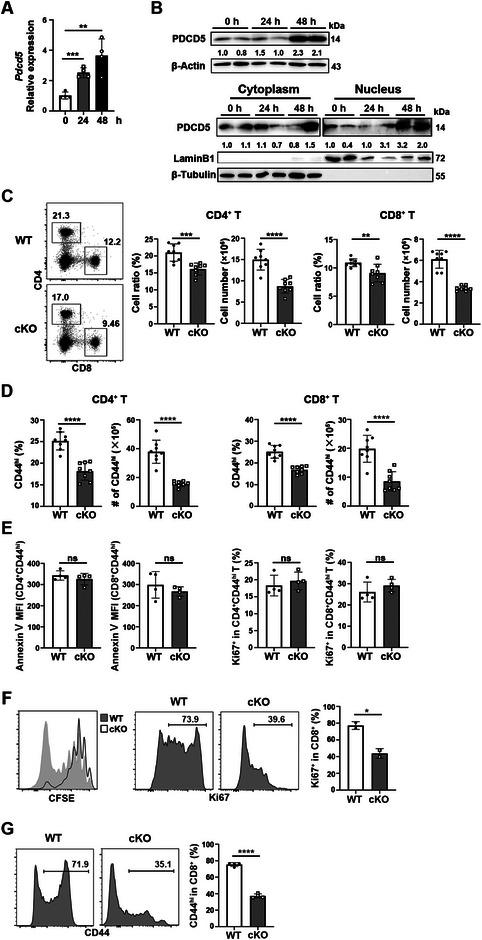
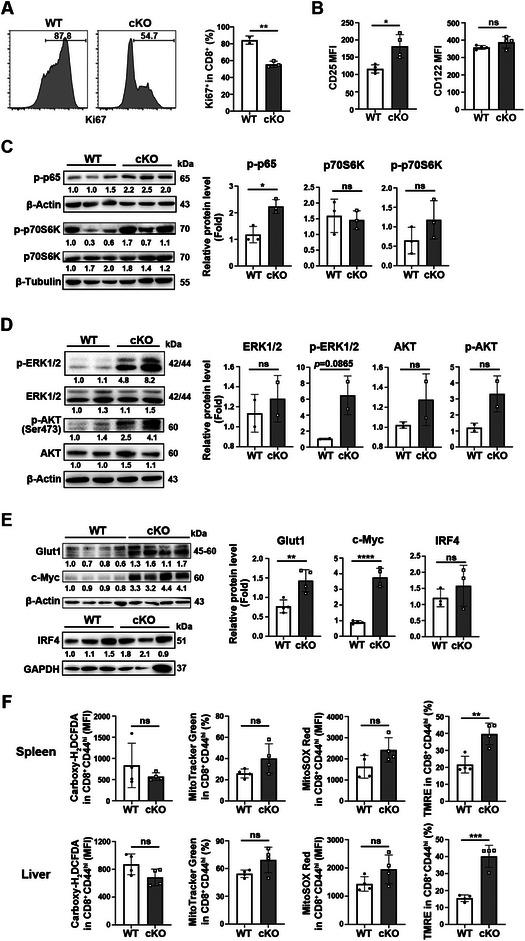
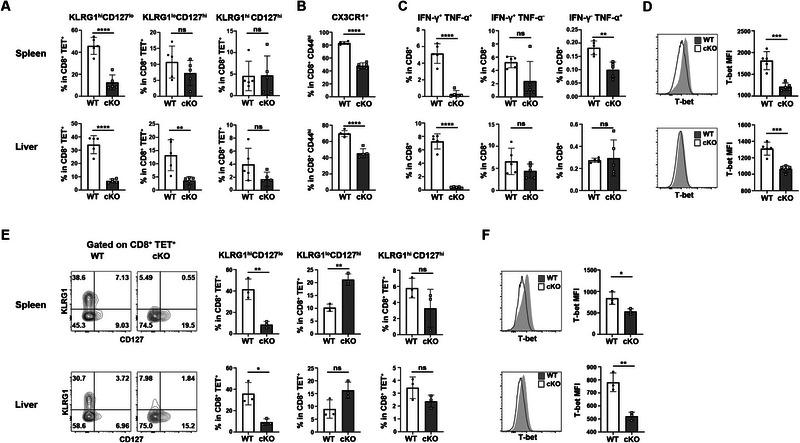
Epigenetic modification plays a crucial role in establishing the transcriptional program that governs the differentiation of CD8 effector T cells. However, the mechanisms by which this process is regulated at an early stage, prior to the expression of master transcription factors, are not yet fully understood. In this study, we have identified PDCD5 as an activation-induced molecule that is necessary for the proper differentiation and expansion of antigen-specific CD8 effector T cells in a mouse model of chronic viral infection. The genetic deletion of Pdcd5 resulted in impaired differentiation and function of effector T cells, while T-cell activation, metabolic reprogramming, and the differentiation of memory/exhausted T cells were largely unaffected. At the molecular level, we observed reduced chromatin accessibility and transcriptional activity of Tbx21 and its regulated genes in Pdcd5 CD8 T cells. We further identified that PRDM9 facilitates the H3K4me3 modification of genes associated with the effector phenotype in CD8 T cells. The interaction between PDCD5 and PRDM9 promotes the nuclear translocation and lysine methyltransferase activity of PRDM9. Collectively, these findings highlight the crucial role of the PDCD5/PRDM9 axis in epigenetic reprogramming during the early stages of fate determination for effector CD8 T cell fate.
表观遗传修饰在建立调控CD8效应T细胞分化的转录程序中起着关键作用。然而,在主转录因子表达之前的早期阶段,该过程是如何被调控的机制尚未完全了解。在这项研究中,我们已确定程序性细胞死亡蛋白5(PDCD5)是一种激活诱导分子,在慢性病毒感染小鼠模型中,它对抗原特异性CD8效应T细胞的正常分化和扩增是必需的。Pdcd5基因缺失导致效应T细胞的分化和功能受损,而T细胞激活、代谢重编程以及记忆/耗竭性T细胞的分化在很大程度上未受影响。在分子水平上,我们观察到在Pdcd5缺陷的CD8 T细胞中,Tbx21及其调控基因的染色质可及性和转录活性降低。我们进一步确定,PR结构域蛋白9(PRDM9)促进CD8 T细胞中与效应表型相关基因的H3K4me3修饰。PDCD5与PRDM9之间的相互作用促进PRDM9的核转位和赖氨酸甲基转移酶活性。总的来说,这些发现突出了PDCD5/PRDM9轴在效应CD8 T细胞命运决定早期阶段的表观遗传重编程中的关键作用。




 Zotero 插件