
治疗干预后神经关联的初步证据:注意力训练技术后默认模式网络中静息态功能连接的改变。
Initial evidence for neural correlates following a therapeutic intervention: altered resting state functional connectivity in the default mode network following attention training technique.
作者信息
Müller Torben, Krug Svenja, Kayali Özlem, Leichter Erik, Jahn Niklas, Winter Lotta, Krüger Tillmann H C, Kahl Kai G, Sinke Christopher, Heitland Ivo
机构信息
Department of Psychiatry, Social Psychiatry and Psychotherapy, Hannover Medical School, Hanover, Germany.
Division of Clinical Psychology and Sexual Medicine, Department of Psychiatry, Social Psychiatry and Psychotherapy, Hannover Medical School, Hanover, Germany.
出版信息
Front Psychiatry. 2025 Mar 6;16:1479283. doi: 10.3389/fpsyt.2025.1479283. eCollection 2025.
INTRODUCTION
The Attention Training Technique (ATT) is a psychotherapeutic intervention in Metacogntive Therapy (MCT) and aims at reducing maladaptive processes by strengthening attentional flexibility. ATT has demonstrated efficacy in treating depression on a clinical level. Here, we evaluated ATT at the neural level. We examined functional connectivity (FC) of the default mode network (DMN).
METHOD
48 individuals diagnosed with Major Depressive Disorder (MDD) and 51 healthy controls (HC) participated in a resting-state (rs) (fMRI) experiment. The participants received either one week of ATT or a sham intervention. Rs-fMRI scans before and after treatment were compared using seed-to-voxel analysis.
RESULTS
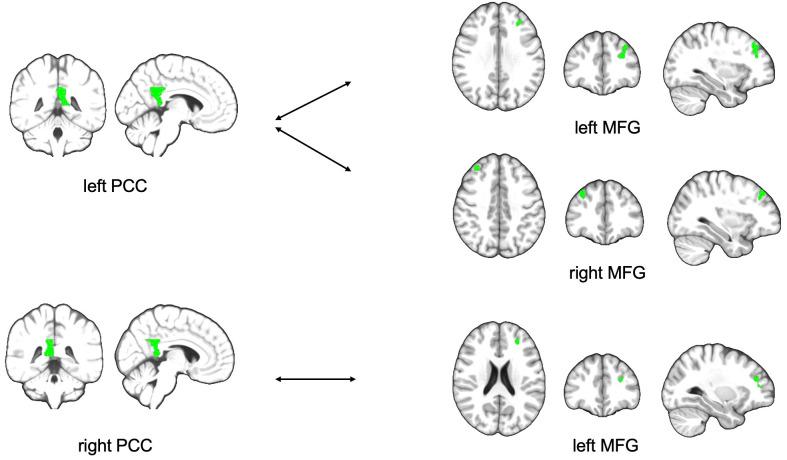
The 2x2x2 analysis did not reach significance. Nevertheless, a resting-state connectivity effect was found on the basis of a posttest at the second measurement time point in MDD. After one week, MDD patients who had received ATT intervention presented lower functional connectivity between the left posterior cingulate cortex (PCC) and the bilateral middle frontal gyrus (MFG) as well as between the right PCC and the left MFG compared to the MDD patients in the sham group. In HC we observed higher rsFC in spatially close but not the same brain regions under the same experimental condition.
CONCLUSION
We found a first hint of a change at the neural level on the basis of ATT. Whether the changes in rsFC found here indicate an improvement in the flexible shift of attentional focus due to ATT needs to be investigated in further research paradigms. Further experiments have to show whether this change in functional connectivity can be used as a specific outcome measure of ATT treatment.
引言
注意力训练技术(ATT)是元认知疗法(MCT)中的一种心理治疗干预措施,旨在通过增强注意力灵活性来减少适应不良过程。ATT已在临床层面证明对治疗抑郁症有效。在此,我们在神经层面评估了ATT。我们检查了默认模式网络(DMN)的功能连接(FC)。
方法
48名被诊断为重度抑郁症(MDD)的个体和51名健康对照者(HC)参与了一项静息态(rs)功能磁共振成像(fMRI)实验。参与者接受了为期一周的ATT或假干预。使用种子点到体素分析比较治疗前后的rs-fMRI扫描结果。
结果
2×2×2分析未达到显著水平。然而,在MDD组第二次测量时间点的后测基础上发现了静息态连接效应。一周后,与假干预组的MDD患者相比,接受ATT干预的MDD患者在左后扣带回皮质(PCC)与双侧额中回(MFG)之间以及右PCC与左MFG之间的功能连接较低。在HC组中,我们在相同实验条件下观察到空间上相近但并非相同的脑区有更高的静息态功能连接。
结论
我们发现了基于ATT的神经层面变化的首个线索。此处发现的静息态功能连接变化是否表明由于ATT导致注意力焦点的灵活转移得到改善,需要在进一步的研究范式中进行探究。进一步的实验必须表明这种功能连接的变化是否可作为ATT治疗的特定结果指标。


 Zotero 插件