
短期暴露于细颗粒物与缺血性卒中死亡率之间的关联及绿地的作用:中国淄博的一项时间序列研究。
Associations between short-term exposure to fine particulate matter with ischemic stroke mortality and the role of green space: a time-series study in Zibo, China.
作者信息
Song Sihao, Cheng Chuanlong, Liu Ying, Duan Yuqi, Zuo Hui, Xi Rui, Ni Zhisong, Liang Kemeng, Li Shufen, Cui Feng, Li Xiujun
机构信息
Department of Biostatistics, School of Public Health, Cheeloo College of Medicine, Shandong University, Jinan, Shandong, China.
Ma'anshan Center for Disease Control and Prevention, Ma'anshan, Anhui, China.
出版信息
J Glob Health. 2025 Mar 21;15:04068. doi: 10.7189/jogh.15.04068.
BACKGROUND
Previous studies on associations between short-term exposure to fine particulate matter (PM) and ischemic stroke (IS) mortality reported inconclusive results. Additionally, whether and how PM and green space interact to precipitate IS deaths remains unclear. We aimed to examine the impacts of short-term exposure to PM on IS mortality and the role of green space in the association.
METHODS
We collected data on daily IS deaths, daily PM concentrations, and monthly normalized difference vegetation index (NDVI) in Zibo City from 2015 to 2019. Generalised additive models were adopted to investigate the short-term impacts of PM on IS mortality, and subgroup analyses were used to examine effect modification by population characteristics. Stratified analyses by green space levels and joint effect model were conducted to test the interactions of PM and green space on IS mortality.
RESULTS
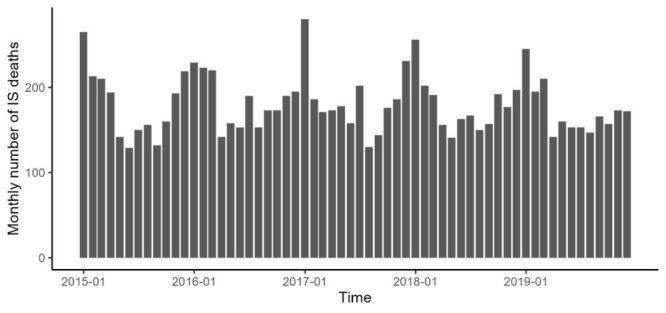
A total of 10 799 IS deaths were included in our study. Exposure to PM was associated with an increased risk of IS mortality, with odds ratios (ORs) of 1.0263 (95% confidence interval (CI) = 1.0017, 1.0516) for each interquartile range (IQR) increase in PM on lag0 and 1.0317 (95% CI = 1.0016, 1.0627) on lag01. The links between PM and IS mortality were not significantly different across genders, ages, or PM zones. Furthermore, our results showed that the effects of PM on IS mortality were higher in low levels of green space. Specifically, for each IQR increase in PM, the ORs (95% CIs) of IS death in the low level and the high level of NDVI were 1.0287 (95% CI = 1.0019, 1.0563) and 0.9934 (95% CI = 0.9296, 1.0615), respectively. In addition, PM and NDVI exhibited significant interactive effects on IS mortality, with relative excess odds due to interaction (REOI) of greater than 0.
CONCLUSIONS
Our findings showed that PM was significantly associated with increasing odds of IS mortality. Furthermore, there were synergetic impacts between PM and lack of greenness on IS mortality. Our results suggest that expanding green spaces, such as increasing park coverage and street greening, along with regulating industrial emissions to reduce PM levels, can help prevent premature deaths from IS.
背景
先前关于短期暴露于细颗粒物(PM)与缺血性中风(IS)死亡率之间关联的研究结果尚无定论。此外,PM与绿地是否以及如何相互作用导致IS死亡仍不清楚。我们旨在研究短期暴露于PM对IS死亡率的影响以及绿地在这种关联中的作用。
方法
我们收集了2015年至2019年淄博市每日IS死亡数据、每日PM浓度数据以及每月归一化植被指数(NDVI)数据。采用广义相加模型研究PM对IS死亡率的短期影响,并进行亚组分析以检验人群特征的效应修正。通过绿地水平进行分层分析和联合效应模型,以检验PM与绿地对IS死亡率的相互作用。
结果
我们的研究共纳入10799例IS死亡病例。暴露于PM与IS死亡率风险增加相关,PM每增加一个四分位数间距(IQR),滞后0天的比值比(OR)为1.0263(95%置信区间(CI)=1.0017,1.0516),滞后01天的OR为1.0317(95%CI=1.0016,1.0627)。PM与IS死亡率之间的关联在性别、年龄或PM区域之间无显著差异。此外,我们的结果表明,在低绿地水平下,PM对IS死亡率的影响更大。具体而言,PM每增加一个IQR,低水平和高水平NDVI下IS死亡的OR(95%CI)分别为1.0287(95%CI=1.0019,1.0563)和0.9934(95%CI=0.9296,1.0615)。此外,PM和NDVI对IS死亡率表现出显著的交互作用,交互作用导致的相对超额比值(REOI)大于0。
结论
我们的研究结果表明,PM与IS死亡率增加的几率显著相关。此外,PM与绿地缺乏对IS死亡率有协同影响。我们的结果表明,扩大绿地,如增加公园覆盖率和街道绿化,同时调节工业排放以降低PM水平,有助于预防IS导致的过早死亡。


 Zotero 插件