
用于评估医疗保健专业人员数字健康能力的DigiHealthCom(数字健康能力)工具中文版:翻译、改编与验证研究。
The Chinese Version of the DigiHealthCom (Digital Health Competence) Instrument for Assessing Digital Health Competence of Health Care Professionals: Translation, Adaptation, and Validation Study.
作者信息
Gao Lu, Chen Meilian, Wei Jingxin, Wang Jinni, Liao Xiaoyan
机构信息
School of Nursing, Southern Medical University, Guangzhou, China.
Nanfang Hospital, Southern Medical University, Guangzhou, China.
出版信息
JMIR Hum Factors. 2025 Mar 21;12:e65373. doi: 10.2196/65373.
BACKGROUND
Digital health competence is increasingly recognized as a core competence for health care professionals. A comprehensive evaluation of knowledge, skills, performance, values, and attitudes necessary to adapt to evolving digital health technologies is essential. DigiHealthCom (Digital Health Competence) is a well-established instrument designed to assess digital health competence across diverse health care professionals.
OBJECTIVE
This study aimed to translate and culturally adapt DigiHealthCom into simplified Chinese (Mandarin) and verify its reliability and validity in assessing digital health competence of Chinese health care professionals.
METHODS
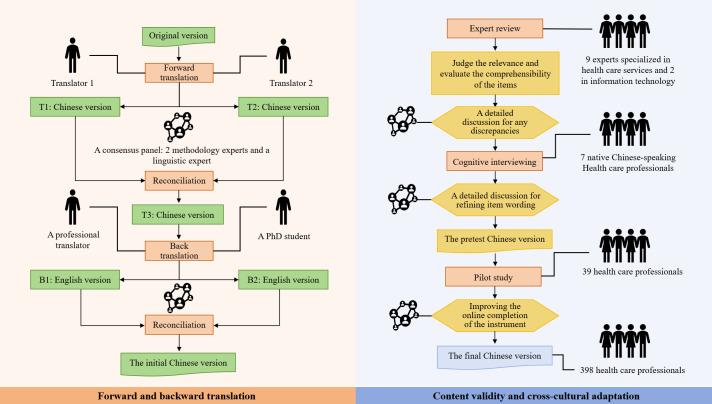
DigiHealthCom was translated into Chinese following the guideline proposed by its original developers. The cultural adaptation involved expert review and cognitive interviewing. Internal consistency, test-retest reliability, content validity, convergent validity, discriminant validity, and factor structure were examined. Item analysis tested item discrimination, item correlation, and item homogeneity. Internal consistency was assessed using Cronbach α, and test-retest reliability was measured using the intraclass correlation coefficient. Content validity was assessed through both item and scale content validity indices. Convergent validity was measured by the Average Variance Extracted and Composite Reliability, while discriminant validity was measured by the heterotrait-monotrait ratio. A five-dimension model of DigiHealthCom was confirmed using confirmatory factor analysis.
RESULTS
The finalized Chinese version of the DigiHealthCom was completed after addressing differences between the back-translations and the original version. No discrepancies affecting item clarity were reported during cognitive interviewing. The validation process involved 398 eligible health care professionals from 36 cities across 15 provinces in China, with 43 participants undergoing a retest after a 2-week interval. Critical ratio values (range 16.05-23.77, P<.001), item-total correlation coefficients (range 0.69-0.89), and Cronbach α if the item deleted (range 0.91-0.96) indicated satisfactory item discrimination, item correlation, and item homogeneity. Cronbach α for dimensions and the scale ranged from 0.94 to 0.98, indicating good internal consistency. The intraclass correlation coefficient was 0.90 (95% CI 0.81-0.95), indicating good test-retest reliability. Item content validity index ranged from 0.82 to 1.00, and the scale content validity index was 0.97, indicating satisfactory content validity. Convergent validity (average variance extracted: 0.60-0.79; composite reliability: 0.94-0.95) and divergent validity (heterotrait-monotrait ratio: 0.72-0.89) were satisfactory. Confirmatory factor analysis confirmed a well-fit five-dimension model (robust chi-square to df ratio=3.10, comparative fit index=0.91, Tucker-Lewis index=0.90, incremental fit index=0.91, root-mean-square error of approximation=0.07, standardized root-mean-square residual=0.05), with each item having a factor loading exceeding 0.40.
CONCLUSIONS
The Chinese version of DigiHealthCom has been proved to be reliable and valid. It is now available for assessing digital health competence among Chinese health care professionals. This assessment can be used to guide health care policy makers and educators in designing comprehensive and implementable educational programs and interventions.
背景
数字健康能力日益被视为医疗保健专业人员的一项核心能力。全面评估适应不断发展的数字健康技术所需的知识、技能、表现、价值观和态度至关重要。数字健康能力评估量表(DigiHealthCom)是一种成熟的工具,旨在评估不同医疗保健专业人员的数字健康能力。
目的
本研究旨在将数字健康能力评估量表翻译成简体中文并进行文化调适,验证其在评估中国医疗保健专业人员数字健康能力方面的信效度。
方法
按照数字健康能力评估量表原开发者提出的指南将其翻译成中文。文化调适包括专家评审和认知访谈。对内部一致性、重测信度、内容效度、聚合效度、区分效度和因子结构进行了检验。项目分析测试了项目区分度、项目相关性和项目同质性。使用克朗巴哈α系数评估内部一致性,使用组内相关系数测量重测信度。通过项目和量表内容效度指数评估内容效度。聚合效度通过平均提取方差和组合信度来衡量,区分效度通过异质特质-同质特质比率来衡量。使用验证性因子分析确认了数字健康能力评估量表的五维度模型。
结果
在解决回译与原始版本之间的差异后,完成了最终的数字健康能力评估量表中文版。在认知访谈中未报告影响项目清晰度的差异。验证过程涉及来自中国15个省份36个城市的398名符合条件的医疗保健专业人员,43名参与者在间隔2周后进行了重新测试。临界比值值(范围16.05 - 23.77,P <.001)、项目-总分相关系数(范围0.69 - 0.89)以及删除项目后的克朗巴哈α系数(范围0.91 - 0.96)表明项目区分度、项目相关性和项目同质性令人满意。维度和量表的克朗巴哈α系数范围为0.94至0.98,表明内部一致性良好。组内相关系数为0.90(95%CI 0.81 - 0.95),表明重测信度良好。项目内容效度指数范围为0.82至1.00,量表内容效度指数为0.97,表明内容效度令人满意。聚合效度(平均提取方差:0.60 - 0.79;组合信度:0.94 - 0.95)和区分效度(异质特质-同质特质比率:0.72 - 0.89)令人满意。验证性因子分析确认了一个拟合良好的五维度模型(稳健的卡方与自由度比率 = 3.10,比较拟合指数 = 0.91,塔克-刘易斯指数 = 0.90,增值拟合指数 = 0.91,近似均方根误差 = 0.07,标准化均方根残差 = 0.05),每个项目的因子载荷超过0.40。
结论
数字健康能力评估量表中文版已被证明具有信效度。它现在可用于评估中国医疗保健专业人员的数字健康能力。该评估可用于指导医疗保健政策制定者和教育工作者设计全面且可实施的教育计划和干预措施。


 Zotero 插件