
利用原发性肿瘤和淋巴结的F-FDG PET影像组学特征预测非小细胞肺癌新辅助化疗免疫治疗的病理完全缓解
Prediction of pathological complete response to neoadjuvant chemoimmunotherapy in non-small cell lung cancer using F-FDG PET radiomics features of primary tumour and lymph nodes.
作者信息
Liu Xingbiao, Ji Zhilin, Zhang Libo, Li Linlin, Xu Wengui, Su Qian
机构信息
Department of Molecular Imaging and Nuclear Medicine, Tianjin Medical University Cancer Institute and Hospital, National Clinical Research Center for Cancer, Huanhuxi Road, Hexi Distinct, Tianjin, 300060, China.
Tianjin's Clinical Research Center for Cancer, Tianjin, 300060, China.
出版信息
BMC Cancer. 2025 Mar 21;25(1):520. doi: 10.1186/s12885-025-13905-7.
BACKGROUND
Predicting the response to neoadjuvant chemoimmunotherapy in patients with resectable non-small cell lung cancer (NSCLC) facilitates clinical treatment decisions. Our study aimed to establish a machine learning model that accurately predicts the pathological complete response (pCR) using F-FDG PET radiomics features.
METHODS
We retrospectively included 210 patients with NSCLC who completed neoadjuvant chemoimmunotherapy and subsequently underwent surgery with pathological results, categorising them into a training set of 147 patients and a test set of 63 patients. Radiomic features were extracted from the primary tumour and lymph nodes. Using 10-fold cross-validation with the least absolute shrinkage and selection operator method, we identified the most impactful radiomic features. The clinical features were screened using univariate and multivariate analyses. Machine learning models were developed using the random forest method, leading to the establishment of one clinical feature model, one primary tumour radiomics model, and two fusion radiomics models. The performance of these models was evaluated based on the area under the curve (AUC).
RESULTS
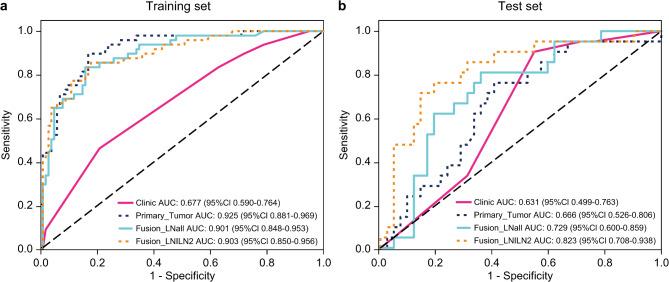
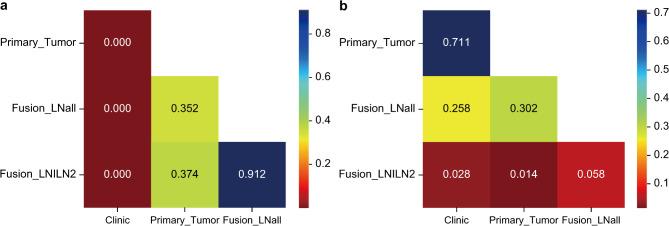
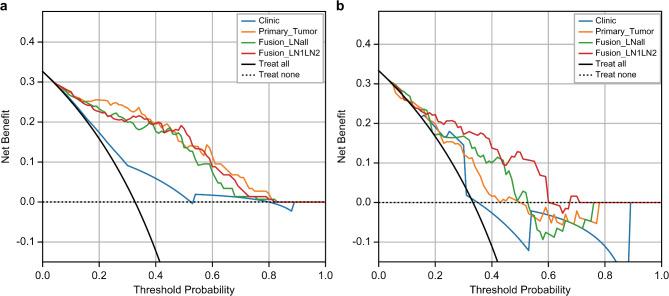
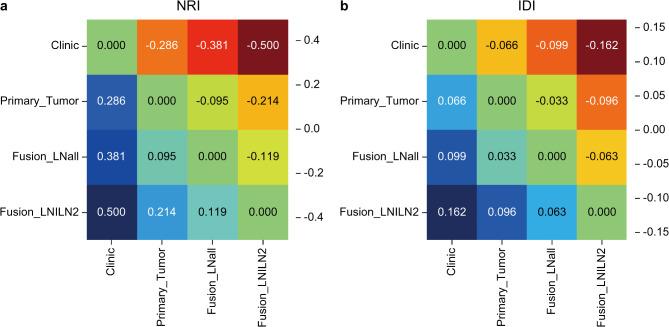
In the training set, the three radiomic models showed comparable AUC values, ranging from 0.901 to 0.925. The clinical model underperformed, with an AUC of 0.677. In the test set, the Fusion_LN1LN2 model achieved the highest AUC (0.823), closely followed by the Fusion_Lnall model with an AUC of 0.729. The primary tumour model achieved a moderate AUC of 0.666, whereas the clinical model had the lowest AUC at 0.631. Additionally, the Fusion_LN1LN2 model demonstrated positive net reclassification improvement and integrated discrimination improvement values compared with the other models, and we employed the SHapley Additive exPlanations methodology to interpret the results of our optimal model.
CONCLUSIONS
Our fusion radiomics model, based on F-FDG-PET, will assist clinicians in predicting pCR before neoadjuvant chemoimmunotherapy for patients with resectable NSCLC.
背景
预测可切除非小细胞肺癌(NSCLC)患者对新辅助化疗免疫治疗的反应有助于临床治疗决策。我们的研究旨在建立一种机器学习模型,该模型使用F-FDG PET影像组学特征准确预测病理完全缓解(pCR)。
方法
我们回顾性纳入了210例完成新辅助化疗免疫治疗并随后接受手术且有病理结果的NSCLC患者,将他们分为147例患者的训练集和63例患者的测试集。从原发肿瘤和淋巴结中提取影像组学特征。使用最小绝对收缩和选择算子方法进行10折交叉验证,我们确定了最具影响力的影像组学特征。通过单变量和多变量分析筛选临床特征。使用随机森林方法开发机器学习模型,从而建立了一个临床特征模型、一个原发肿瘤影像组学模型和两个融合影像组学模型。基于曲线下面积(AUC)评估这些模型的性能。
结果
在训练集中,三个影像组学模型显示出可比的AUC值,范围从0.901到0.925。临床模型表现较差,AUC为0.677。在测试集中,Fusion_LN1LN2模型的AUC最高(0.823),紧随其后的是Fusion_Lnall模型,AUC为0.729。原发肿瘤模型的AUC为中等水平,为0.666,而临床模型的AUC最低,为0.631。此外,与其他模型相比,Fusion_LN1LN2模型显示出正的净重新分类改善和综合判别改善值,并且我们采用SHapley加性解释方法来解释我们最优模型的结果。
结论
我们基于F-FDG-PET的融合影像组学模型将帮助临床医生在可切除NSCLC患者新辅助化疗免疫治疗前预测pCR。




 Zotero 插件