
吸入性糖皮质激素在支气管扩张症中的应用:来自欧洲支气管扩张症注册研究(EMBARC)的数据。
Use of inhaled corticosteroids in bronchiectasis: data from the European Bronchiectasis Registry (EMBARC).
作者信息
Pollock Jennifer, Polverino Eva, Dhar Raja, Dimakou Katerina, Traversi Letizia, Bossios Apostolos, Haworth Charles, Loebinger Michael R, De Soyza Anthony, Vendrell Montserrat, Burgel Pierre Regis, Mertsch Pontus, McDonnell Melissa Jane, Skgrat Sabina, Maiz-Carro Luis, Sibila Oriol, van der Eerden Menno, Kauppi Paula, Hill Adam T, Wilson Robert, Milenkovic Branislava, Menéndez Rosario, Murris Marlene, Crichton Megan L, Borecki Sermin, Obradovic Dusanka, Irfan Muhammed, Eshenkulova Venera, Nowinski Adam, Amorim Adelina, Torres Antoni, Lorent Natalie, Welte Tobias, Blasi Francesco, Van Braeckel Eva, Altenburg Josje, Shteinberg Michal, Boersma Wim, Elborn Joseph Stuart, Aliberti Stefano, Ringshausen Felix C, Goeminne Pieter, Chalmers James D
机构信息
Division of Respiratory Medicine and Gastroenterology, University of Dundee, Dundee, UK.
Pneumology Department, Vall d'Hebron Barcelona Hospital Campus, Barcelona, Spain.
出版信息
Thorax. 2025 May 20;80(6):358-368. doi: 10.1136/thorax-2024-221825.
INTRODUCTION
Current bronchiectasis guidelines advise against the use of inhaled corticosteroids (ICS) except in patients with associated asthma, allergic bronchopulmonary aspergillosis (ABPA) and/or chronic obstructive pulmonary disease (COPD). This study aimed to describe the use of ICS in patients with bronchiectasis across Europe.
METHODS
Patients with bronchiectasis were enrolled into the European Bronchiectasis Registry from 2015 to 2022. Patients were grouped into ICS users and non-users at baseline and clinical characteristics associated with ICS use were investigated. Patients were followed up for clinical outcomes of exacerbation, hospitalisation and mortality for up to 5 years. We evaluated if elevated blood eosinophil counts (above the laboratory upper limit of normal) modified the effect of ICS on exacerbations.
RESULTS
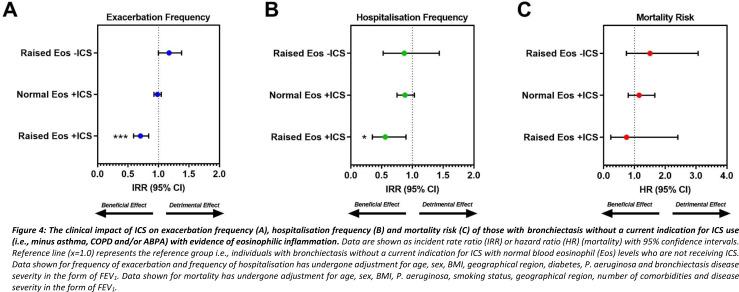
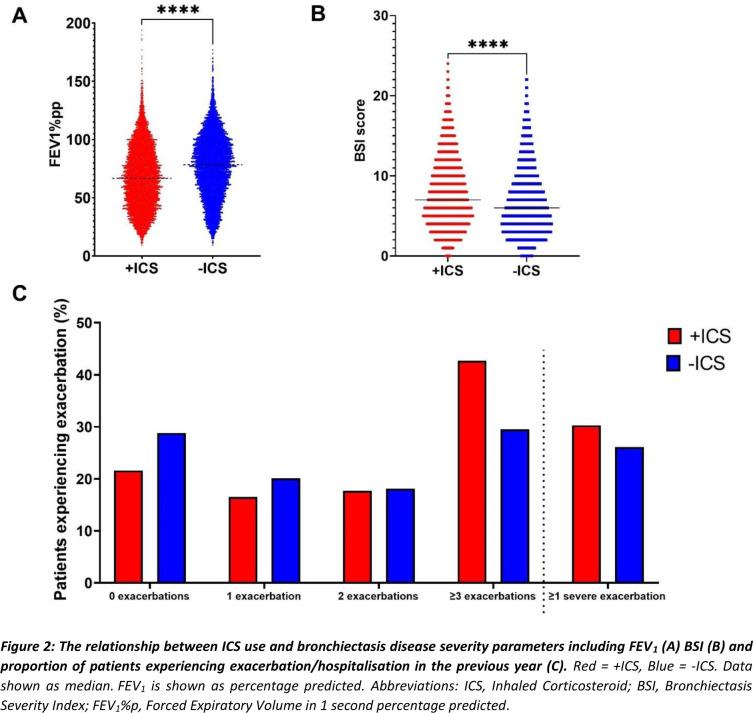
19 324 patients were included for analysis and 10 109 (52.3%) were recorded as being prescribed ICS at baseline. After exclusion of patients with a history of asthma, COPD and/or ABPA, 3174/9715 (32.7%) patients with bronchiectasis were prescribed ICS. Frequency of ICS use varied across countries, ranging from 17% to 85% of included patients. ICS users had more severe disease, with significantly worse lung function, higher Bronchiectasis Severity Index scores and more frequent exacerbations at baseline (p<0.0001). Overall, ICS users did not have a reduced risk of exacerbation or hospitalisation during follow-up, but a significant reduction in exacerbation frequency was observed in the subgroup of ICS users with elevated blood eosinophil counts (relative risk 0.70, 95% CI 0.59 to 0.84, p<0.001).
CONCLUSION
ICS use is common in bronchiectasis, including in those not currently recommended ICS according to bronchiectasis guidelines. ICS use may be associated with reduced exacerbation frequency in patients with elevated blood eosinophils.
引言
当前支气管扩张症指南建议,除合并哮喘、变应性支气管肺曲霉病(ABPA)和/或慢性阻塞性肺疾病(COPD)的患者外,不建议使用吸入性糖皮质激素(ICS)。本研究旨在描述ICS在欧洲支气管扩张症患者中的使用情况。
方法
2015年至2022年,支气管扩张症患者被纳入欧洲支气管扩张症登记处。患者在基线时被分为ICS使用者和非使用者,并对与ICS使用相关的临床特征进行调查。对患者进行长达5年的随访,观察其病情加重、住院和死亡等临床结局。我们评估了血液嗜酸性粒细胞计数升高(高于实验室正常上限)是否会改变ICS对病情加重的影响。
结果
19324例患者纳入分析,10109例(52.3%)在基线时被记录为使用ICS。排除有哮喘、COPD和/或ABPA病史的患者后,3174/9715例(32.7%)支气管扩张症患者使用ICS。ICS的使用频率在各国有所不同,在所纳入患者中占比从17%至85%不等。ICS使用者的病情更严重,基线时肺功能明显更差,支气管扩张严重程度指数评分更高,病情加重更频繁(p<0.0001)。总体而言,ICS使用者在随访期间病情加重或住院的风险并未降低,但在血液嗜酸性粒细胞计数升高的ICS使用者亚组中,病情加重频率显著降低(相对风险0.70,95%置信区间0.59至0.84,p<0.001)。
结论
ICS在支气管扩张症中使用普遍,包括那些目前支气管扩张症指南不建议使用ICS的患者。血液嗜酸性粒细胞计数升高的患者使用ICS可能与病情加重频率降低有关。


 Zotero 插件