
转基因植物中RNA干扰诱导效应的分类及检测技术
Classification of and detection techniques for RNAi-induced effects in GM plants.
作者信息
Diaz Cecilia, Ayobahan Steve U, Simon Samson, Zühl Luise, Schiermeyer Andreas, Eilebrecht Elke, Eilebrecht Sebastian
机构信息
Department Ecotoxicology, Fraunhofer Institute for Molecular Biology and Applied Ecology IME, Schmallenberg, Germany.
Department Ecotoxicogenomics, Fraunhofer Institute for Molecular Biology and Applied Ecology IME, Schmallenberg, Germany.
出版信息
Front Plant Sci. 2025 Mar 7;16:1535384. doi: 10.3389/fpls.2025.1535384. eCollection 2025.
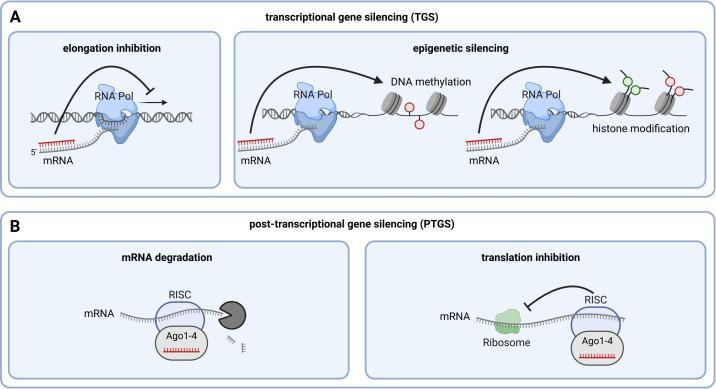
RNA interference (RNAi) is a biotechnological tool used for gene silencing in plants, with both endogenous and exogenous applications. Endogenous approaches, such as host-induced gene silencing (HIGS), involve genetically modified (GM) plants, while exogenous methods include spray-induced gene silencing (SIGS). The RNAi mechanism hinges on the introduction of double-stranded RNA (dsRNA), which is processed into short interfering RNAs (siRNAs) that degrade specific messenger RNAs (mRNAs). However, unintended effects on non-target organisms and GM plants are a concern due to sequence homologies or siRNA-induced epigenetic changes. Regulatory bodies such as the EPA and EFSA emphasize the need for comprehensive risk assessments. Detecting unintended effects is complex, often relying on bioinformatic tools and untargeted analyses like transcriptomics and metabolomics, though these methods require extensive genomic data. This review aims to classify mechanisms of RNAi effects induced by short interfering RNA from different sources in plants and to identify technologies that can be used to detect these effects. In addition, practical case studies are summarized and discussed in which previously unintended RNAi effects in genetically modified plants have been investigated. Current literature is limited but suggests RNAi is relatively specific, with few unintended effects observed in GM crops. However, further studies are needed to fully understand and mitigate potential risks, particularly those related to transcriptional gene silencing (TGS) mechanisms, which are less predictable than post-transcriptional gene silencing (PTGS). Particularly the application of untargeted approaches such as small RNA sequencing and transcriptomics is recommended for thorough and comprehensive risk assessments.
RNA干扰(RNAi)是一种用于植物基因沉默的生物技术工具,具有内源性和外源性应用。内源性方法,如宿主诱导的基因沉默(HIGS),涉及转基因植物,而外源性方法包括喷雾诱导的基因沉默(SIGS)。RNAi机制取决于双链RNA(dsRNA)的引入,双链RNA被加工成短干扰RNA(siRNA),后者降解特定的信使RNA(mRNA)。然而,由于序列同源性或siRNA诱导的表观遗传变化,对非靶标生物和转基因植物的意外影响令人担忧。美国环境保护局(EPA)和欧洲食品安全局(EFSA)等监管机构强调需要进行全面的风险评估。检测意外影响很复杂,通常依赖于生物信息学工具以及转录组学和代谢组学等非靶向分析,不过这些方法需要大量的基因组数据。本综述旨在对植物中不同来源的短干扰RNA诱导的RNAi效应机制进行分类,并确定可用于检测这些效应的技术。此外,还总结并讨论了实际案例研究,其中对转基因植物中先前未预料到的RNAi效应进行了研究。目前的文献有限,但表明RNAi相对具有特异性,在转基因作物中观察到的意外效应较少。然而,需要进一步研究以充分理解和减轻潜在风险,特别是与转录基因沉默(TGS)机制相关的风险,转录基因沉默机制比转录后基因沉默(PTGS)更难预测。尤其推荐应用小RNA测序和转录组学等非靶向方法进行全面和综合的风险评估。

 Zotero 插件