
揭示靶向降钙素基因相关肽(CGRP)受体的单克隆抗体erenumab在慢性和发作性偏头痛患者中的疗效和安全性:一项GRADE评估的随机临床试验系统评价和荟萃分析及亚组分析
Unveiling the efficacy and safety of Erenumab, a monoclonal antibody targeting calcitonin gene-related peptide (CGRP) receptor, in patients with chronic and episodic migraine: a GRADE-assessed systematic review and meta-analysis of randomized clinical trials with subgroup analysis.
作者信息
Haseeb Mohamed E, Mohammed Hazem E, Yaser Hatem, Hanen George, Nasser Mohamed, Yaser Shehab, Bady Zeyad
机构信息
Faculty of Medicine, Minia University, Minia, Egypt.
Faculty of Medicine, Assiut University, Assiut, Egypt.
出版信息
Head Face Med. 2025 Mar 26;21(1):19. doi: 10.1186/s13005-025-00494-w.
BACKGROUND
Migraine is a highly prevalent and disabling disease, affecting nearly 14% of the global population. Preventive medications involve drugs like beta-adrenergic blockers, antidepressants, and anticonvulsants. However, these drugs lacked effectiveness, and patients showed poor tolerance and low adherence to them. Erenumab, a calcitonin gene-related peptide receptor blocker, has recently shown promising results in migraine management. In this meta-analysis, the efficacy of Erenumab is investigated by employing a subgroup analysis approach.
METHODS
We conducted a systematic search of six electronic databases until July 2024. Review Manager 5.4 software was utilized for the analysis, based on either weighted mean difference (MD) and standard deviation (SD) for continuous outcomes or risk ratio (RR) for dichotomous outcomes, with a confidence interval (CI) of 95%. A P-value < 0.05 indicated statistical significance. The study was registered on PROSPERO with registration number CRD42024573300. Additionally, we conducted subgroup analyses and assessed the quality of evidence using GRADE.
RESULTS
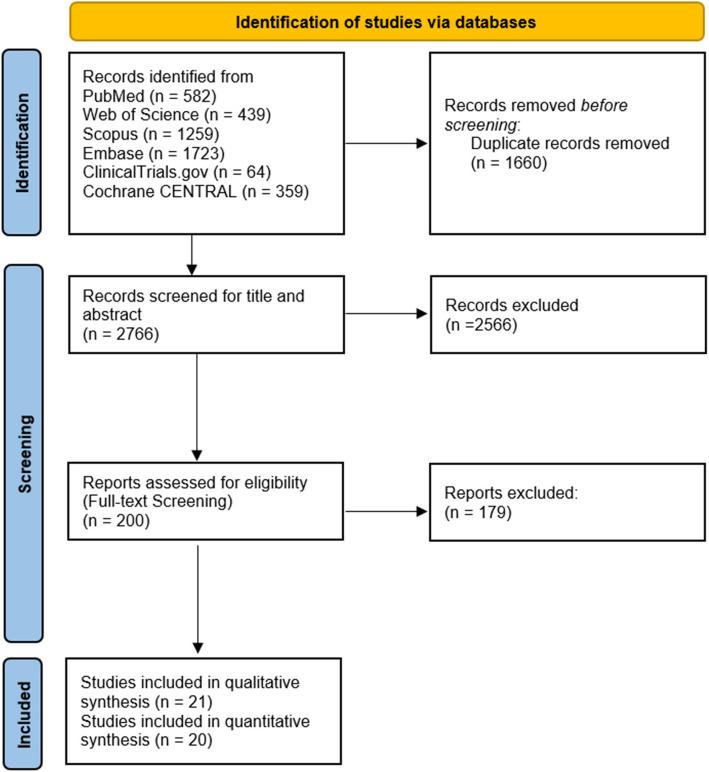
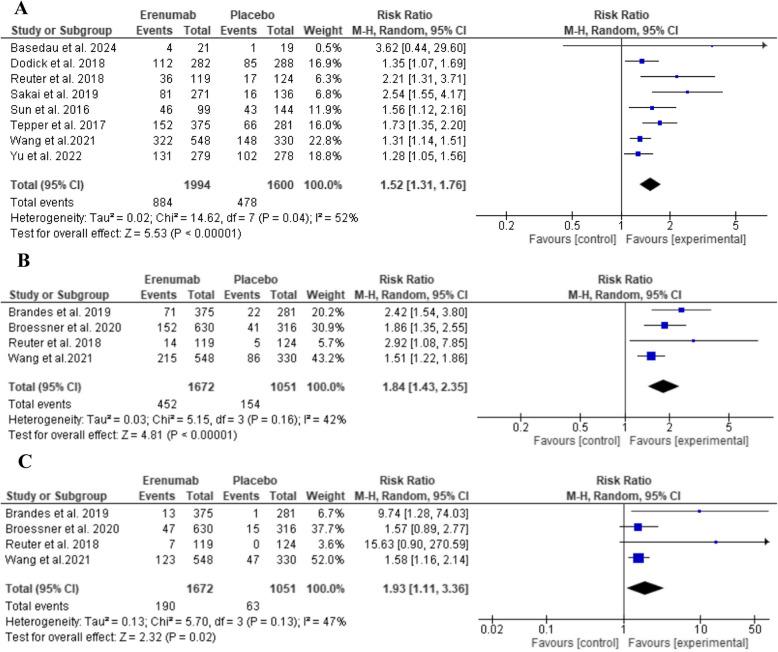
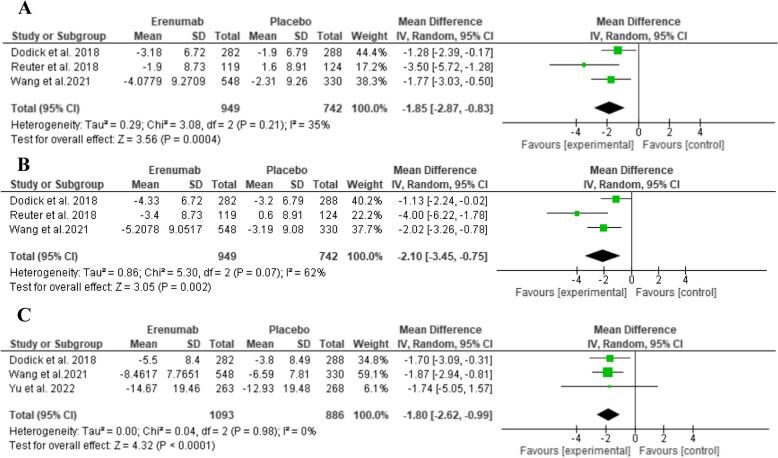
A total of 20 randomized controlled trials (n = 5212) were included in our analysis. At three months, Erenumab showed statistically significant improvements in monthly migraine days (MMD), monthly acute migraine-specific medication days (MSMD), Headache Impact Test (HIT-6) score, and ≥ 50% reduction from baseline in MMD (MD: -1.78, 95% CI: [-2.37 to -1.20], P < 0.00001), (MD: -1.36, 95% CI: [-1.92 to -0.81], P < 0.00001), (MD: -2.83, 95% CI: [-3.83 to -1.82], P < 0.00001), and (RR: 1.52, 95% CI: [1.31 to 1.76], P < 0.00001), respectively. Subgroup analysis revealed that Erenumab was significantly more effective in patients with prior preventive treatment failures compared to patients with no prior failure. No significant difference in Erenumab`s response existed between episodic and chronic migraine or between 140 and 70 mg, except for MSMD in dose subgrouping. Only constipation emerged as a significant adverse effect in the Erenumab group.
CONCLUSIONS
This meta-analysis found that Erenumab significantly reduced migraine attack frequency, medication days, and physical impairment. It was more effective for patients with prior treatment failures. The 140 mg dose showed better MSMD reduction than 70 mg. Erenumab's safety profile was similar to that of placebo, with only constipation noted as significant.
背景
偏头痛是一种高度流行且使人致残的疾病,影响着全球近14%的人口。预防性药物包括β-肾上腺素能阻滞剂、抗抑郁药和抗惊厥药等。然而,这些药物疗效欠佳,患者对其耐受性差且依从性低。艾美单抗是一种降钙素基因相关肽受体阻滞剂,最近在偏头痛治疗中显示出有前景的结果。在这项荟萃分析中,采用亚组分析方法研究了艾美单抗的疗效。
方法
我们对六个电子数据库进行了系统检索,直至2024年7月。使用Review Manager 5.4软件进行分析,对于连续性结果采用加权均数差(MD)和标准差(SD),对于二分性结果采用风险比(RR),置信区间(CI)为95%。P值<0.05表示具有统计学意义。该研究已在PROSPERO注册,注册号为CRD42024573300。此外,我们进行了亚组分析,并使用GRADE评估证据质量。
结果
我们的分析共纳入20项随机对照试验(n = 5212)。在三个月时,艾美单抗在每月偏头痛天数(MMD)、每月急性偏头痛特异性用药天数(MSMD)、头痛影响测试(HIT-6)评分以及MMD较基线降低≥50%方面显示出统计学上的显著改善,分别为(MD:-1.78,95%CI:[-2.37至-1.20],P<0.00001)、(MD:-1.36,95%CI:[-1.92至-0.81],P<0.00001)、(MD:-2.83,95%CI:[-3.83至-1.82],P<0.00001)和(RR:1.52,95%CI:[1.31至1.76],P<0.00001)。亚组分析显示,与既往无预防治疗失败的患者相比,艾美单抗在既往预防治疗失败的患者中显著更有效。发作性偏头痛和慢性偏头痛之间或140 mg与70 mg之间,除了剂量亚组分析中的MSMD外,艾美单抗的反应无显著差异。在艾美单抗组中,只有便秘是显著的不良反应。
结论
这项荟萃分析发现,艾美单抗显著降低了偏头痛发作频率、用药天数和身体损伤。它对既往治疗失败的患者更有效。140 mg剂量在降低MSMD方面比70 mg表现更好。艾美单抗的安全性与安慰剂相似,仅便秘被视为显著不良反应。


 Zotero 插件