
迁移小体,细胞间通讯的关键参与者。
Migrasomes, critical players in intercellular communication.
作者信息
Tan Zhiyong, Yang Chadanfeng, Fu Shi, Wu Junchao, Huang Yinglong, Li Haihao, Gong Chen, Lv Dihao, Wang Jiansong, Ding Mingxia, Wang Haifeng
机构信息
Department of Urology, Yunnan Institute of Urology, The Second Affiliated Hospital of Kunming Medical University, No. 347, Dianmian Street, Wuhua District, Kunming, Yunnan, 650101, People's Republic of China.
Urological Disease Clinical Medical Center of Yunnan Province, The Second Affiliated Hospital of Kunming Medical University, No. 347, Dianmian Street, Wuhua District, Kunming, Yunnan, 650101, People's Republic of China.
出版信息
Cancer Cell Int. 2025 Mar 25;25(1):113. doi: 10.1186/s12935-025-03754-6.
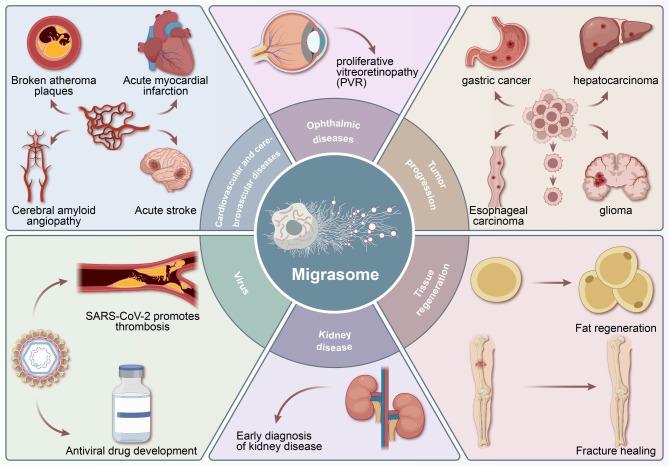
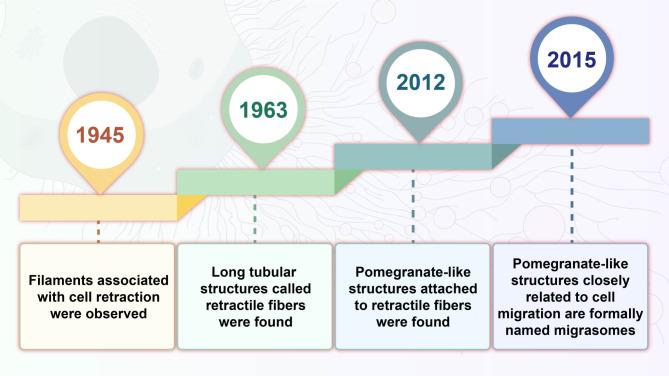
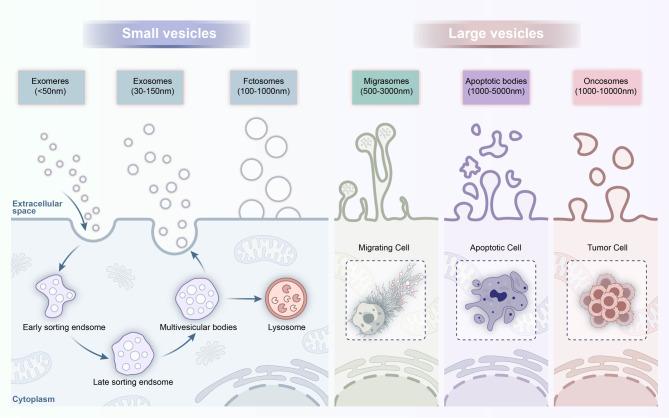
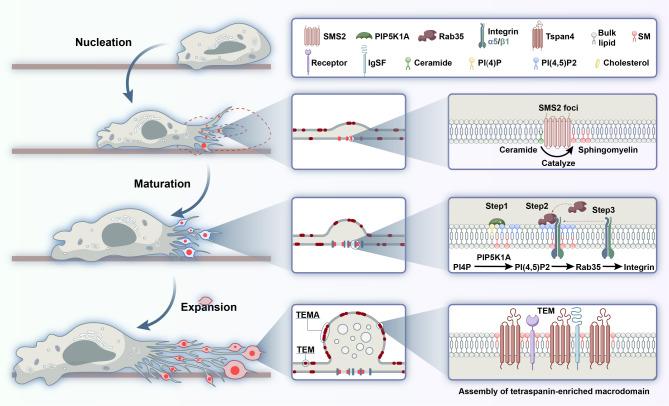
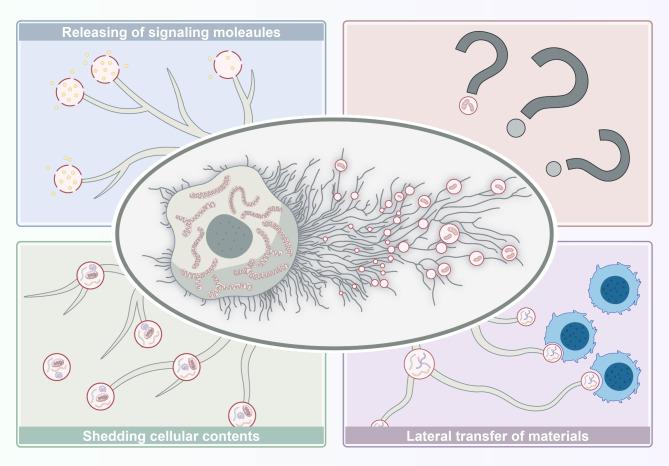
Migrasomes are a newly discovered type of extracellular vesicle (EV) formed during cell migration, playing a pivotal role in intercellular communication. These vesicles are generated by retracting fibers of migrating cells and encapsulate various molecules, such as proteins, lipids, and RNA, allowing the transfer of biochemical signals to neighboring cells. Current evidence suggests that migrasomes are involved in a wide range of physiological processes such as embryogenesis, angiogenesis, immune modulation, and mitochondrial quality control. Moreover, migrasomes are implicated in pathological conditions, including cancer metastasis, cardiovascular diseases, and viral infections. To fully understand their significance, it is critical to first explore the molecular mechanisms underlying their formation and function. Recent studies have shed light on the biogenesis, release, and biological properties of migrasomes, all of which are key to understanding their role in cell-to-cell communication. In this review, we provide an up-to-date summary of migrasome biogenesis, release, characterization, and their biological activities in intercellular communication, while also proposing potential new functions for these vesicles.
迁移小体是细胞迁移过程中新发现的一种细胞外囊泡(EV),在细胞间通讯中起关键作用。这些囊泡由迁移细胞的收缩纤维产生,并包裹各种分子,如蛋白质、脂质和RNA,从而实现生化信号向邻近细胞的传递。目前的证据表明,迁移小体参与了广泛的生理过程,如胚胎发生、血管生成、免疫调节和线粒体质量控制。此外,迁移小体还与病理状况有关,包括癌症转移、心血管疾病和病毒感染。为了充分理解它们的重要性,首先探索其形成和功能的分子机制至关重要。最近的研究揭示了迁移小体的生物发生、释放和生物学特性,所有这些都是理解它们在细胞间通讯中作用的关键。在这篇综述中,我们提供了迁移小体生物发生、释放、表征及其在细胞间通讯中的生物学活性的最新总结,同时也提出了这些囊泡潜在的新功能。
 Zotero 插件