
甲基乙二醛(MGO)或其衍生物的消耗可改善慢性不可预测温和应激(CUMS)诱导的神经炎症。
Depletion of MGO or Its Derivatives Ameliorate CUMS-Induced Neuroinflammation.
作者信息
Liu Bing, Dong Ke, Zhao Yun, Wang Xue, Sun Zhaowei, Xie Fang, Qian Lingjia
机构信息
Beijing Institute of Basic Medical Sciences, Academy of Military Medical Sciences, Beijing 100191, China.
School of Medicine, South China University of Technology, Guangzhou 511442, China.
出版信息
Cells. 2025 Mar 8;14(6):397. doi: 10.3390/cells14060397.
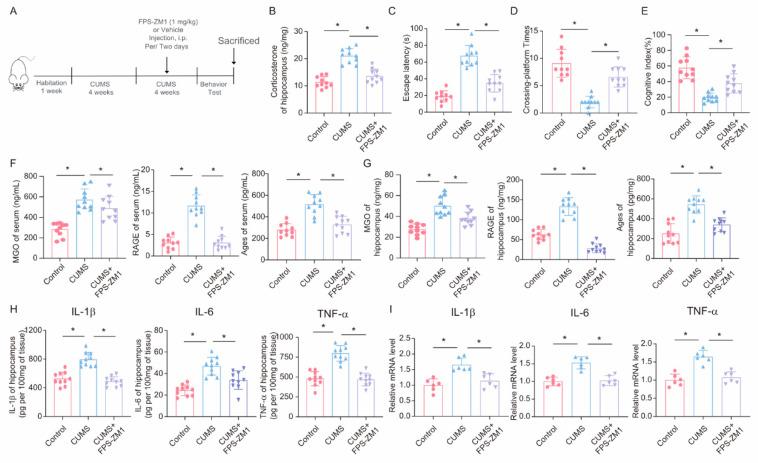
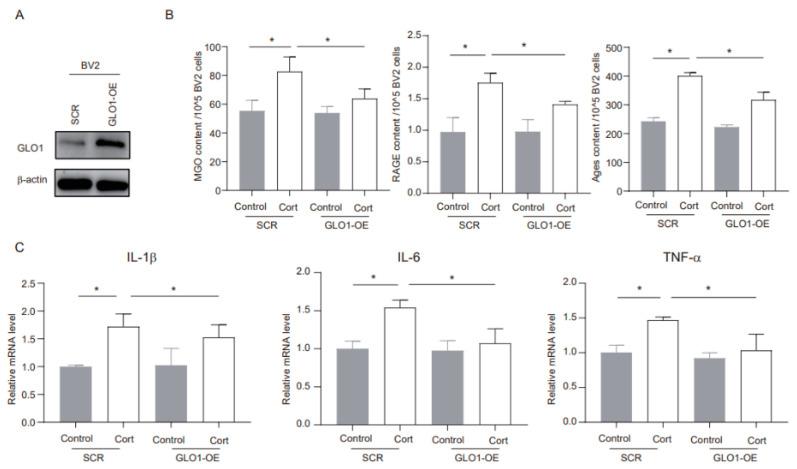
Advanced glycation end products (AGEs) are a series of structurally complex and harmful compounds formed through the reaction between the carbonyl group of reducing sugars (such as glucose and fructose) and the free amino groups of proteins, lipids, or nucleic acids. Excessive accumulation of AGEs in the body can trigger oxidative stress, induce inflammatory responses, and contribute to the development of diabetes, atherosclerosis, and neurological disorders. Within the category of dicarbonyl compounds, methylglyoxal (MGO)-a byproduct resulting from glucose degradation-serves as a pivotal precursor in the formation of AGEs and the induction of neurotoxicity. Specifically, AGEs generated from MGO display significant cytotoxicity toward cells in the central nervous system. Therefore, we aimed to investigate the role of MGO-AGEs in neuroinflammation mediated by CUMS. Interestingly, we found that the overexpression of glyoxalase 1 (GLO1) reduced the levels of MGO in corticosterone-treated microglia, thereby alleviating the inflammatory response. Furthermore, overexpression of GLO1 in the hippocampus of chronically stressed mice reduced MGO levels, mitigating CUMS-induced neuroinflammation and cognitive impairment. Additionally, when using the receptor for advanced glycation end products (RAGE) inhibitor FPS-ZM1 in primary microglia cells, we observed that despite corticosterone-induced elevation of MGO, no significant inflammatory response occurred. This suggests that RAGE clearance can reduce MGO-AGE-mediated neurotoxicity. Subsequently, we used FPS-ZM1 to treat chronically stressed mice and found that it significantly ameliorated neuroinflammation and cognitive dysfunction. These results suggest that targeting MGO metabolism could serve as a therapeutic approach to manage neuroinflammation in stress-related mental disorders.
晚期糖基化终末产物(AGEs)是一系列结构复杂且有害的化合物,由还原糖(如葡萄糖和果糖)的羰基与蛋白质、脂质或核酸的游离氨基之间的反应形成。AGEs在体内的过度积累会引发氧化应激,诱导炎症反应,并促进糖尿病、动脉粥样硬化和神经疾病的发展。在二羰基化合物类别中,甲基乙二醛(MGO)——葡萄糖降解的副产物——是AGEs形成和神经毒性诱导的关键前体。具体而言,由MGO产生的AGEs对中枢神经系统中的细胞表现出显著的细胞毒性。因此,我们旨在研究MGO-AGEs在慢性不可预测温和应激(CUMS)介导的神经炎症中的作用。有趣的是,我们发现乙二醛酶1(GLO1)的过表达降低了皮质酮处理的小胶质细胞中MGO的水平,从而减轻了炎症反应。此外,在慢性应激小鼠的海马中过表达GLO1降低了MGO水平,减轻了CUMS诱导的神经炎症和认知障碍。此外,在原代小胶质细胞中使用晚期糖基化终末产物受体(RAGE)抑制剂FPS-ZM1时,我们观察到尽管皮质酮诱导MGO升高,但未发生明显的炎症反应。这表明RAGE清除可以降低MGO-AGE介导的神经毒性。随后,我们使用FPS-ZM1治疗慢性应激小鼠,发现它显著改善了神经炎症和认知功能障碍。这些结果表明,针对MGO代谢可能是一种治疗与应激相关精神障碍中神经炎症的方法。




 Zotero 插件