
源自海参的岩藻糖基化糖胺聚糖寡糖HS14是血小板Toll样受体2的新型抑制剂。
Fucosylated Glycosaminoglycan Oligosaccharide HS14, Derived from Sea Cucumbers, Is a Novel Inhibitor of Platelet Toll-like Receptor 2.
作者信息
Sun Huifang, Zhu Guangyu, Li Sujuan, Li Pengfei, Zhang Jiali, Yin Ronghua, Yuan Lin, Gao Na, Zhao Jinhua
机构信息
School of Chemistry and Materials Science, South-Central Minzu University, Wuhan 430074, China.
College of Life Sciences, South-Central Minzu University, Wuhan 430074, China.
出版信息
Mar Drugs. 2025 Mar 4;23(3):110. doi: 10.3390/md23030110.
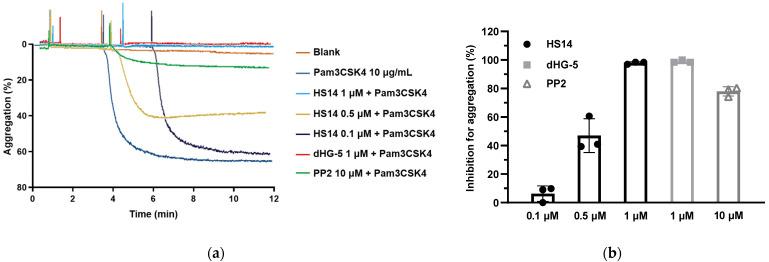
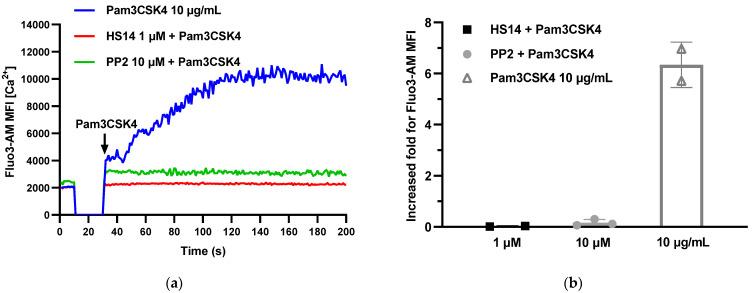
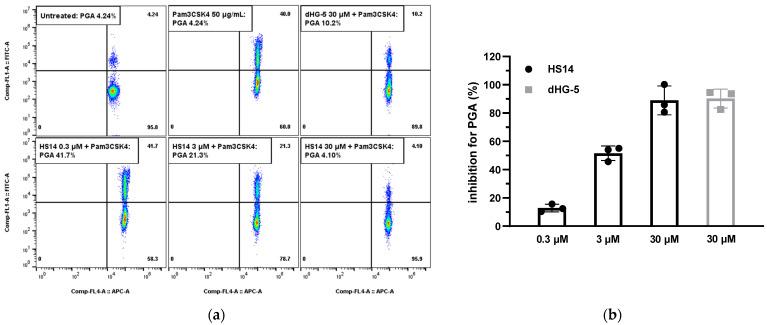
(1) Background: Toll-like receptor 2 (TLR2) on platelets is increasingly recognized as a pivotal mediator in infection-induced platelet activation and aggregation, contributing to both inflammatory and thrombotic diseases. Targeting TLR2 on platelets offers a promising therapeutic strategy for inflammatory and thrombotic-related disorders. However, inhibitors targeting platelet TLR2 have not yet been reported. (2) Methods: Platelet aggregation was assessed using a light transmission aggregometer. Platelet activation was evaluated by measuring the release of P-selectin and von Willebrand factor (vWF) via ELISA. Intracellular Ca mobilization was quantified using Fluo 3-AM fluorescence, recorded by flow cytometry. Static platelet adhesion was visualized under a microscope, and the formation of platelet-granulocyte aggregates in human whole blood was analyzed by flow cytometry. (3) Results: Fucosylated glycosaminoglycan (FG) tetradecasaccharide HS14 inhibited the activation and aggregation of human platelets induced by the synthetic bacterial lipopeptide Pam3CSK4 in a concentration-dependent manner. This inhibitory effect gives rise to significant anti-inflammatory and anti-thrombotic activities, as evidenced by reduced platelet adhesion and decreased platelet-granulocyte aggregates formation in human whole blood. (4) Conclusions: This study is the first to identify FG oligosaccharide HS14 as a promising inhibitor of platelet TLR2/TLR1, demonstrating significant therapeutic potential for inflammatory and thrombotic-related diseases.
(1)背景:血小板上的Toll样受体2(TLR2)日益被认为是感染诱导的血小板活化和聚集的关键介质,在炎症和血栓形成性疾病中均起作用。靶向血小板上的TLR2为炎症和血栓形成相关疾病提供了一种有前景的治疗策略。然而,尚未有针对血小板TLR2的抑制剂的报道。(2)方法:使用透光率聚集仪评估血小板聚集。通过酶联免疫吸附测定法(ELISA)测量P-选择素和血管性血友病因子(vWF)的释放来评估血小板活化。使用Fluo 3-AM荧光定量细胞内钙动员,通过流式细胞术记录。在显微镜下观察静态血小板黏附,并通过流式细胞术分析人全血中血小板-粒细胞聚集体的形成。(3)结果:岩藻糖基化糖胺聚糖(FG)十四糖HS14以浓度依赖性方式抑制合成细菌脂肽Pam3CSK4诱导的人血小板活化和聚集。这种抑制作用产生了显著的抗炎和抗血栓活性,人全血中血小板黏附减少和血小板-粒细胞聚集体形成减少证明了这一点。(4)结论:本研究首次确定FG寡糖HS14是一种有前景的血小板TLR2/TLR1抑制剂,对炎症和血栓形成相关疾病具有显著的治疗潜力。




 Zotero 插件