
高速原子力显微镜揭示的鱼精蛋白-DNA凝聚的时空动力学
Spatiotemporal dynamics of protamine-DNA condensation revealed by high-speed atomic force microscopy.
作者信息
Nishide Goro, Lim Keesiang, Kobayashi Akiko, Qiu Yujia, Hazawa Masaharu, Ando Toshio, Okada Yuki, Wong Richard W
机构信息
Division of Nano Life Science in the Graduate School of Frontier Science Initiative, WISE Program for Nano-Precision Medicine, Science and Technology, Kanazawa University, Kanazawa, Ishikawa 920-1192, Japan.
WPI-Nano Life Science Institute, Kanazawa University, Kakuma-machi, Kanazawa, Ishikawa 920-1192, Japan.
出版信息
Nucleic Acids Res. 2025 Mar 20;53(6). doi: 10.1093/nar/gkaf152.
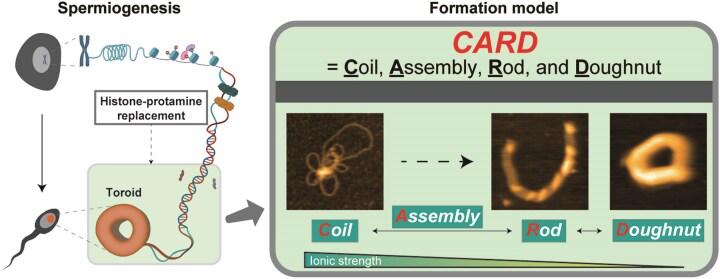
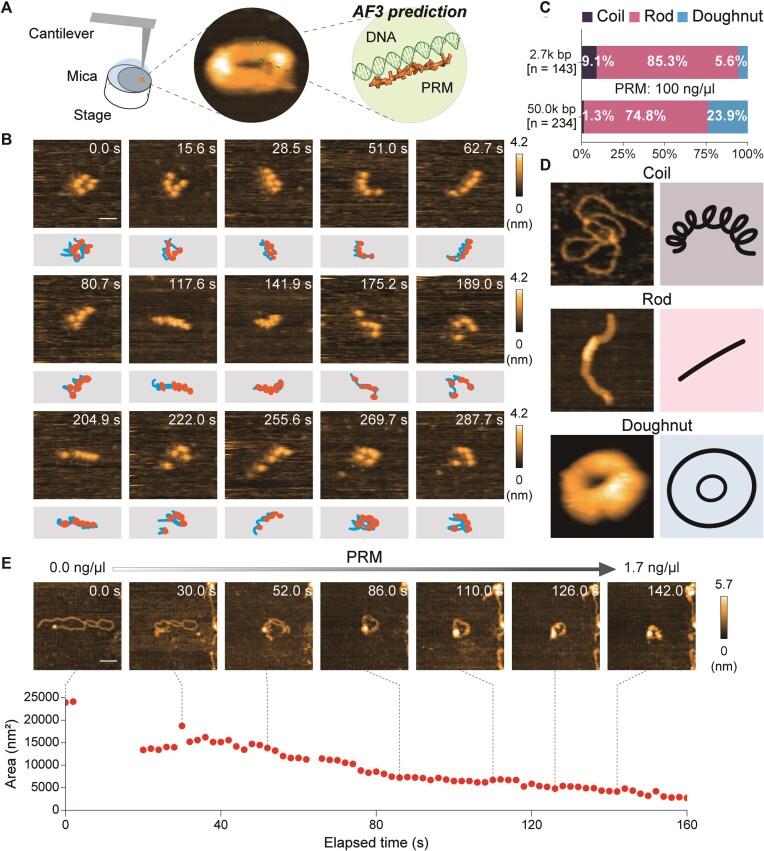
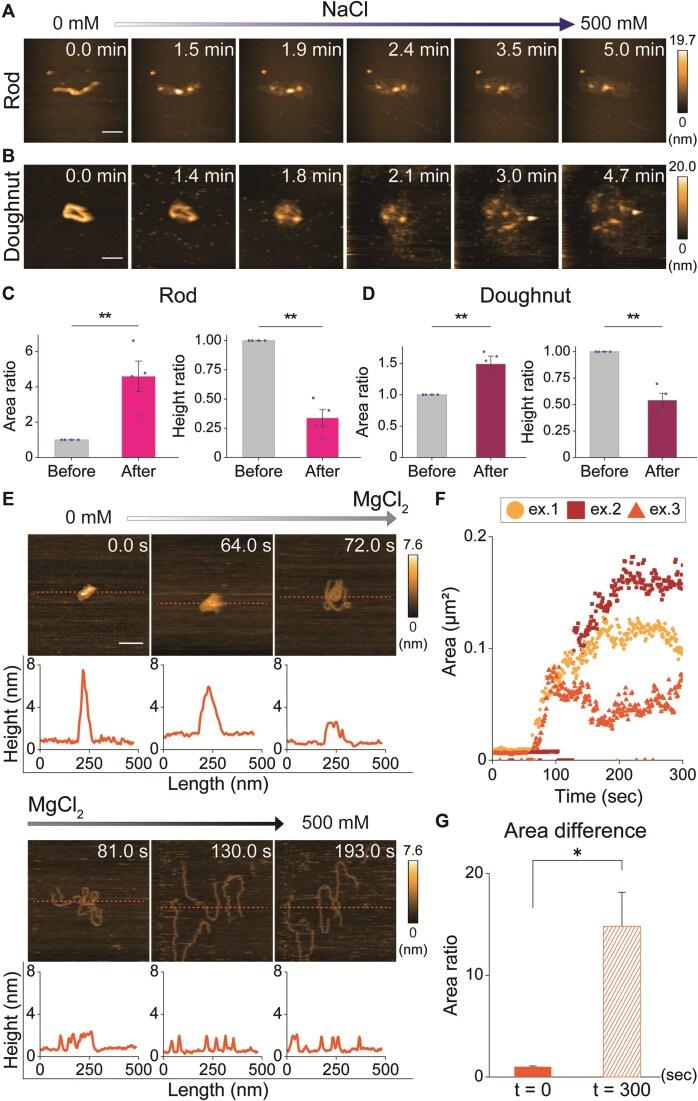
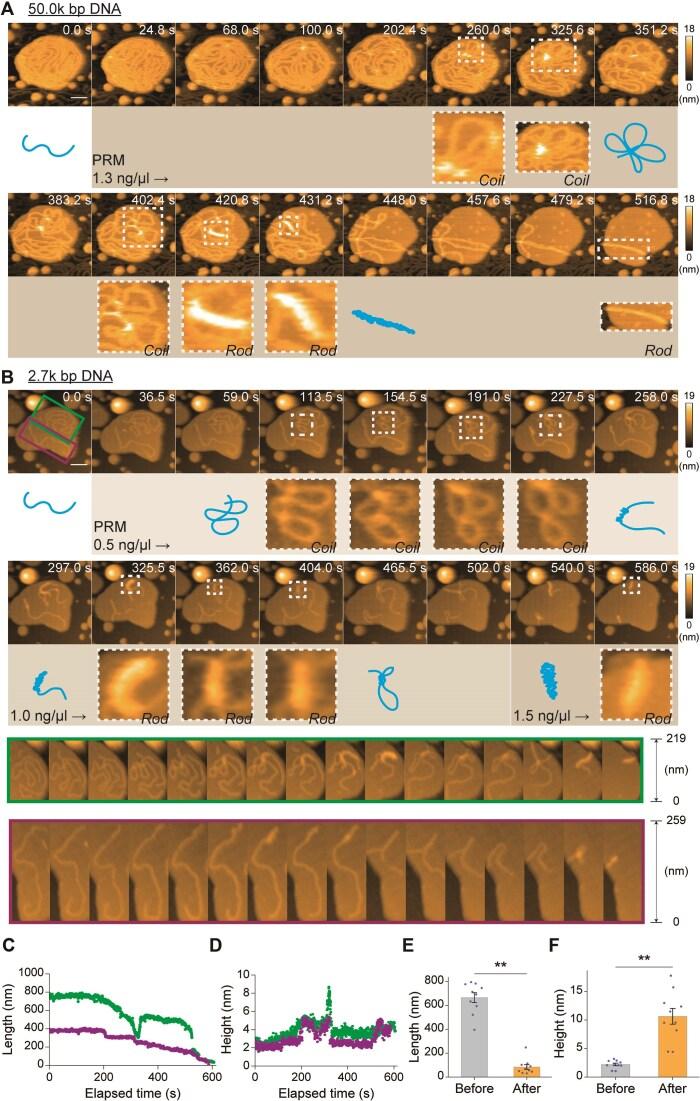
Protamines (PRMs) play a crucial role in sperm chromatin condensation, replacing histones to form nucleo-PRM structures, specifically PRM-DNA complexes. Despite their importance in reproduction, the detailed mechanisms underlying PRM-mediated DNA condensation have remained elusive. In this study, we employed high-speed atomic force microscopy (HS-AFM) to directly visualize the real-time binding dynamics of PRM to DNA under physiological conditions. Our HS-AFM observations reveal that PRM insertion initiating the formation of DNA coils. Further, we observed a heterogeneous spatial distribution of PRM-induced DNA looping. With continuous PRM addition, DNA progresses through a series of folding transitions, forming coiled-like structures that evolve into clockwise spirals, rod-shaped intermediates, and ultimately toroid-like nanostructures. Based on these real-time observations, we propose the CARD (Coil-Assembly-Rod-Doughnut) model to describe the stepwise process of toroid formation during DNA condensation. Our findings underscore the versatility of HS-AFM in capturing the spatiotemporal dynamics of PRM-DNA interactions and provide critical insights into the molecular mechanisms driving PRM-induced chromatin compaction. This study advances our understanding of sperm chromatin architecture and offers a framework for future research into chromatin organization, reproductive biology, and nucleic acid therapeutics.
鱼精蛋白(PRMs)在精子染色质凝聚过程中发挥着关键作用,它们取代组蛋白形成核鱼精蛋白结构,特别是鱼精蛋白 - DNA复合物。尽管它们在生殖过程中很重要,但鱼精蛋白介导的DNA凝聚的详细机制仍然不清楚。在这项研究中,我们采用高速原子力显微镜(HS - AFM)在生理条件下直接观察鱼精蛋白与DNA的实时结合动态。我们的HS - AFM观察结果表明,鱼精蛋白插入引发了DNA螺旋的形成。此外,我们观察到鱼精蛋白诱导的DNA环化存在异质空间分布。随着鱼精蛋白的持续添加,DNA经历一系列折叠转变,形成盘绕状结构,进而演变成顺时针螺旋、杆状中间体,最终形成环形纳米结构。基于这些实时观察结果,我们提出了CARD(螺旋 - 组装 - 杆 - 圆环)模型来描述DNA凝聚过程中环形形成的逐步过程。我们的研究结果强调了HS - AFM在捕捉鱼精蛋白 - DNA相互作用的时空动态方面的多功能性,并为驱动鱼精蛋白诱导的染色质压实的分子机制提供了关键见解。这项研究推进了我们对精子染色质结构的理解,并为未来关于染色质组织、生殖生物学和核酸治疗学的研究提供了一个框架。

 Zotero 插件