
抗CD47抗体玛格罗利单抗联合西妥昔单抗用于结直肠癌和其他实体瘤患者的1b/2期研究。
A Phase 1b/2 Study of the Anti-CD47 Antibody Magrolimab with Cetuximab in Patients with Colorectal Cancer and Other Solid Tumors.
作者信息
Eng Cathy, Lakhani Nehal J, Philip Philip A, Schneider Charles, Johnson Benny, Kardosh Adel, Chao Mark P, Patnaik Amita, Shihadeh Fadi, Lee Yeonju, Song Kai, Jin Denise, Huo Yanan, Howland Michael, Fisher George A, Hecht J Randolph
机构信息
Division of Hematology/Oncology, Department of Internal Medicine, Vanderbilt University Medical Center, Nashville, TN, USA.
The START Center for Cancer Research, Grand Rapids, MI, USA.
出版信息
Target Oncol. 2025 May;20(3):519-530. doi: 10.1007/s11523-025-01130-y. Epub 2025 Mar 26.
BACKGROUND
Chemotherapy plus epidermal growth factor receptor (EGFR) inhibitors, such as cetuximab, is standard therapy for KRAS wild-type (KRASwt) colorectal cancer (CRC); however, responses are infrequent. Magrolimab is a monoclonal antibody targeting CD47, an antiphagocytic signal overexpressed in solid tumors (STs).
OBJECTIVE
This open-label, multicenter phase 1b/2 study (NCT02953782) aimed to determine the recommended phase 2 dose (RP2D) and evaluate the safety, tolerability, and efficacy of magrolimab + cetuximab in patients with advanced CRC or other STs.
PATIENTS AND METHODS
A total of 78 patients were enrolled at eight study sites in the USA. In phase 1b, patients with advanced STs received weekly maintenance doses of magrolimab at 10-45 mg/kg and cetuximab at 200-250 mg/m following 3 + 3 dose-escalation. In phase 2, patients with anti-EGFR-refractory CRC received magrolimab + cetuximab at RP2Ds. Primary endpoints were dose-limiting toxicities, adverse events, and objective response rate (ORR; phase 2).
RESULTS
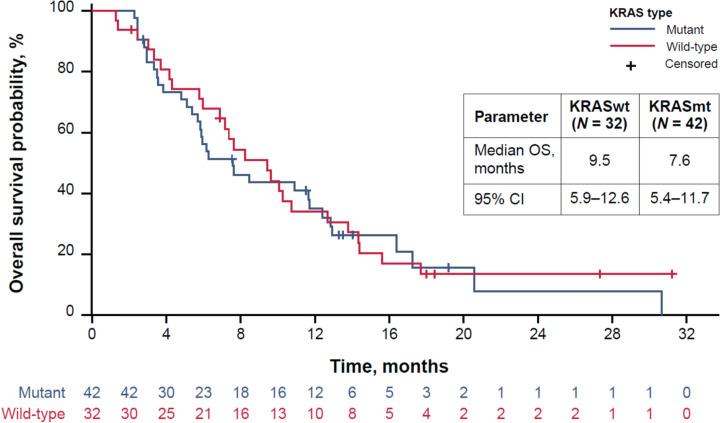
The maximum tolerated dose was not reached in phase 1b. Two RP2Ds were explored in phase 2: magrolimab at 30 or 45 mg/kg plus cetuximab at 250 mg/m. Most common treatment-related adverse events (TRAEs) were dermatitis acneiform (35.9%), infusion-related reactions (33.3%), dry skin (32.1%), fatigue (32.1%), and headache (29.5%). Most common grade ≥ 3 TRAEs were anemia (11.5%), increased blood bilirubin (9.0%), and decreased lymphocyte count (9.0%). Discontinuation of any study treatment owing to TRAEs occurred in 3.8% of patients. No deaths occurred due to TRAEs. In phase 2, ORR was 6.3% and 0% in the KRASwt and KRASmt CRC cohorts, respectively; disease control rate was 50.0% and 38.1%, and median overall survival was 9.5 and 7.6 months, respectively.
CONCLUSIONS
These results indicate tolerability and potential antitumor activity when combining anti-CD47 therapy and cetuximab in heavily pretreated patients with CRC.
背景
化疗联合表皮生长因子受体(EGFR)抑制剂,如西妥昔单抗,是KRAS野生型(KRASwt)结直肠癌(CRC)的标准治疗方法;然而,缓解情况并不常见。玛格罗利单抗是一种靶向CD47的单克隆抗体,CD47是一种在实体瘤(STs)中过表达的抗吞噬信号。
目的
这项开放标签、多中心1b/2期研究(NCT02953782)旨在确定推荐的2期剂量(RP2D),并评估玛格罗利单抗+西妥昔单抗在晚期CRC或其他STs患者中的安全性、耐受性和疗效。
患者和方法
在美国的8个研究地点共招募了78名患者。在1b期,晚期STs患者在3+3剂量递增后,接受每周一次的玛格罗利单抗维持剂量10-45mg/kg和西妥昔单抗200-250mg/m²。在2期,抗EGFR难治性CRC患者接受RP2D剂量的玛格罗利单抗+西妥昔单抗治疗。主要终点为剂量限制性毒性、不良事件和客观缓解率(ORR;2期)。
结果
1b期未达到最大耐受剂量。在2期探索了两个RP2D:玛格罗利单抗30或45mg/kg加西妥昔单抗250mg/m²。最常见的治疗相关不良事件(TRAEs)为痤疮样皮炎(35.9%)、输液相关反应(33.3%)、皮肤干燥(32.1%)、疲劳(32.1%)和头痛(29.5%)。最常见的≥3级TRAEs为贫血(11.5%)血胆红素升高(9.0%)和淋巴细胞计数降低(9.0%)。3.8%的患者因TRAEs而停用任何研究治疗。未发生因TRAEs导致的死亡。在2期,KRASwt和KRASmt CRC队列的ORR分别为6.3%和0%;疾病控制率分别为50.0%和38.1%,中位总生存期分别为9.5和7.6个月。
结论
这些结果表明,在经过大量预处理的CRC患者中,抗CD47疗法与西妥昔单抗联合使用具有耐受性和潜在的抗肿瘤活性。

 Zotero 插件