
循环代谢生物标志物与肺癌风险的关联:一项基于人群的前瞻性队列研究。
Association of circulating metabolic biomarkers with risk of lung cancer: a population-based prospective cohort study.
作者信息
Wu Lan, Yang Jun, Chen Yu, Lin Jiahao, Huang Wenkai, Li Mengmeng
机构信息
Department of Cancer Prevention, State Key Laboratory of Oncology in South China, Guangdong Provincial Clinical Research Center for Cancer, Sun Yat-Sen University Cancer Center, Guangzhou, China.
School of Public Health, Guangzhou Medical University, Guangzhou, China.
出版信息
BMC Med. 2025 Mar 26;23(1):176. doi: 10.1186/s12916-025-03993-4.
BACKGROUND
There is emerging evidence that metabolites might be associated with risk of lung cancer, but their relationships have not been fully characterized. We aimed to investigate the association between circulating metabolic biomarkers and lung cancer risk and the potential underlying pathways.
METHODS
Nuclear magnetic resonance metabolomic profiling was conducted on baseline plasma samples from 91,472 UK Biobank participants without cancer and pregnancy. Multivariate Cox regression models were employed to assess the hazard ratios (HRs) of 164 metabolic biomarkers (including metabolites and lipoprotein subfractions) and 9 metabolic biomarker principal components (PCs) for lung cancer, after adjusting for covariates and false discovery rate (FDR). Pathway analysis was conducted to investigate the potential metabolic pathways.
RESULTS
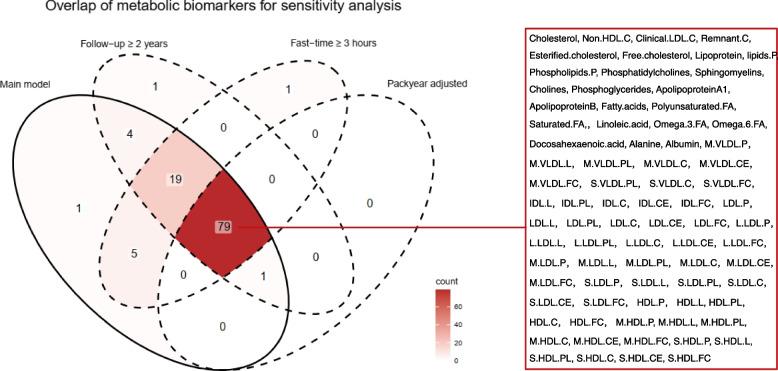
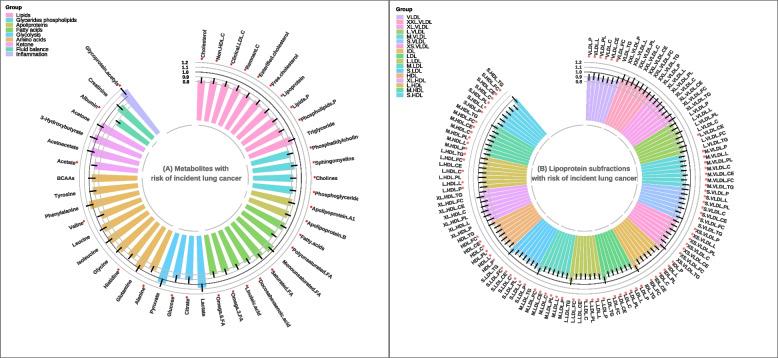
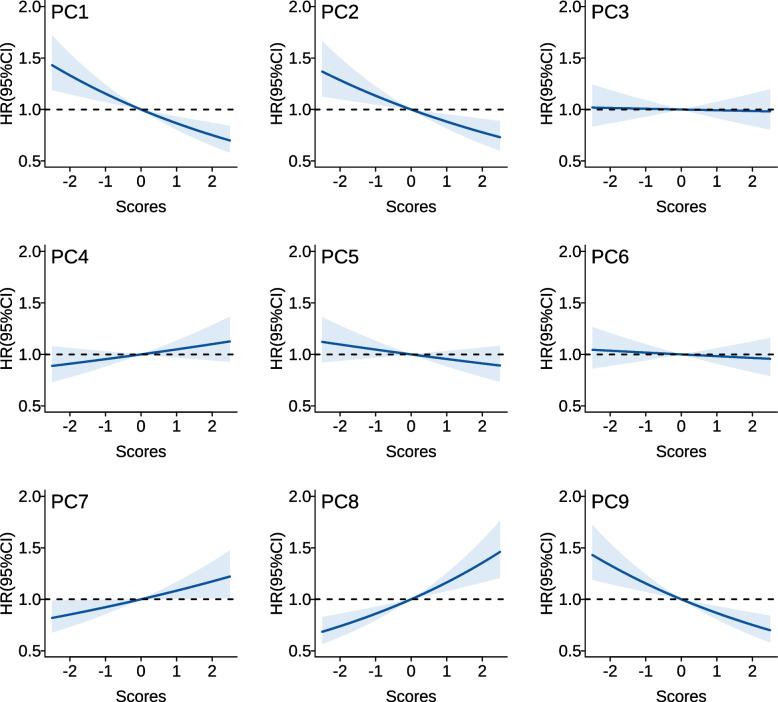
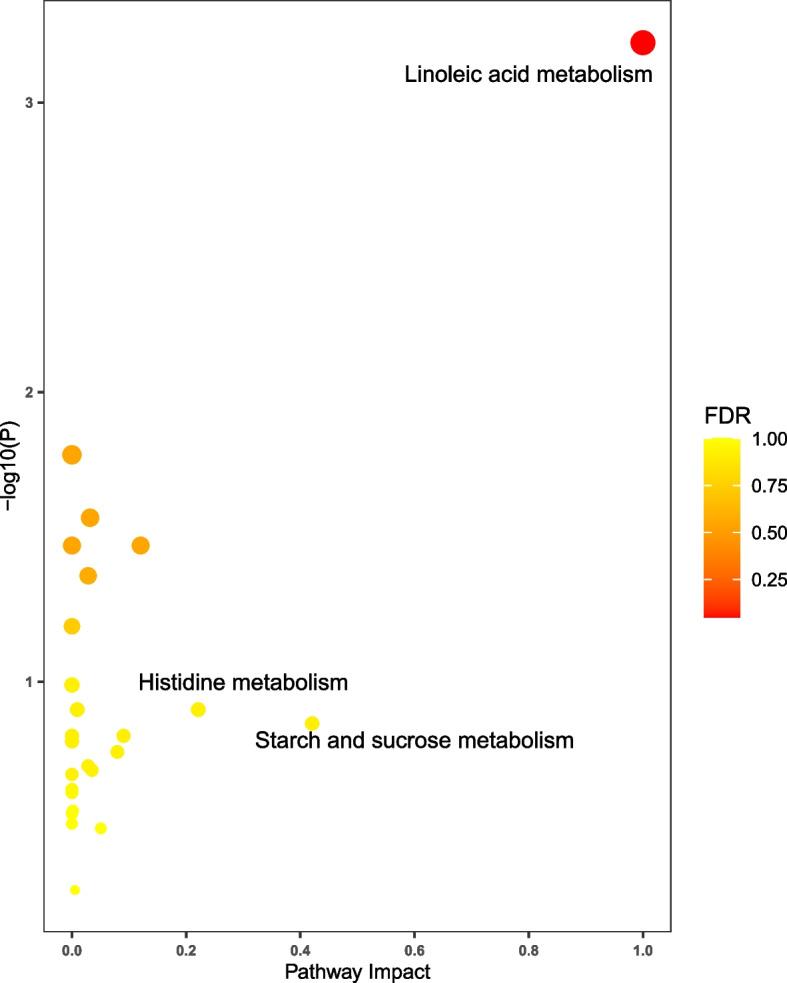
During a median follow-up of 11.0 years, 702 participants developed lung cancer. A total of 109 metabolic biomarkers (30 metabolites and 79 lipoprotein subfractions) were associated with the risk of lung cancer. Glycoprotein acetyls demonstrated a positive association with lung cancer risk [HR = 1.13 (95%CI: 1.04, 1.22)]. Negative associations with lung cancer were found for albumin [0.78 (95%CI: 0.72, 0.83)], acetate [0.91 (95%CI: 0.85, 0.97)], valine [0.90 (95%CI: 0.83, 0.98)], alanine [0.88 (95%CI: 0.82, 0.95)], glucose [0.91 (95%CI: 0.85, 0.99)], citrate [0.91 (95%CI: 0.85, 0.99)], omega-3 fatty acids [0.83 (95%CI: 0.77, 0.90)], linoleic acid [0.83 (95%CI: 0.77, 0.89)], etc. Nine PCs represented over 90% of the total variances, and among those with statistically significant estimates, PC1 [0.85 (95%CI: 0.80, 0.92)], PC2 [0.88 (95%CI: 0.82, 0.95)], and PC9 [0.87 (95%CI: 0.80, 0.93)] were negatively associated with lung cancer risk, whereas PC7 [1.08 (95%CI: 1.00, 1.16)] and PC8 [1.16 (95%CI: 1.08, 1.26)] showed positive associations with lung cancer risk. The pathway analysis showed that the "linoleic acid metabolism" was statistically significant after the FDR adjustment (p value 0.0496).
CONCLUSIONS
Glycoprotein acetyls had a positive association with lung cancer risk while other metabolites and lipoprotein subfractions showed negative associations. Certain metabolites and lipoprotein subfractions might be independent risk factors for lung cancer. Our findings shed new light on the etiology of lung cancer and might aid the selection of high-risk individuals for lung cancer screening.
背景
越来越多的证据表明,代谢物可能与肺癌风险相关,但其关系尚未完全明确。我们旨在研究循环代谢生物标志物与肺癌风险之间的关联以及潜在的相关途径。
方法
对来自英国生物银行的91472名无癌症及妊娠的参与者的基线血浆样本进行核磁共振代谢组学分析。采用多变量Cox回归模型评估164种代谢生物标志物(包括代谢物和脂蛋白亚组分)和9种代谢生物标志物主成分(PCs)对肺癌的风险比(HRs),并对协变量和错误发现率(FDR)进行校正。进行通路分析以研究潜在的代谢途径。
结果
在中位随访11.0年期间,702名参与者患肺癌。共有109种代谢生物标志物(30种代谢物和79种脂蛋白亚组分)与肺癌风险相关。糖蛋白乙酰化物与肺癌风险呈正相关[HR = 1.13(95%CI:1.04,1.22)]。白蛋白[0.78(95%CI:0.72,0.83)]、乙酸盐[0.91(95%CI:0.85,0.97)]、缬氨酸[0.90(95%CI:0.83,0.98)]、丙氨酸[0.88(95%CI:0.82,0.95)]、葡萄糖[0.91(95%CI:0.85,0.99)]、柠檬酸盐[0.91(95%CI:0.85,0.99)]、ω-3脂肪酸[0.83(95%CI:0.77,0.90)]、亚油酸[0.83(95%CI:0.77,0.89)]等与肺癌呈负相关。9个PCs代表了总方差的90%以上,在具有统计学显著估计值的PCs中,PC1[0.85(95%CI:0.80,0.92)]、PC2[0.88(95%CI:0.82,0.95)]和PC9[0.87(95%CI:0.80,0.93)]与肺癌风险呈负相关,而PC7[1.08(95%CI:1.00,1.16)]和PC8[1.16(95%CI:1.08,1.26)]与肺癌风险呈正相关。通路分析显示,经FDR校正后,“亚油酸代谢”具有统计学意义(p值0.0496)。
结论
糖蛋白乙酰化物与肺癌风险呈正相关,而其他代谢物和脂蛋白亚组分呈负相关。某些代谢物和脂蛋白亚组分可能是肺癌的独立危险因素。我们的研究结果为肺癌病因学提供了新的线索,可能有助于选择肺癌筛查的高危个体。

 Zotero 插件