
肝硬化合并脓毒症重症患者凝血功能障碍评分与生存的关系:一项回顾性研究
Relationship between coagulopathy score and survival in critically ill patients with liver cirrhosis and sepsis: a retrospective study.
作者信息
Wang Tao, Wang Decai, Shi Ruizi, Zeng Xintao, Yang Pei, Chen Xi, Chen Sirui, Qin Chuan, Wan Chidan, Wang Jianjun
机构信息
Department of Hepatobiliary Surgery, Union Hospital, Tongji Medical College, Huazhong University of Science and Technology, Wuhan, 430022, China.
Department of Urology, School of Medicine, Mianyang Central Hospital, University of Electronic Science and Technology of China, Mianyang, 621000, China.
出版信息
BMC Infect Dis. 2025 Mar 26;25(1):418. doi: 10.1186/s12879-025-10848-z.
BACKGROUND
This research focused on exploring the association between coagulopathy scores and the survival outcomes, both short-term and long-term, in individuals diagnosed with liver cirrhosis complicated by sepsis.
METHODS
This study retrospectively analyzed data from individuals with liver cirrhosis and sepsis who were admitted to the intensive care unit (ICU) at Beth Israel Deaconess Medical Center between 2008 and 2022. The main outcome of interest was all-cause mortality within 28 days post-admission, while the secondary outcome assessed mortality within 90 days. We used the Kaplan-Meier analysis to compare the mortality risk among the different groups. To evaluate the relationship between coagulopathy score and mortality risk in patients with liver cirrhosis and sepsis, a multivariate Cox proportional hazards regression analysis was performed. The predictive performance of the coagulopathy score for short- and long-term all-cause mortality was assessed using receiver operating characteristic (ROC) curve analysis, which included evaluation of its sensitivity, specificity, and area under the curve. Subgroup analyses were performed to evaluate the relationship between coagulopathy score and survival across different groups.
RESULTS
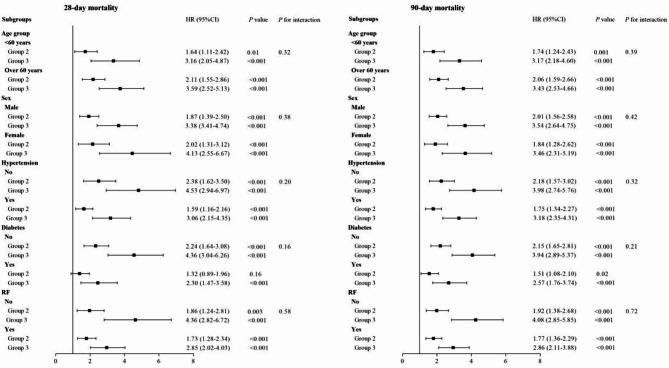
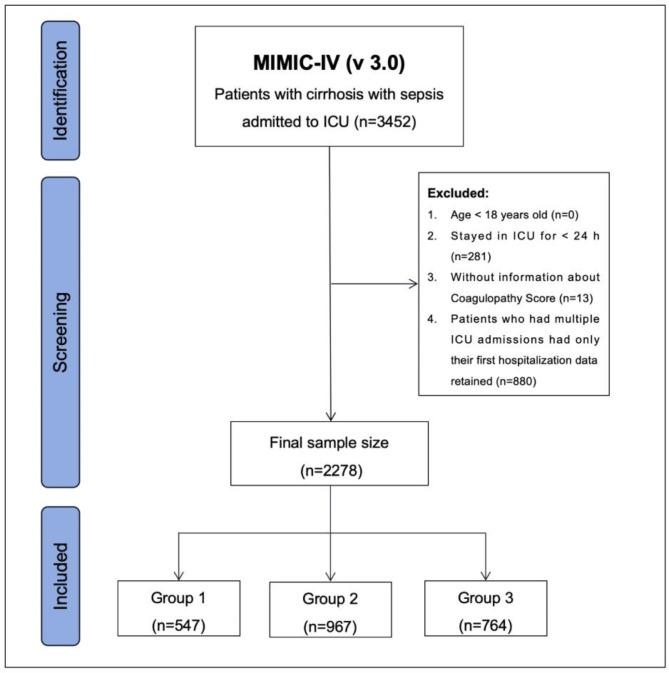
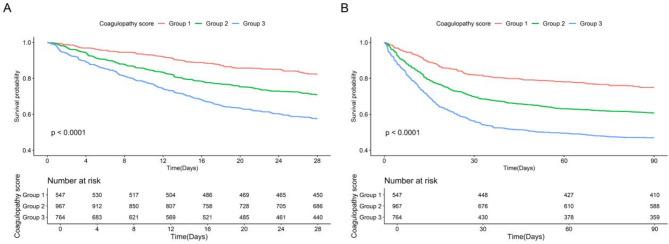
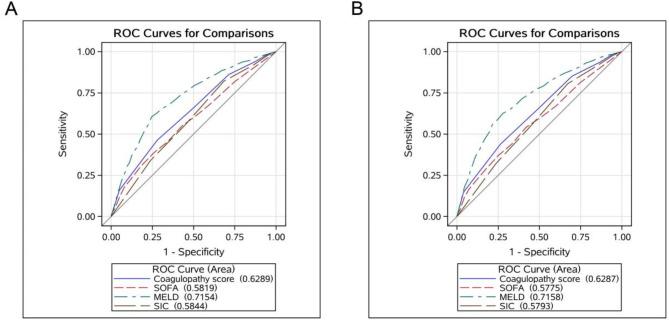
The study included a total of 2,278 patients. Kaplan-Meier survival analysis demonstrated that individuals with elevated coagulopathy scores exhibited markedly higher rates of ICU mortality, in-hospital mortality, as well as 28-day and 90-day mortality, with all log-rank tests yielding P-values of less than 0.001. The results of the multivariate Cox regression analysis showed that an elevated coagulopathy score was independently linked to higher 28-day and 90-day all-cause mortality, both before and after controlling for potential confounders. ROC curve analysis showed that although the coagulopathy score was slightly less predictive of prognosis than the Model for End-stage Liver Disease score, it significantly outperformed the Sequential Organ Failure Assessment score and the Sepsis-induced Coagulopathy score. Subgroup analysis revealed no significant interaction between the coagulopathy score and survival across the different subgroups.
CONCLUSIONS
Higher coagulopathy scores in critically ill patients with liver cirrhosis and sepsis were independently associated with poor prognosis. Due to its simplicity and potential predictive value, the coagulopathy score can serve as an effective complement to existing clinical tools for managing critically ill patients with liver cirrhosis and sepsis.
背景
本研究聚焦于探讨凝血功能障碍评分与肝硬化合并脓毒症患者短期和长期生存结局之间的关联。
方法
本研究回顾性分析了2008年至2022年间在贝斯以色列女执事医疗中心重症监护病房(ICU)收治的肝硬化合并脓毒症患者的数据。主要关注的结局是入院后28天内的全因死亡率,次要结局评估的是90天内的死亡率。我们使用Kaplan-Meier分析来比较不同组之间的死亡风险。为了评估凝血功能障碍评分与肝硬化合并脓毒症患者死亡风险之间的关系,进行了多变量Cox比例风险回归分析。使用受试者工作特征(ROC)曲线分析评估凝血功能障碍评分对短期和长期全因死亡率的预测性能,包括评估其敏感性、特异性和曲线下面积。进行亚组分析以评估凝血功能障碍评分与不同组生存之间的关系。
结果
该研究共纳入2278例患者。Kaplan-Meier生存分析表明,凝血功能障碍评分升高的个体在ICU死亡率、住院死亡率以及28天和90天死亡率方面均显著更高,所有对数秩检验的P值均小于0.001。多变量Cox回归分析结果显示,在控制潜在混杂因素前后,凝血功能障碍评分升高均与较高的28天和90天全因死亡率独立相关。ROC曲线分析表明,尽管凝血功能障碍评分对预后的预测性略低于终末期肝病模型评分,但明显优于序贯器官衰竭评估评分和脓毒症诱导的凝血功能障碍评分。亚组分析显示,凝血功能障碍评分与不同亚组的生存之间无显著交互作用。
结论
肝硬化合并脓毒症的重症患者凝血功能障碍评分较高与预后不良独立相关。由于其简单性和潜在的预测价值,凝血功能障碍评分可作为管理肝硬化合并脓毒症重症患者现有临床工具的有效补充。
 Zotero 插件