
不同患者群体中健康的社会决定因素、累积性生理应激负荷与蒽环类药物心脏毒性之间的关联
Associations Between Social Determinants of Health, Allostatic Load, and Anthracycline Cardiotoxicity in a Diverse Patient Population.
作者信息
Zhang Lili, Song Justin, Hanif Waqas, Clark Rachel, Haroun Magued, Dandamudi Mrunalini, Simoza Patricia Guia, Slipczuk Leandro, Garcia Mario J, Pu Min, Gongora Carlos A, Neilan Tomas G, Makower Della F, Chambers Earle C, Rodriguez Carlos J
机构信息
Division of Cardiology, Department of Medicine, Montefiore Medical Center Albert Einstein College of Medicine Bronx NY USA.
Department of Medicine UCLA Health Los Angeles CA USA.
出版信息
J Am Heart Assoc. 2025 Apr;14(7):e036649. doi: 10.1161/JAHA.124.036649. Epub 2025 Mar 27.
BACKGROUND
Allostatic load (AL) is a measurement of physiological burden of chronic stress, operationalized using a composite score derived from biomarkers from multiple physiologic systems. The relationship between AL and anthracycline cardiotoxicity is unclear.
METHODS AND RESULTS
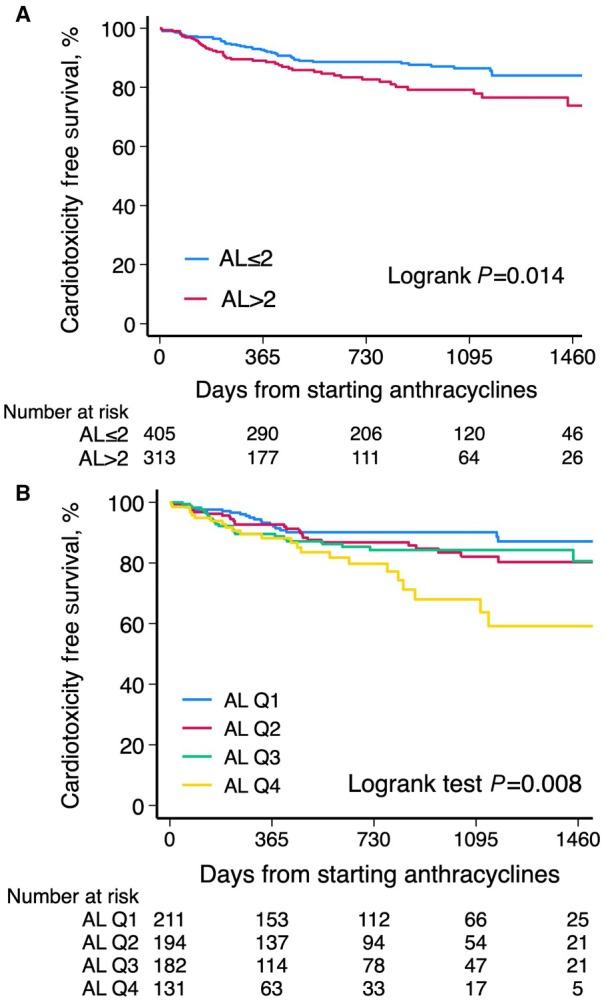
We included consecutive adult patients who underwent anthracycline-based chemotherapy from 2016 to 2019 for any type of cancer. Patients with preexisting heart failure and lack of AL score measures were excluded from the analysis. A composite AL score was calculated using 9 biomarkers tested before initiating chemotherapy. The end point was the development of cardiotoxicity (defined as clinical heart failure or drop in left ventricular ejection fraction≥10% to <50%). A total of 718 patients were included in the analysis (29% Non-Hispanic White, 31% Non-Hispanic Black, 40% Hispanic). The mean AL score was 2.4±1.4 and it was significantly higher in Non-Hispanic Black and Hispanic patients compared with Non-Hispanic White patients (2.5±1.3 in Non-Hispanic Black versus 2.4±1.3 in Hispanic versus 2.1±1.5 in Non-Hispanic White, =0.031). In patients who developed cardiotoxicity, AL score was significantly higher than patients without cardiotoxicity (2.7±1.4 versus 2.3±1.3, =0.006). AL score was independently associated with incident anthracycline cardiotoxicity after adjusting for race and ethnicity, age, sex, cardiovascular risk factors, anthracycline dose, baseline left ventricular ejection fraction, cancer type, and cancer metastasis (hazard ratio 1.20 per 1 AL score increase [95% CI, 1.02-1.43], =0.033). AL score remained significantly associated with anthracycline cardiotoxicity after additional adjustment of social determinants of health.
CONCLUSIONS
AL score can be a potential important prognostic marker in the prediction of cardiotoxicity in patients with cancer undergoing cardiotoxic treatment independent of social determinants of health.
背景
应激负荷(AL)是对慢性应激生理负担的一种测量方法,通过综合多个生理系统生物标志物得出的分数来实现。AL与蒽环类药物心脏毒性之间的关系尚不清楚。
方法与结果
我们纳入了2016年至2019年因任何类型癌症接受基于蒽环类药物化疗的成年连续患者。分析排除了已有心力衰竭和缺乏AL评分测量值的患者。在开始化疗前使用9种生物标志物计算综合AL评分。终点是心脏毒性的发生(定义为临床心力衰竭或左心室射血分数下降≥10%至<50%)。共有718名患者纳入分析(29%非西班牙裔白人,31%非西班牙裔黑人,40%西班牙裔)。平均AL评分为2.4±1.4,非西班牙裔黑人和西班牙裔患者的AL评分显著高于非西班牙裔白人患者(非西班牙裔黑人2.5±1.3,西班牙裔2.4±1.3,非西班牙裔白人2.1±1.5,P=0.031)。发生心脏毒性的患者,其AL评分显著高于未发生心脏毒性的患者(2.7±1.4对2.3±1.3,P=0.006)。在调整种族和族裔、年龄、性别、心血管危险因素、蒽环类药物剂量、基线左心室射血分数、癌症类型和癌症转移后,AL评分与蒽环类药物所致心脏毒性独立相关(每增加1个AL评分,风险比为1.20[95%CI,1.02-1.43],P=0.033)。在进一步调整健康的社会决定因素后,AL评分仍与蒽环类药物心脏毒性显著相关。
结论
AL评分可能是预测接受心脏毒性治疗的癌症患者心脏毒性的一个潜在重要预后标志物,且独立于健康的社会决定因素。

 Zotero 插件