
基于3D打印、负载细胞水凝胶的角膜替代物在兔模型上的临床前测试
Preclinical Testing of 3D Printed, Cell Loaded Hydrogel Based Corneal Substitutes on Rabbit Model.
作者信息
Basoz Deniz, Akalinli Aslihan, Buyuksungur Senem, Celebi A R Cenk, Yucel Deniz, Hasirci Nesrin, Hasirci Vasif
机构信息
Acibadem Mehmet Ali Aydinlar University (ACU), Biomaterials R&D Center, Istanbul, 34752, Türkiye.
ACU, Graduate Department of Biomaterials, Istanbul, 34752, Türkiye.
出版信息
Macromol Biosci. 2025 Jul;25(7):e2400595. doi: 10.1002/mabi.202400595. Epub 2025 Mar 27.
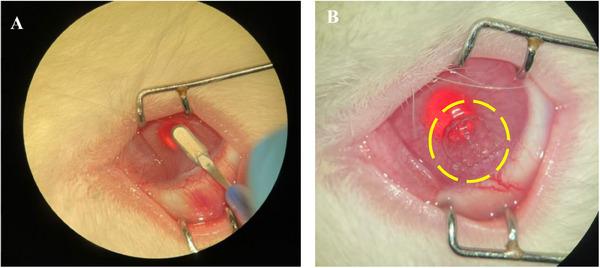
Many people lose their vision due to corneal stroma injuries of the eye and the golden solution is transplantation of allografts from donors. Unfortunately, the limited availability of donor tissue, risk of disease transmission, and immune rejection are serious handicaps. However, implants made of biomaterials can be used as substitutes. In this study, cell-loaded and cell-free, methacrylated gelatin (GelMA) implants are 3D printed and tested under in vitro conditions. The samples are physically characterized for their printability, equilibrium water content, compressive mechanical strength, and transparency; they retained 60%-80% of light transmission in the visible region as in the native corneas. In brief, they are suitable for further testing. Then cell loaded samples are tested in vivo on New Zealand white rabbits for 90 days. In the in vivo tests, these cell loaded, disk shaped implants are almost completely degraded and allowed reorganization of the tissue forming at the implantation site. Also, the immune response initially observed decreased in time and by the end of 90 days the tissue regained its normal, healthy architecture with multilayered, non-keratinized epithelium. It can be concluded that the implants developed in this study are promising for clinical use in corneal stroma recovery.
许多人因眼部角膜基质损伤而失明,而最佳解决方案是移植来自供体的同种异体移植物。不幸的是,供体组织供应有限、疾病传播风险和免疫排斥是严重的障碍。然而,由生物材料制成的植入物可用作替代品。在本研究中,载有细胞和无细胞的甲基丙烯酸化明胶(GelMA)植入物通过3D打印并在体外条件下进行测试。对样品的可打印性、平衡含水量、压缩机械强度和透明度进行了物理表征;它们在可见光区域保留了与天然角膜一样60%-80%的透光率。简而言之,它们适合进一步测试。然后将载有细胞的样品在新西兰白兔体内进行90天的测试。在体内测试中,这些载有细胞的盘状植入物几乎完全降解,并允许在植入部位形成的组织重新组织。此外,最初观察到的免疫反应随时间下降,到90天结束时,组织恢复了具有多层非角化上皮的正常健康结构。可以得出结论,本研究中开发的植入物在角膜基质恢复的临床应用中具有前景。
 Zotero 插件