
睡眠质量、睡眠时间与阿尔茨海默病生物标志物之间的关联:一项系统评价与荟萃分析。
Associations among sleep quality, sleep duration, and Alzheimer's disease biomarkers: A systematic review and meta-analysis.
作者信息
Chen Chun-Lin, Zhang Miao-Yu, Wang Zhi-Lin, Deng Jia-Hui, Bao Yan-Ping, Shi Jie, Lu Lin, Shi Le
机构信息
Peking University Sixth Hospital, Peking University Institute of Mental Health, NHC Key Laboratory of Mental Health (Peking University), National Clinical Research Center for Mental Disorders (Peking University Sixth Hospital), Beijing, China.
Department of Psychiatry, Henan Mental Hospital, The Second Affiliated Hospital of Xinxiang Medical University, Xinxiang, China.
出版信息
Alzheimers Dement. 2025 Mar;21(3):e70096. doi: 10.1002/alz.70096.
INTRODUCTION
Although sleep disturbances are widely recognized as risk factors for cognitive decline and Alzheimer's disease (AD), their influence on AD biomarkers remains unclear. This study aimed to clarify whether sleep quality or sleep duration affect amyloid beta (Aβ) and tau levels in plasma, cerebrospinal fluid (CSF), and positron emission tomography (PET) in non-demented populations.
METHODS
PubMed, Web of Science, and Embase were systematically searched up to February 2025.
RESULTS
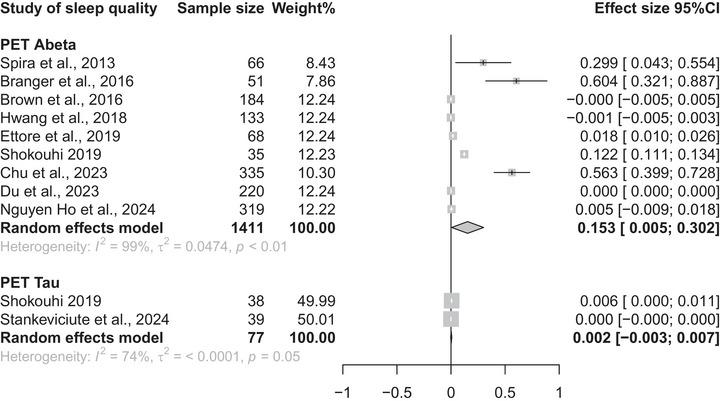
In total, 30 studies were included comprising 14,997 subjects. Individuals with poor sleep quality exhibited greater PET Aβ burden and higher Aβ42 levels in plasma than those with good sleep quality. Shorter sleep duration was associated with higher Aβ burden on PET. However, no association between either sleep quality or sleep duration and tau levels was found.
DISCUSSION
Sleep may be a modifiable marker of early AD management by modulating Aβ levels.
HIGHLIGHTS
lPoor sleep quality and shorter sleep duration were significantly associated with higher amyloid beta (Aβ) burden detected by positron emission tomography (PET) in non-demented populations. Poor sleep quality was also associated with elevated Aβ42 levels in plasma. lNo significant associations were found between sleep quality or sleep duration and tau levels in plasma, cerebrospinal fluid, or PET. lInterventions targeting sleep could serve as a viable and low-cost prevention strategy for early management of Alzheimer's disease.
引言
尽管睡眠障碍被广泛认为是认知能力下降和阿尔茨海默病(AD)的风险因素,但其对AD生物标志物的影响仍不清楚。本研究旨在阐明睡眠质量或睡眠时间是否会影响非痴呆人群血浆、脑脊液(CSF)和正电子发射断层扫描(PET)中的淀粉样β蛋白(Aβ)和tau蛋白水平。
方法
截至2025年2月,系统检索了PubMed、科学网和Embase。
结果
共纳入30项研究,涉及14997名受试者。睡眠质量差的个体与睡眠质量好的个体相比,PET检测到的Aβ负荷更高,血浆中Aβ42水平也更高。睡眠时间较短与PET检测到的较高Aβ负荷相关。然而,未发现睡眠质量或睡眠时间与tau蛋白水平之间存在关联。
讨论
睡眠可能是通过调节Aβ水平来实现早期AD管理的一个可调节指标。
要点
在非痴呆人群中,睡眠质量差和睡眠时间短与正电子发射断层扫描(PET)检测到的较高淀粉样β蛋白(Aβ)负荷显著相关。睡眠质量差还与血浆中Aβ42水平升高有关。
未发现睡眠质量或睡眠时间与血浆、脑脊液或PET中的tau蛋白水平之间存在显著关联。
针对睡眠的干预措施可作为一种可行且低成本的预防策略,用于阿尔茨海默病的早期管理。


 Zotero 插件