
隧道纳米管在神经胶质细胞中的作用。
Role of tunneling nanotubes in neuroglia.
作者信息
Xu Weichen, Yang Xingyu, Zheng Hongmei, Chen Changzheng, Yuan Jiajia
机构信息
Department of Ophthalmology, Renmin Hospital of Wuhan University, Wuhan, Hubei Province, China.
出版信息
Neural Regen Res. 2026 Mar 1;21(3):1023-1036. doi: 10.4103/NRR.NRR-D-24-01129. Epub 2025 Mar 25.
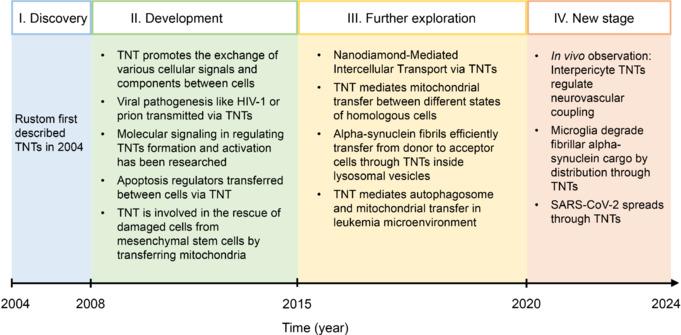
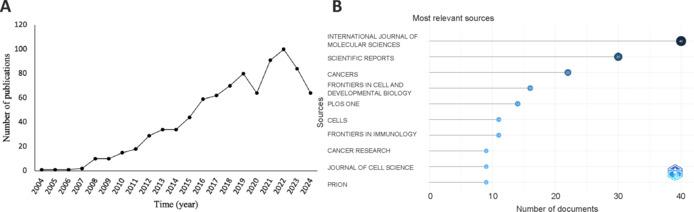
Tunneling nanotubes are crucial structures for cellular communication and are observed in a variety of cell types. Glial cells, the most abundant cells in the nervous system, play a vital role in intercellular signaling and can show abnormal activation under pathological conditions. Our bibliometric analysis indicated a substantial increase in research on tunneling nanotubes over the past two decades, highlighting their important role in cellular communication. This review focuses on the formation of tunneling nanotubes in various types of glial cells, including astrocytes, microglia, glioma cells, and Schwann cells, as well as their roles in cellular communication and cargo transport. We found that glial cells influence the stability of the neural system and play a role in nerve regeneration through tunneling nanotubes. Tunneling nanotubes facilitate the transmission and progression of diseases by transporting pathogens and harmful substances. However, they are also involved in alleviating cellular stress by removing toxins and delivering essential nutrients. Understanding the interactions between glial cells through tunneling nanotubes could provide valuable insights into the complex neural networks that govern brain function and responses to injury.
隧道纳米管是细胞通讯的关键结构,在多种细胞类型中都有观察到。神经胶质细胞是神经系统中数量最多的细胞,在细胞间信号传导中起着至关重要的作用,并且在病理条件下可能会出现异常激活。我们的文献计量分析表明,在过去二十年中,关于隧道纳米管的研究大幅增加,凸显了它们在细胞通讯中的重要作用。本综述聚焦于各种类型神经胶质细胞中隧道纳米管的形成,包括星形胶质细胞、小胶质细胞、胶质瘤细胞和雪旺细胞,以及它们在细胞通讯和货物运输中的作用。我们发现神经胶质细胞通过隧道纳米管影响神经系统的稳定性,并在神经再生中发挥作用。隧道纳米管通过运输病原体和有害物质促进疾病的传播和进展。然而,它们也通过清除毒素和输送必需营养物质参与减轻细胞应激。了解通过隧道纳米管的神经胶质细胞之间的相互作用,可为控制脑功能和对损伤反应的复杂神经网络提供有价值的见解。



 Zotero 插件