
嵌合抗原受体自然杀伤细胞的临床概况。
The clinical landscape of CAR NK cells.
作者信息
Jørgensen Lasse Vedel, Christensen Emil Birch, Barnkob Mike Bogetofte, Barington Torben
机构信息
Department of Clinical Immunology, Odense University Hospital, Odense, Denmark.
Centre for Cellular Immunotherapy of Haematological Cancer Odense (CITCO), Odense, Denmark.
出版信息
Exp Hematol Oncol. 2025 Mar 27;14(1):46. doi: 10.1186/s40164-025-00633-8.
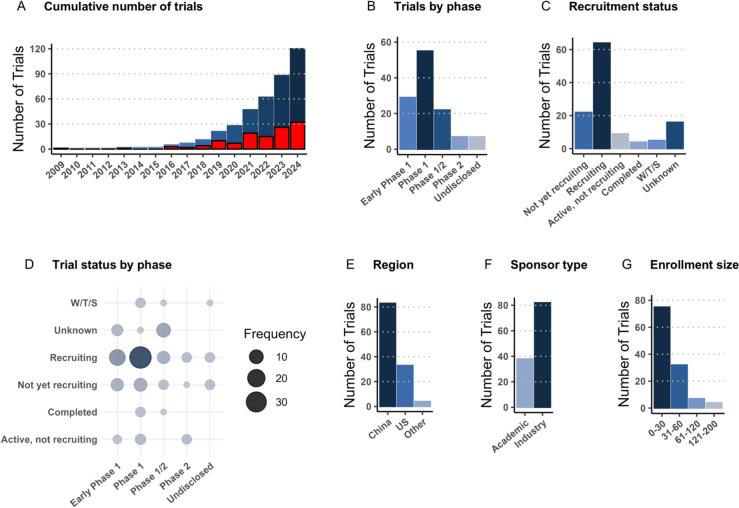
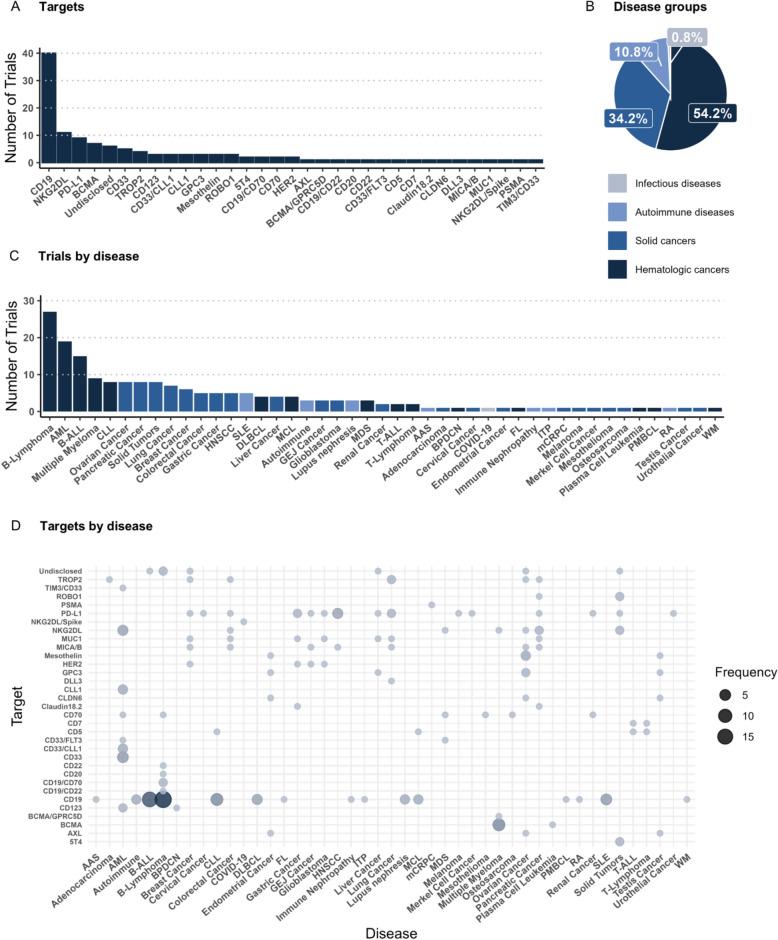
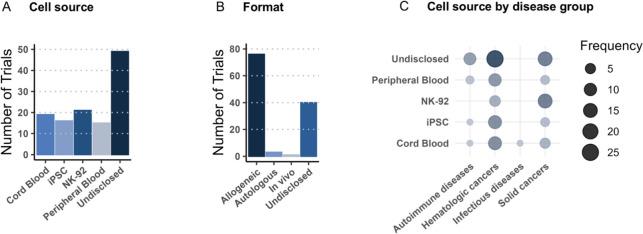
Chimeric antigen receptor (CAR) NK cell therapy has emerged as a promising alternative to CAR T cell therapy, offering significant advantages in terms of safety and versatility. Here we explore the current clinical landscape of CAR NK cells, and their application in hematologic malignancies and solid cancers, as well as their potential for treating autoimmune disorders. Our analysis draws from data collected from 120 clinical trials focused on CAR NK cells, and presents insights into the demographics and characteristics of these studies. We further outline the specific targets and diseases under investigation, along with the major cell sources, genetic modifications, combination strategies, preconditioning- and dosing regimens, and manufacturing strategies being utilized. Initial results from 16 of these clinical trials demonstrate promising efficacy of CAR NK cells, particularly in B cell malignancies, where response rates are comparable to those seen with CAR T cells but with lower rates of severe adverse effects, such as cytokine release syndrome (CRS), immune effector cell-associated neurotoxicity syndrome (ICANS), and graft-versus-host disease (GvHD). However, challenges remain in solid tumor applications, where only modest efficacy has been observed to date. Our analysis reveals that research is increasingly focused on enhancing CAR NK cell persistence, broadening their therapeutic targets, and refining manufacturing processes to improve accessibility and scalability. With recent advancements in NK cell engineering and their increased clinical applications, CAR NK cells are predicted to become an integral component of next-generation immunotherapies, not only for cancer but potentially for immune-mediated diseases as well.
嵌合抗原受体(CAR)自然杀伤细胞疗法已成为CAR T细胞疗法的一种有前景的替代方案,在安全性和通用性方面具有显著优势。在这里,我们探讨了CAR NK细胞的当前临床情况,及其在血液系统恶性肿瘤和实体癌中的应用,以及它们治疗自身免疫性疾病的潜力。我们的分析来自于120项专注于CAR NK细胞的临床试验收集的数据,并呈现了对这些研究的人口统计学和特征的见解。我们进一步概述了正在研究的具体靶点和疾病,以及主要的细胞来源、基因修饰、联合策略、预处理和给药方案,以及所采用的制造策略。其中16项临床试验的初步结果显示CAR NK细胞具有有前景的疗效,特别是在B细胞恶性肿瘤中,其缓解率与CAR T细胞相当,但严重不良反应发生率较低,如细胞因子释放综合征(CRS)、免疫效应细胞相关神经毒性综合征(ICANS)和移植物抗宿主病(GvHD)。然而,实体瘤应用中仍存在挑战,迄今为止仅观察到适度的疗效。我们的分析表明,研究越来越集中在增强CAR NK细胞的持久性、拓宽其治疗靶点以及改进制造工艺以提高可及性和可扩展性。随着NK细胞工程的最新进展及其临床应用的增加,预计CAR NK细胞将成为下一代免疫疗法的一个组成部分,不仅用于癌症治疗,也可能用于免疫介导的疾病治疗。




 Zotero 插件