
阿拉伯联合酋长国一家三级护理医院中靶向抗菌药物使用的前瞻性审计与反馈
Prospective Audit and Feedback of Targeted Antimicrobials Use at a Tertiary Care Hospital in the United Arab Emirates.
作者信息
Gulam Shabaz Mohiuddin, Thomas Dixon, Ahamed Fiaz, Baker Danial E
机构信息
College of Pharmacy, Gulf Medical University, Ajman 4184, United Arab Emirates.
Clinical Pharmacy Department, Thumbay University Hospital, Ajman 4184, United Arab Emirates.
出版信息
Antibiotics (Basel). 2025 Feb 26;14(3):237. doi: 10.3390/antibiotics14030237.
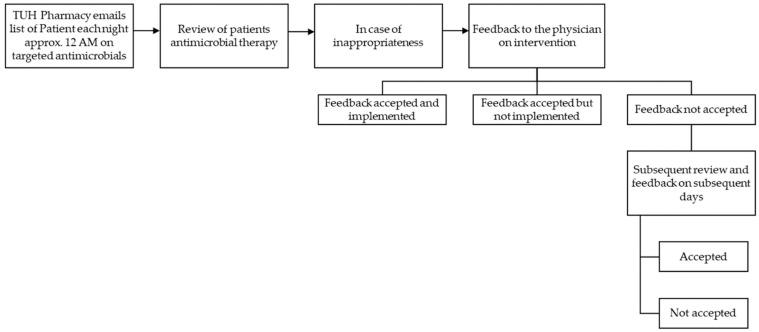
Antimicrobial stewardship programs improve antimicrobial use and help combat antimicrobial resistance. The Infectious Disease Society of America's (IDSA) recommended core interventions include prospective audit and feedback along with formulary restriction and preauthorization. IDSA recommends any one of these interventions be implemented in acute care hospitals to improve antimicrobial stewardship. The objective of this project was to implement a prospective audit and feedback system using selected antimicrobials at a tertiary care hospital in the United Arab Emirates as the foundation to build an antimicrobial stewardship program. A total of 497 patients met the inclusion and exclusion criteria during the study period; the post-intervention group had 260 patients, and the control group had 237 patients. After the implementation of the program, a total of 186 interventions were recommended, and 76% were accepted. The length of stay, length of therapy, and days of therapy were lower in the intervention group compared to the control group ( < 0.05). There was no statistically significant difference in clinical outcome measures (e.g., 30-day readmission, 30-day all-cause mortality, 30-day emergency visit with the same infection, and 60-day readmission). This single-center quasi-experimental research was conducted from August 2023 to July 2024. A pharmacist-led prospective audit and feedback system was initiated in February 2024 after review and approval of the medical staff, in addition to formulary restrictions. Data from patients receiving the selected antimicrobial before February 2024 were collected from their charts and related medical records without any intervention; this was used by our control group. After implementation, the hospital pharmacy's records were evaluated during the night shift to determine whether they met the inclusion criteria. The records of the eligible patients were then evaluated by the clinical pharmacist. In case of antimicrobial inappropriateness, feedback was provided to the prescriber. If the recommendation was not accepted, succeeding reviews and feedback were provided on subsequent days. The effectiveness of the intervention was measured using clinical and antibiotic use measures. Implementation of a pilot pharmacist-led antimicrobial stewardship program resulted in modification in antimicrobial use measures (i.e., defined daily doses of targeted antimicrobials and days of antimicrobial therapy) without an increase in length of stay or readmissions or mortality.
抗菌药物管理计划可改善抗菌药物的使用情况,并有助于对抗抗菌药物耐药性。美国传染病学会(IDSA)推荐的核心干预措施包括前瞻性审核与反馈,以及药品目录限制和预先授权。IDSA建议在急性护理医院实施这些干预措施中的任何一项,以改善抗菌药物管理。本项目的目的是在阿拉伯联合酋长国的一家三级护理医院实施一个使用选定抗菌药物的前瞻性审核与反馈系统,作为建立抗菌药物管理计划的基础。在研究期间,共有497名患者符合纳入和排除标准;干预后组有260名患者,对照组有237名患者。该计划实施后,共提出了186项干预措施,其中76%被采纳。与对照组相比,干预组的住院时间、治疗时长和治疗天数更低(P<0.05)。临床结局指标(如30天再入院率、30天全因死亡率、因同一感染进行的30天急诊就诊以及60天再入院率)没有统计学上的显著差异。这项单中心准实验研究于2023年8月至2024年7月进行。在获得医务人员审查和批准后,除了药品目录限制外,于2024年2月启动了由药剂师主导的前瞻性审核与反馈系统。2024年2月之前接受选定抗菌药物治疗的患者的数据,从其病历和相关医疗记录中收集,未进行任何干预;对照组使用这些数据。实施后,在夜班期间对医院药房的记录进行评估,以确定其是否符合纳入标准。然后,临床药剂师对符合条件的患者记录进行评估。如果抗菌药物使用不当,会向开处方者提供反馈。如果建议未被接受,则在随后几天提供后续审查和反馈。使用临床和抗生素使用指标来衡量干预措施的有效性。实施一项由药剂师主导的抗菌药物管理试点计划,导致抗菌药物使用指标(即目标抗菌药物的限定日剂量和抗菌药物治疗天数)得到改善,而住院时间、再入院率或死亡率并未增加。

 Zotero 插件