
吉西他滨联合基于S-1的诱导放化疗后手术切除对局部晚期胰腺导管腺癌患者的影响:聚焦于UR-LA病例
Impact of Surgical Resection After Induction Gemcitabine Plus S-1-Based Chemoradiotherapy in Patients with Locally Advanced Pancreatic Ductal Adenocarcinoma: A Focus on UR-LA Cases.
作者信息
Kishiwada Masashi, Mizuno Shugo, Hayasaki Aoi, Kaluba Benson, Fujii Takehiro, Noguchi Daisuke, Ito Takahiro, Iizawa Yusuke, Tanemura Akihiro, Murata Yasuhiro, Kuriyama Naohisa
机构信息
Department of Hepatobiliary Pancreatic and Transplant Surgery, Mie University School of Medicine, 2-174 Edobashi, Tsu 514-8507, Mie, Japan.
出版信息
Cancers (Basel). 2025 Mar 20;17(6):1048. doi: 10.3390/cancers17061048.
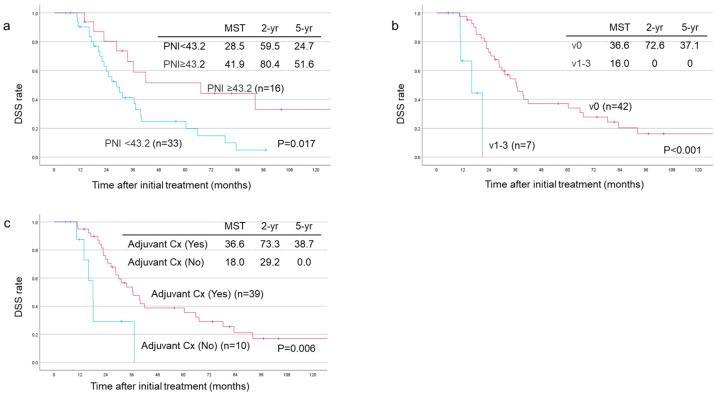
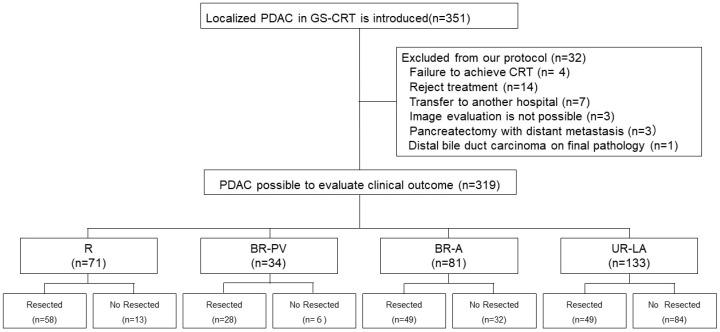
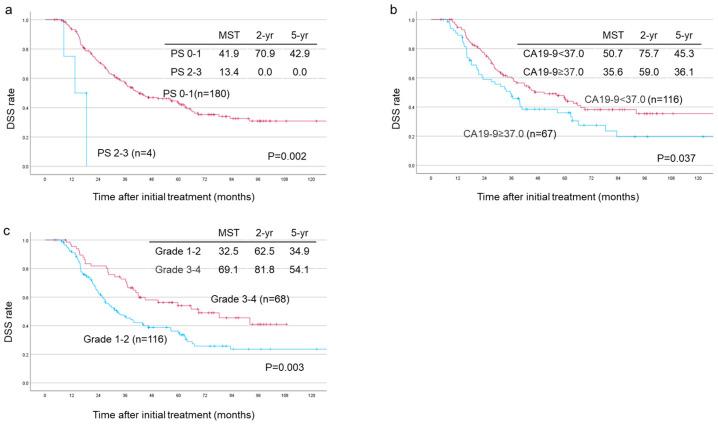
This study aimed to assess the safety and efficacy of gemcitabine plus S-1-based chemoradiotherapy (GS-CRT) among patients with locally advanced pancreatic ductal adenocarcinoma (PDAC), especially among those with unresectable locally advanced (UR-LA) cases. : A total of 351 consecutive PDAC patients were enrolled and prognostic predictors of disease-specific survival (DSS) were identified. The treatment completion rate was 98.9% and Grade 3 or higher adverse events occurred in 181 cases (51.6%). Among 319 re-evaluated patients, pancreatectomy was performed in 184 (57.7%). Based on resectability, the 5-year DSS rates for the entire cohort were 39.6% (R), 43.8% (BR-PV), 21.2% (BR-A) and 13.3% (UR-LA), while the predictors of DSS were performance status (PS), hemoglobin (Hb) level, celiac artery (CA) involvement of ≥180 degrees and JPS 8th T category. In the resected cases, the predictors of DSS were preoperative PS, preoperative CA19-9 level, preoperative JPS-T factor, degree of histological response and adjuvant chemotherapy. In UR-LA resected patients, preoperative prognostic nutritional index (PNI), absence of pathological venous invasion and adjuvant chemotherapy were predictors of DSS. Even though Grade 3 or higher adverse events were encountered in about half of the cases, they were uneventfully managed. Therefore, GS-CRT is safe and highly tolerable with potential to improve patients' prognosis. Preoperative PS, CA19-9 levels and histological response are important prognostic factors, as well as adjuvant therapy. In UR-LA patients, prognostic nutritional index (PNI) and adjuvant chemotherapy were important for curative intent surgery.
本研究旨在评估吉西他滨联合基于S-1的放化疗(GS-CRT)在局部晚期胰腺导管腺癌(PDAC)患者中的安全性和疗效,尤其是在不可切除的局部晚期(UR-LA)病例中。共纳入351例连续的PDAC患者,并确定了疾病特异性生存(DSS)的预后预测因素。治疗完成率为98.9%,181例(51.6%)发生3级或更高等级的不良事件。在319例重新评估的患者中,184例(57.7%)接受了胰腺切除术。根据可切除性,整个队列的5年DSS率分别为39.6%(R)、43.8%(BR-PV)、21.2%(BR-A)和13.3%(UR-LA),而DSS的预测因素为体能状态(PS)、血红蛋白(Hb)水平、腹腔干(CA)累及≥180度和日本胰腺学会(JPS)第8版T分类。在切除病例中,DSS的预测因素为术前PS、术前CA19-9水平、术前JPS-T因子、组织学反应程度和辅助化疗。在UR-LA切除患者中,术前预后营养指数(PNI)、无病理静脉侵犯和辅助化疗是DSS的预测因素。尽管约一半的病例出现了3级或更高等级的不良事件,但均得到了妥善处理。因此,GS-CRT是安全且耐受性良好的,具有改善患者预后的潜力。术前PS、CA19-9水平和组织学反应是重要的预后因素,辅助治疗也是如此。在UR-LA患者中,预后营养指数(PNI)和辅助化疗对根治性手术很重要。


 Zotero 插件