
溴化阻燃剂暴露对血清总胆红素的影响:一项横断面分析。
The impact of brominated flame retardants exposure on serum total bilirubin: A cross-sectional analysis.
作者信息
Huang Shanshan, Lin Tong, Chen Jialu, Zhou Fen, Yang Junjie, Mao Haiyan, Yang Zhouxin
机构信息
Department of Critical Care Medicine, Ningbo Medical Center Lihuili Hospital, Ningbo, China.
Zhejiang Key Laboratory of Geriatrics and Geriatrics Institute of Zhejiang Province, Zhejiang Hospital, Hangzhou, China.
出版信息
PLoS One. 2025 Mar 28;20(3):e0320523. doi: 10.1371/journal.pone.0320523. eCollection 2025.
BACKGROUND
Brominated flame retardants (BFRs) are harmful, bioaccumulative, and persistent environmental pollutants, posing significant health risks. Elevated bilirubin levels can cause neurotoxicity and damage to the heart, liver, kidneys, and other organs. This study utilizes National Health and Nutrition Examination Survey (NHANES) data to investigate the association between exposure to BFRs and total bilirubin (TB) levels in adult participants.
METHODS
Based on data from the NHANES 2007-2016, TB levels were divided into tertiles. Spearman's rank correlation was used to analyze the relationship between individual BFRs and TB levels. Weighted linear regression analysis, restricted cubic splines (RCS), and stratified analysis were conducted to assess the correlation between individual BFRs and TB levels. Weighted quantile sum (WQS) regression and quantile-based g-computation (QGC) analysis were used to comprehensively evaluate the impact of BFRs exposure on serum TB levels.
RESULTS
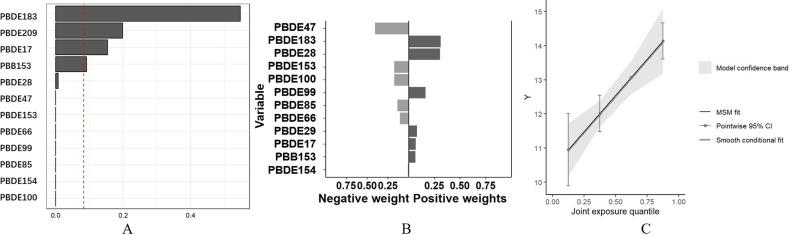
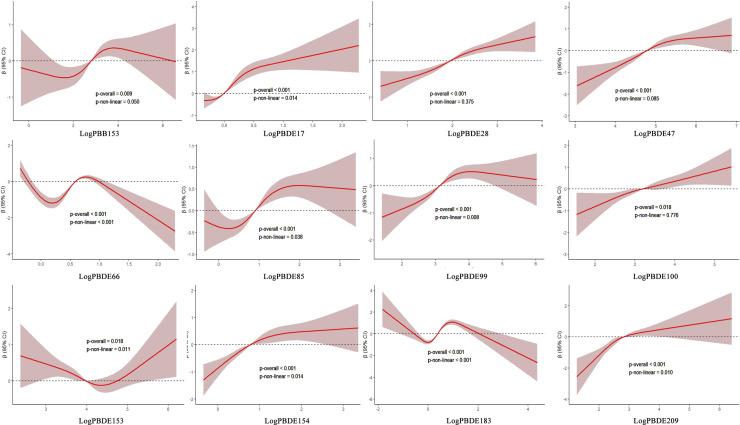
The study included 5831 participants. The results showed that PBB153, PBDE17, PBDE47, PBDE85, PBDE99, PBDE100, PBDE209, and PBDE183 were significantly correlated with TB levels (p < 0.05), with PBDE183 having the highest Spearman rank correlation coefficient of 0.292. After adjusting for confounding factors, most BFR remained significantly positively correlated with TB, while PBDE153 (β: - 0.031, 95%CI: - 0.317, 0.255, p = 0.829) and PBDE66 (β: 0.285, 95%CI: - 0.208, 0.777, p = 0.253) were not statistically significant. RCS analysis indicated that PBDE153 concentration had a significant U-shaped correlation with TB (p < 0.05), while PBDE17, PBDE99, PBDE154, and PBDE209 had an inverted "J"-shaped correlation (p < 0.05). PBB153, PBDE66, PBDE85, and PBDE183 also exhibited significant nonlinear S-shaped correlations with TB (p < 0.05). After stratification by age and gender, most individual BFR remained significantly positively correlated with TB levels (p < 0.05). WQS regression and QGC analysis indicated that mixed BFRs exposure was positively correlated with TB levels (β: 0.553, 95%CI: 0.384, 0.722, p < 0.001 and β: 1.060, 95%CI: 0.587, 1.532, p < 0.001), with PBDE183 contributing the most.
CONCLUSIONS
BFRs exposure is significantly positively correlated with TB levels, further suggesting the potential health impact of BFRs exposure on humans.
背景
溴化阻燃剂(BFRs)是有害的、具有生物累积性和持久性的环境污染物,会带来重大健康风险。胆红素水平升高会导致神经毒性,并损害心脏、肝脏、肾脏和其他器官。本研究利用美国国家健康与营养检查调查(NHANES)数据,调查成年参与者中BFRs暴露与总胆红素(TB)水平之间的关联。
方法
基于2007 - 2016年NHANES的数据,将TB水平分为三分位数。采用Spearman等级相关性分析个体BFRs与TB水平之间的关系。进行加权线性回归分析、受限立方样条(RCS)分析和分层分析,以评估个体BFRs与TB水平之间的相关性。使用加权分位数和(WQS)回归和基于分位数的g计算(QGC)分析,全面评估BFRs暴露对血清TB水平的影响。
结果
该研究纳入了5831名参与者。结果显示,多溴联苯153(PBB153)、多溴二苯醚17(PBDE17)、多溴二苯醚47(PBDE47)、多溴二苯醚85(PBDE85)、多溴二苯醚99(PBDE99)、多溴二苯醚100(PBDE100)、多溴二苯醚209(PBDE209)和多溴二苯醚183(PBDE183)与TB水平显著相关(p < 0.05),其中PBDE183的Spearman等级相关系数最高,为0.292。在调整混杂因素后,大多数BFR仍与TB显著正相关,而多溴二苯醚153(β: - 0.031,95%置信区间: - 0.317,0.255,p = 0.829)和多溴二苯醚66(β:0.285,95%置信区间: - 0.208,0.777,p = 0.253)无统计学意义。RCS分析表明,PBDE153浓度与TB呈显著的U形相关性(p < 0.05),而PBDE17、PBDE99、PBDE154和PBDE209呈倒“J”形相关性(p < 0.05)。PBB153、PBDE66、PBDE85和PBDE183与TB也呈现出显著的非线性S形相关性(p < 0.05)。按年龄和性别分层后,大多数个体BFR仍与TB水平显著正相关(p < 0.05)。WQS回归和QGC分析表明,混合BFRs暴露与TB水平呈正相关(β:0.553,95%置信区间:0.384,0.722,p < 0.001和β:1.060,95%置信区间:0.587,1.532,p < 0.001),其中PBDE183的贡献最大。
结论
BFRs暴露与TB水平显著正相关,进一步表明BFRs暴露对人类的潜在健康影响。

 Zotero 插件