
HLA - A*02:01型与黑色素瘤患者免疫检查点抑制剂治疗的疗效和毒性的关联:一项回顾性队列研究
Association of HLA-A*02:01 type with efficacy and toxicity of immune checkpoint inhibitor therapy in melanoma patients: a retrospective cohort study.
作者信息
Manger Isabel, Schmitt Christina, Berking Carola, French Lars E, Vera-Gonzalez Julio, Heinzerling Lucie
机构信息
Department of Dermatology, Friedrich-Alexander-Universität Erlangen-Nürnberg (FAU), Uniklinikum Erlangen, CCC Erlangen-EMN, CCC WERA, Erlangen, Germany.
Bavarian Centre for Cancer Research (BZKF), Uniklinikum Erlangen and LMU Munich, Munich, Germany.
出版信息
BMC Cancer. 2025 Mar 28;25(1):565. doi: 10.1186/s12885-025-13857-y.
BACKGROUND
Immune checkpoint inhibitors (ICI) are highly effective but may induce severe or even fatal and unpredictable immune-related adverse events (irAEs). It is unclear whether human leukocyte antigen (HLA) genes contribute to the susceptibility of developing irAEs during ICI therapy.
METHODS
This multicentre retrospective study investigated the association of irAE and outcome with HLA-A02:01 status in a cohort of 97 patients with metastatic melanoma undergoing ICI therapy. Organ-specific irAEs and therapy outcome as assessed by response rate, progression-free survival (PFS) and overall survival (OS) were analysed depending on HLA type HLA-A02:01. For the outcome only patients with cutaneous melanoma were analysed. Chi square test, exact fisher test, Kruskal Wallis test and log rank test were employed for statistical analysis (p ≤ 0.05).
RESULTS
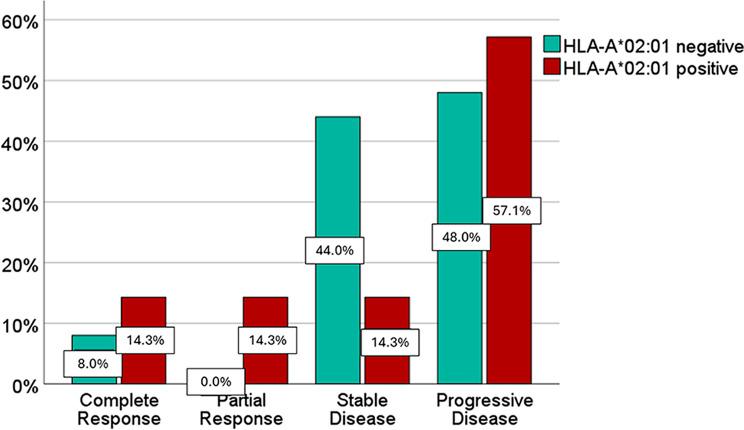
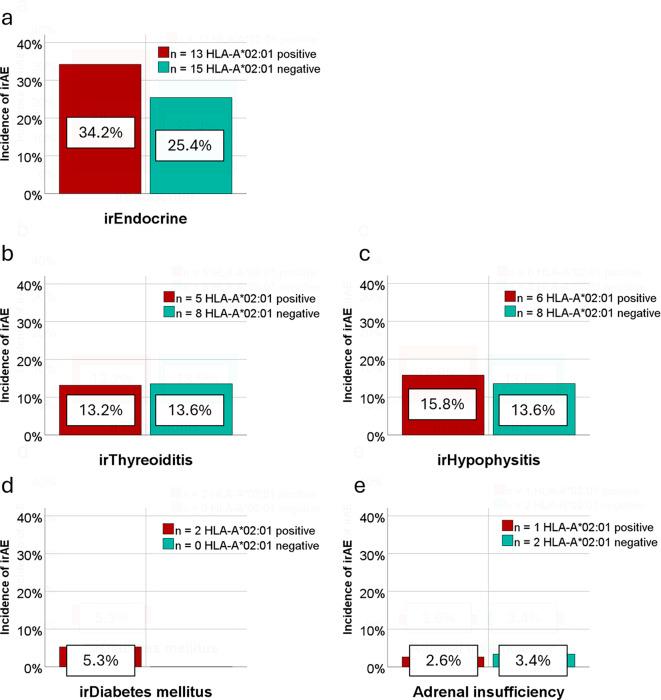
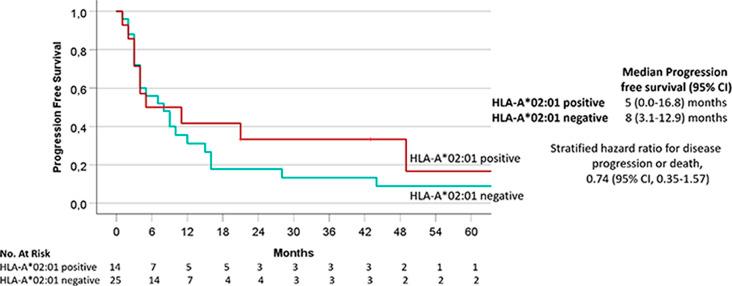
The cohort included 38 HLA-A02:01 positive (39.2%) and 59 HLA-A02:01 negative (60.8%) patients. Data showed no evidence of an association of HLA-A02:01 with organ-specific irAEs except for a numerical difference in immune-related colitis. Furthermore, response rates of the subgroup of patients with metastatic cutaneous melanoma did not differ between the two cohorts. The median PFS was 5 months and 8 months in HLA-A02:01 positive and negative patients with cutaneous melanoma, respectively.
CONCLUSION
HLA-A02:01 was not associated with specific checkpoint inhibitor-induced organ toxicity in this cohort of HLA-A-typed melanoma patients. Interestingly, in the relatively small subgroup of patients with cutaneous melanoma an earlier progression in HLA-A02:01 positive patients was observed, however not in the long term. These findings are exploratory due to the limited sample size and require validation in larger, prospective cohorts.
背景
免疫检查点抑制剂(ICI)疗效显著,但可能引发严重甚至致命且不可预测的免疫相关不良事件(irAE)。目前尚不清楚人类白细胞抗原(HLA)基因是否会导致ICI治疗期间发生irAE的易感性。
方法
这项多中心回顾性研究调查了97例接受ICI治疗的转移性黑色素瘤患者队列中irAE及预后与HLA-A02:01状态的关联。根据HLA类型HLA-A02:01分析了器官特异性irAE以及通过缓解率、无进展生存期(PFS)和总生存期(OS)评估的治疗结果。仅对皮肤黑色素瘤患者的预后进行了分析。采用卡方检验、精确费舍尔检验、克鲁斯卡尔-沃利斯检验和对数秩检验进行统计分析(p≤0.05)。
结果
该队列包括38例HLA-A02:01阳性(39.2%)和59例HLA-A02:01阴性(60.8%)患者。数据显示,除免疫相关结肠炎存在数值差异外,没有证据表明HLA-A02:01与器官特异性irAE有关联。此外,两个队列中转移性皮肤黑色素瘤患者亚组的缓解率没有差异。HLA-A02:01阳性和阴性的皮肤黑色素瘤患者的中位PFS分别为5个月和8个月。
结论
在这个HLA分型的黑色素瘤患者队列中,HLA-A02:01与特定检查点抑制剂诱导的器官毒性无关。有趣的是,在相对较小的皮肤黑色素瘤患者亚组中,观察到HLA-A02:01阳性患者进展较早,但从长期来看并非如此。由于样本量有限,这些发现具有探索性,需要在更大的前瞻性队列中进行验证。


 Zotero 插件