
使用尿液样本的人乳头瘤病毒实时聚合酶链反应检测的准确性:一项系统评价和荟萃分析
Accuracy of real-time PCR assays for human papillomavirus using urine samples: a systematic review and meta-analysis.
作者信息
Park Byeong-Min, Kim Soohyun, Choi Jieun, Song Yoonkyung, Park Seungman
机构信息
Department of Laboratory Medicine, National Cancer Center, Goyang-si, Gyeonggi-do, South Korea.
Department of Health Promotion, National Health Insurance Service Ilsan Hospital, Goyang-si, Gyeonggi-do, South Korea.
出版信息
J Clin Microbiol. 2025 May 14;63(5):e0135224. doi: 10.1128/jcm.01352-24. Epub 2025 Mar 31.
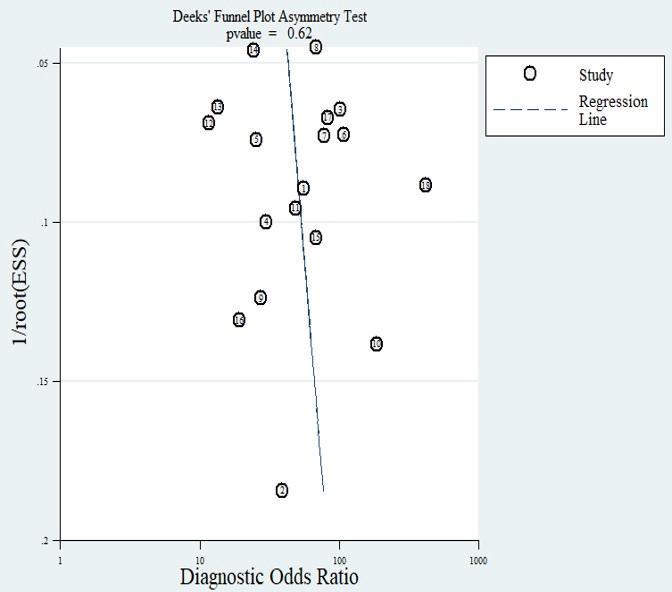
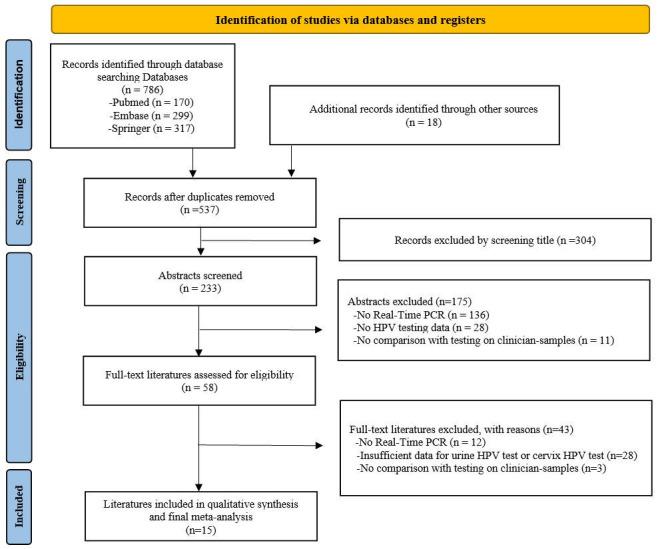
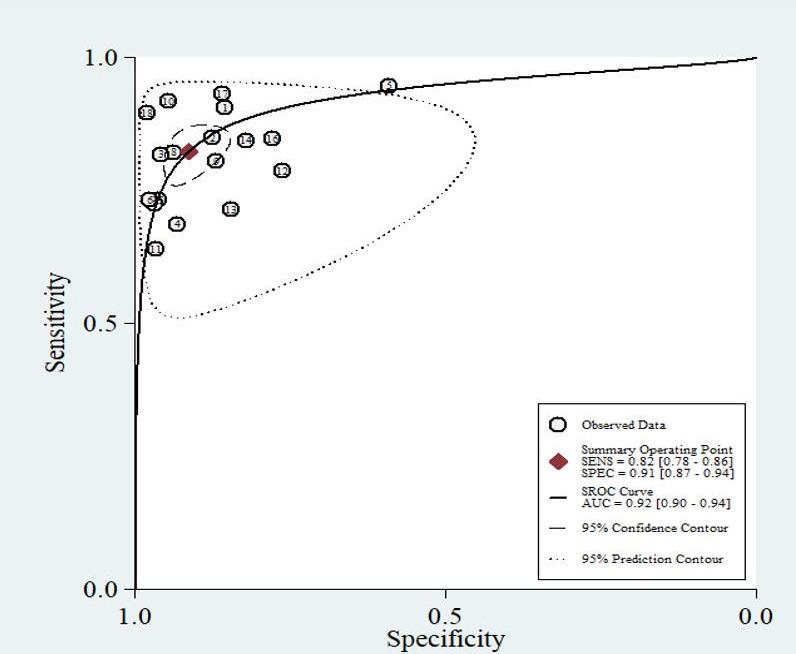
This study aims to assess the diagnostic accuracy of real-time PCR assays for detecting human papillomavirus (HPV) in urine samples through a systematic review and meta-analysis. A comprehensive search of PubMed, Embase, and Springer databases (2014-2024) was conducted. Studies comparing urine-based HPV tests with cervical samples as the reference standard were included. Diagnostic accuracy measures such as sensitivity, specificity, diagnostic odds ratio (DOR), likelihood ratios (LR+ and LR-), percent agreement, and Cohen's kappa were calculated. Heterogeneity was assessed using the Higgins' I² index, and subgroup analyses were performed based on HPV test type and urine volume. The study revealed that 15 studies met the inclusion criteria, with pooled sensitivity of urine-based HPV tests at 0.82 (95% CI, 0.78-0.86), specificity at 0.91 (95% CI, 0.87-0.94), positive LR at 9.5 (95% CI, 6.3-14.3), negative LR at 0.19 (95% CI, 0.16-0.24), DOR at 49 (95% CI, 32-75), and the area under the curve at 0.92 (95% CI, 0.90-0.94), with significant heterogeneity observed (I² >50%), particularly in sensitivity and specificity, and subgroup analysis indicating that urine volumes ≤20 mL demonstrated higher sensitivity compared to those >20 mL, despite this finding being based on a limited number of studies. Results suggest that urine-based HPV testing shows strong diagnostic accuracy and could be a viable alternative to cervical swabs, with potential benefits for increasing screening accessibility, especially in areas with limited healthcare resources, despite some variability and limitations in the data.IMPORTANCEThis study is significant as it thoroughly evaluates the diagnostic accuracy of real-time PCR assays for human papillomavirus (HPV) detection in urine samples through a rigorous systematic review and meta-analysis. By integrating data from multiple databases and comparing urine-based HPV tests with the established cervical sample reference standard, the study provides valuable insights into the effectiveness and reliability of non-invasive HPV screening methods. The findings demonstrate that urine-based tests exhibit high sensitivity and specificity, offering a promising alternative to traditional cervical swabs. This advancement has significant implications for increasing accessibility to HPV screening, particularly in under-resourced settings, thereby potentially enhancing cervical cancer prevention efforts on a broader scale. The study not only fills a critical gap in HPV screening methodologies but also supports the development of more inclusive and practical public health strategies for combating cervical cancer.
本研究旨在通过系统评价和荟萃分析评估实时荧光定量聚合酶链反应(PCR)检测尿液样本中人类乳头瘤病毒(HPV)的诊断准确性。对PubMed、Embase和Springer数据库(2014 - 2024年)进行了全面检索。纳入了将基于尿液的HPV检测与宫颈样本作为参考标准进行比较的研究。计算了诊断准确性指标,如敏感性、特异性、诊断比值比(DOR)、似然比(LR +和LR -)、一致率和科恩kappa系数。使用希金斯I²指数评估异质性,并根据HPV检测类型和尿量进行亚组分析。研究发现,15项研究符合纳入标准,基于尿液的HPV检测的合并敏感性为0.82(95%CI,0.78 - 0.86),特异性为0.91(95%CI,0.87 - 0.94),阳性似然比为9.5(95%CI,6.3 - 14.3),阴性似然比为0.19(95%CI,0.16 - 0.24),DOR为49(95%CI,32 - 75),曲线下面积为0.92(95%CI,0.90 - 0.94),观察到显著的异质性(I²>50%),特别是在敏感性和特异性方面,亚组分析表明,尿量≤20 mL的检测相比尿量>20 mL的检测具有更高的敏感性,尽管这一发现基于数量有限的研究。结果表明,基于尿液的HPV检测显示出较高的诊断准确性,可能是宫颈拭子检测的可行替代方法,对于提高筛查的可及性具有潜在益处,特别是在医疗资源有限的地区,尽管数据存在一些变异性和局限性。重要性本研究具有重要意义,因为它通过严格的系统评价和荟萃分析全面评估了实时荧光定量PCR检测尿液样本中人类乳头瘤病毒(HPV)的诊断准确性。通过整合多个数据库的数据,并将基于尿液的HPV检测与既定的宫颈样本参考标准进行比较,该研究为非侵入性HPV筛查方法的有效性和可靠性提供了有价值的见解。研究结果表明,基于尿液的检测具有高敏感性和特异性,为传统宫颈拭子检测提供了有前景的替代方法。这一进展对于提高HPV筛查的可及性具有重要意义,特别是在资源匮乏的地区,从而有可能在更广泛的范围内加强宫颈癌预防工作。该研究不仅填补了HPV筛查方法学中的关键空白,还支持了制定更具包容性和实用性的抗击宫颈癌的公共卫生策略。



 Zotero 插件