
韩国骨关节炎患者的精神药物使用情况
Psychotropic Drug Use in Korean Patients With Osteoarthritis.
作者信息
Kang Seong-Hun, Kim Hyun Ah, Choi Insun, Park Chan Mi, Jhang Hoyol, Kim Jinhyun, Go Dong Jin, Jang Suhyun
机构信息
Division of Rheumatology, Hallym University Sacred Heart Hospital, Anyang, Korea.
National Evidence-based Healthcare Collaborating Agency, Seoul, Korea.
出版信息
J Korean Med Sci. 2025 Mar 31;40(12):e53. doi: 10.3346/jkms.2025.40.e53.
BACKGROUND
There are few safe effective ways to relieve osteoarthritis (OA) pain; as a result, off-label psychotropic drug prescriptions have increased worldwide. This study examined the change in psychotropic drug prescriptions for patients with OA from 2011 to 2020 using the Korean National Health Insurance Service dataset.
METHODS
The study population consisted of patients with hip or knee OA aged ≥ 65 years. Psychotropic drugs included opioids, benzodiazepines, non-benzodiazepine hypnotics (Z-drugs), anti-epileptics, tricyclic antidepressants, selective serotonin reuptake inhibitors (SSRIs), serotonin and norepinephrine reuptake inhibitors (SNRIs), typical antipsychotics, atypical antipsychotics, and anxiolytics. The prevalence and long-term (> 3 months) prescription rates of psychotropic drugs in OA patients were calculated.
RESULTS
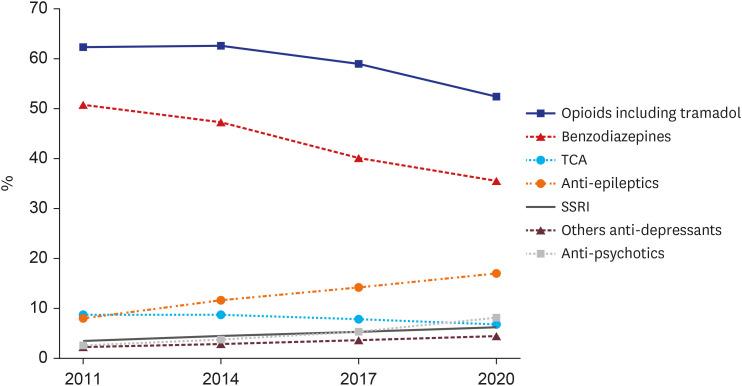
The study included 1,821,158 patients with OA (mean age 71.7 years; 65.32% female). Of the cohort, 49% had comorbidities for which psychotropics were indicated. The prevalence of psychotropic prescriptions decreased from 58.2% to 52.0% in 2018 and then leveled off. The long-term prescription rate remained constant until 2018 and then increased slightly. The most commonly prescribed psychotropics were opioids and long- and short-acting benzodiazepines. The prescription rates of opioids and long-acting benzodiazepines decreased from 2011 to 2020. For those with psychiatric co-morbidities, the prescription rates of anti-epileptics and SNRIs increased, while the prescription rates of anti-epileptics, SSRIs, other antidepressants, and atypical psychotropics increased for those without such co-morbidities. The most commonly prescribed psychotropics were diazepam and alprazolam, excluding tramadol and tramadol-acetaminophen combination. For those with psychiatric co-morbidities, the prescription rates of gabapentin and fentanyl increased, while for those without such co-morbidities, the prescription rates of lorazepam, fentanyl, escitalopram and quetiapine increased.
CONCLUSION
A significant number of older Korean patients with OA were prescribed psychotropic drugs in the absence of comorbidities requiring such drugs, including drugs that have little effect on OA and unfavorable safety profiles in older adults.
背景
缓解骨关节炎(OA)疼痛的安全有效方法较少,因此,全球范围内非适应证精神药物处方有所增加。本研究利用韩国国民健康保险服务数据集,调查了2011年至2020年OA患者精神药物处方的变化情况。
方法
研究人群包括年龄≥65岁的髋或膝OA患者。精神药物包括阿片类药物、苯二氮䓬类药物、非苯二氮䓬类催眠药(Z类药物)、抗癫痫药、三环类抗抑郁药、选择性5-羟色胺再摄取抑制剂(SSRI)、5-羟色胺和去甲肾上腺素再摄取抑制剂(SNRI)、典型抗精神病药、非典型抗精神病药和抗焦虑药。计算OA患者中精神药物的患病率和长期(>3个月)处方率。
结果
该研究纳入了1,821,158例OA患者(平均年龄71.7岁;女性占65.32%)。在该队列中,49%的患者有使用精神药物的合并症。精神药物处方患病率在2018年从58.2%降至52.0%,随后趋于平稳。长期处方率在2018年前保持不变,随后略有上升。最常开具的精神药物是阿片类药物以及长效和短效苯二氮䓬类药物。从2011年到2020年,阿片类药物和长效苯二氮䓬类药物的处方率下降。对于有精神合并症的患者,抗癫痫药和SNRI的处方率增加,而对于无此类合并症的患者,抗癫痫药、SSRI、其他抗抑郁药和非典型精神药物的处方率增加。最常开具的精神药物是地西泮和阿普唑仑,不包括曲马多和曲马多-对乙酰氨基酚复方制剂。对于有精神合并症的患者,加巴喷丁和芬太尼的处方率增加,而对于无此类合并症的患者,劳拉西泮、芬太尼、艾司西酞普兰和喹硫平的处方率增加。
结论
相当数量的韩国老年OA患者在无需要此类药物的合并症情况下开具了精神药物,包括对OA几乎没有作用且对老年人安全性不佳的药物。

 Zotero 插件