
用于非前列腺实体瘤脑转移的PSMA靶向PET成像:一项系统综述
PSMA-targeted PET imaging for brain metastases from non-prostatic solid tumors: a systematic review.
作者信息
Dall' Armellina Sara, Aghakhanyan Gayane, Rizzo Alessio, Fanni Salvatore C, Aringhieri Giacomo, Faggioni Lorenzo, Cioni Dania, Neri Emanuele, Volterrani Duccio, Morbelli Silvia
机构信息
Nuclear Medicine Unit, Service Area Department, Azienda Socio-Sanitaria Territoriale (ASST)-Rhodense P.O. Bollate, Milan, Italy.
Department of Translational Research and of New Surgical and Medical Technology, Nuclear Medicine Unit, University of Pisa, Pisa, Italy.
出版信息
Front Oncol. 2025 Mar 17;15:1553505. doi: 10.3389/fonc.2025.1553505. eCollection 2025.
INTRODUCTION
Prostate-Specific Membrane Antigen (PSMA) is a transmembrane glycoprotein initially identified in prostate cancer (PCa) but also expressed in the neovasculature of various solid tumors. Recently, PSMA PET has emerged as a promising tool for detecting brain metastases (BMs) from non-prostatic cancers, offering diagnostic capabilities in addition to conventional imaging. This systematic review evaluates the role of PSMA-targeted radiopharmaceuticals in imaging BMs, highlighting their comparative diagnostic performance and exploring their potential for theranostic applications.
METHODS
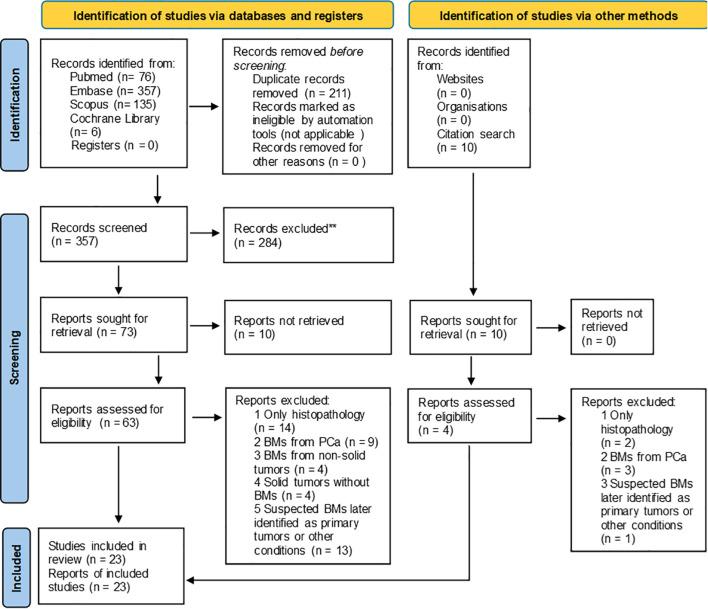
A systematic review of the literature was conducted following PRISMA guidelines. Studies evaluating the diagnostic accuracy of PSMA PET imaging in identifying brain metastases (BMs) from non-prostatic solid tumors were included. Both full research articles and case reports were considered to capture the breadth of current evidence. The methodological quality of the included studies was assessed using the QUADAS-2 tool, and data were synthesized qualitatively.
RESULTS
The review includes 23 studies reporting on 77 BMs from diverse primary malignancies, including lung, breast, salivary gland, thyroid, kidney, and melanoma. PSMA PET demonstrated high tumor-to-background ratios (TBR), enabling superior detection of BMs compared to conventional imaging modalities such as contrast-enhanced MRI and [18F]FDG PET. In post-radiotherapy cases, PSMA PET effectively differentiated radionecrosis from tumor recurrence. Moreover, PSMA PET demonstrated superior sensitivity in detecting thyroid metastases compared to traditional scintigraphy methods, highlighting its potential in cases where standard techniques yield inconclusive results.
CONCLUSIONS
PSMA PET imaging shows significant promise in improving the diagnosis and management of BMs from non-prostatic cancers. While its theranostic applications remain underexplored, initial findings suggest promising avenues for integrating PSMA PET into personalized neuro-oncology care. Future studies should focus on standardizing imaging protocols, exploring PSMA PET utility in diverse tumor subtypes, and validating its role in clinical decision-making to maximize its impact on patient outcomes.
引言
前列腺特异性膜抗原(PSMA)是一种跨膜糖蛋白,最初在前列腺癌(PCa)中被发现,但也在各种实体瘤的新生血管中表达。最近,PSMA正电子发射断层扫描(PET)已成为检测非前列腺癌脑转移瘤(BMs)的一种有前景的工具,除了传统成像外还提供诊断能力。本系统评价评估了PSMA靶向放射性药物在脑转移瘤成像中的作用,突出了它们的比较诊断性能,并探索了它们在治疗诊断应用中的潜力。
方法
按照PRISMA指南对文献进行系统评价。纳入评估PSMA PET成像在识别非前列腺实体瘤脑转移瘤中的诊断准确性的研究。完整的研究文章和病例报告均被考虑在内,以涵盖当前证据的广度。使用QUADAS-2工具评估纳入研究的方法学质量,并对数据进行定性综合。
结果
该评价纳入了23项研究,报告了来自不同原发性恶性肿瘤(包括肺癌、乳腺癌、唾液腺癌、甲状腺癌、肾癌和黑色素瘤)的77个脑转移瘤。PSMA PET显示出高肿瘤与背景比值(TBR),与传统成像方式(如对比增强MRI和[18F]FDG PET)相比,能够更好地检测脑转移瘤。在放射治疗后的病例中,PSMA PET有效地将放射性坏死与肿瘤复发区分开来。此外,与传统闪烁扫描方法相比,PSMA PET在检测甲状腺转移瘤方面显示出更高的敏感性,突出了其在标准技术结果不明确的病例中的潜力。
结论
PSMA PET成像在改善非前列腺癌脑转移瘤的诊断和管理方面显示出巨大潜力。虽然其治疗诊断应用仍未得到充分探索,但初步研究结果表明,将PSMA PET纳入个性化神经肿瘤学护理有前景广阔的途径。未来的研究应专注于标准化成像方案,探索PSMA PET在不同肿瘤亚型中的效用,并验证其在临床决策中的作用,以最大限度地提高其对患者预后的影响。

 Zotero 插件