
逐步反应引导治疗方案优于基于血小板生成素受体激动剂的二线治疗方案用于重度持续性/慢性免疫性血小板减少症:一项来自中国的多中心前瞻性研究
Stepwise response-guided treatment protocol superior to thrombopoietin receptor agonist-based second-line therapy for severe persistent/chronic immune thrombocytopenia: a multicenter prospective study from China.
作者信息
Fu Lingling, Lin Xi, Chen Zhenping, Wang Zhifa, Liu Yan, Wang Lijuan, Hu Yu, Ma Jingyao, Wang Nan, Cheng Xiaoling, Ma Jie, Wu Runhui
机构信息
Hematology Department, Beijing Children's Hospital, Capital Medical University, National Center for Children's Health, Beijing, China.
Department of Clinical Laboratory Center, Beijing Children's Hospital, Capital Medical University, National Center for Children's Health, Beijing, China.
出版信息
Res Pract Thromb Haemost. 2025 Feb 11;9(2):102702. doi: 10.1016/j.rpth.2025.102702. eCollection 2025 Feb.
BACKGROUND
The first second-line international recommendation for children with severe persistent/chronic immune thrombocytopenia is thrombopoietin receptor agonist (TPO-RA)-based treatment; however, <30% can achieve sustained response off-treatment (SRoT), leading to a heavy medical burden.
OBJECTIVES
This study aimed to confirm the efficacy of the stepwise response-guided treatment protocol compared with TPO-RA-based second-line therapy for children with severe P/CITP.
METHODS
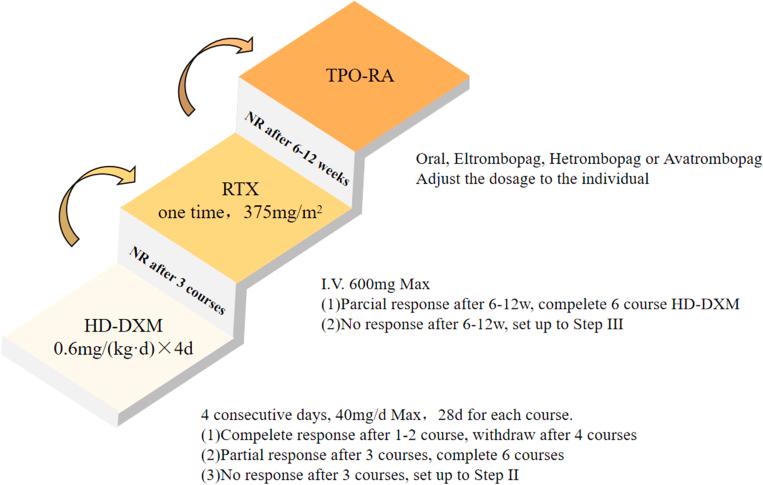
The stepwise response-guided treatment protocol is an individualized stratified immune thrombocytopenia treatment starting with high-dose dexamethasone, then adding rituximab and TPO-RAs in sequential order according to treatment response. A prospective, multicenter clinical cohort study enrolled severe P/CITP children with a 1-year follow-up. We compared the treatment outcome response of platelet count, bleeding control, and treatment-related side effects and cost outcomes (escalation status, SRoT, and treatment costs) between the stepwise group and the TPO-RA-based second-line treatment group (TPO-RA group).
RESULTS
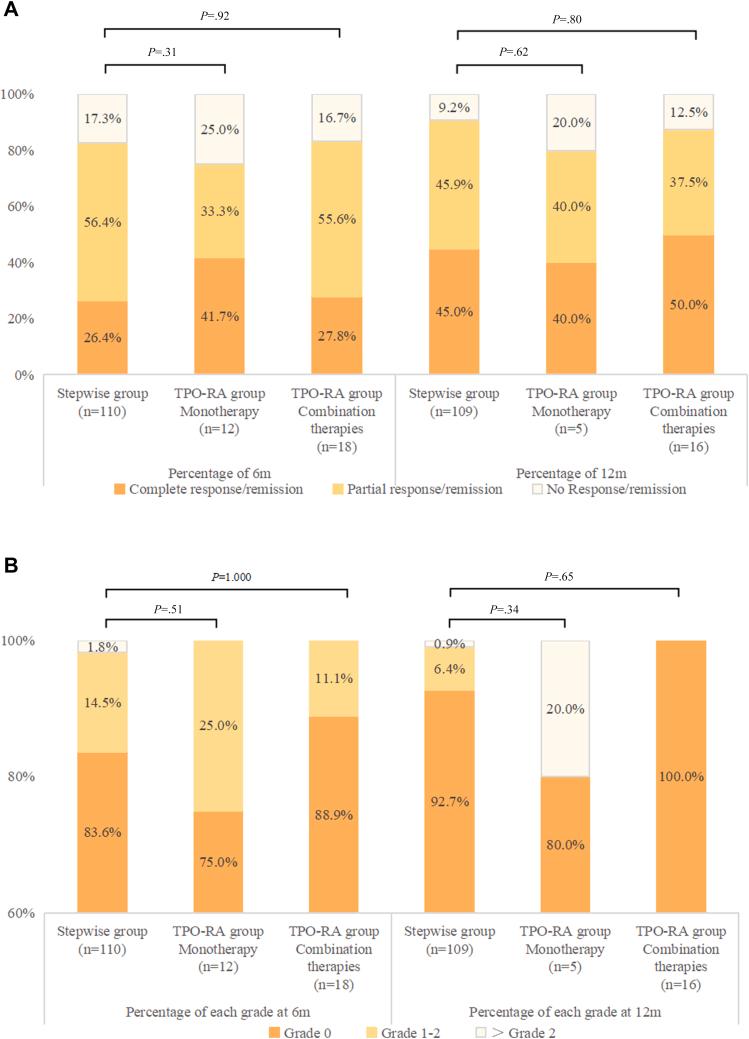
The study enrolled 143 cases of severe P/CITP children with a 12-month follow-up period. There were no differences in baseline characteristics between the stepwise and TPO-RA groups ( > .05). Response/remission rates and bleeding grades showed no differences ( > .05), but there were fewer side effects related to treatment in the stepwise group (9.0%; < .00). A total of 74% in the stepwise group achieved SRoT while none in the TPO-RA group did. The cost of treatment was significantly lower in the stepwise group compared with the TPO-RA group over the 12-month follow-up period (USD 68.26/kg vs USD 384.76/kg, < .00).
CONCLUSION
The stepwise response-guided treatment protocol effectively stratifies children with severe P/CITP based on treatment response, enabling individualized treatment strategies. This protocol achieves comparable efficacy and safety while reducing the treatment burden compared with TPO-RA-based second-line therapy, making it a preferable option for children with severe P/CITP.
背景
对于重度持续性/慢性免疫性血小板减少症患儿,国际上一线二线治疗推荐为基于血小板生成素受体激动剂(TPO-RA)的治疗;然而,不到30%的患儿能够在停药后实现持续缓解(SRoT),这导致了沉重的医疗负担。
目的
本研究旨在证实与基于TPO-RA的二线治疗相比,逐步反应引导治疗方案对重度持续性/慢性免疫性血小板减少症(P/CITP)患儿的疗效。
方法
逐步反应引导治疗方案是一种个体化分层免疫性血小板减少症治疗方法,起始于高剂量地塞米松,然后根据治疗反应依次添加利妥昔单抗和TPO-RA。一项前瞻性、多中心临床队列研究纳入了重度P/CITP患儿,并进行为期1年的随访。我们比较了逐步治疗组和基于TPO-RA的二线治疗组(TPO-RA组)在血小板计数、出血控制、治疗相关副作用和成本结果(升级状态、SRoT和治疗成本)方面的治疗结果反应。
结果
该研究纳入了143例重度P/CITP患儿,随访期为12个月。逐步治疗组和TPO-RA组之间在基线特征方面无差异(P>0.05)。反应/缓解率和出血分级无差异(P>0.05),但逐步治疗组中与治疗相关的副作用较少(9.0%;P<0.00)。逐步治疗组中共有74%的患儿实现了SRoT,而TPO-RA组中无一例实现。在12个月的随访期内,逐步治疗组的治疗成本显著低于TPO-RA组(68.26美元/千克对384.76美元/千克,P<0.00)。
结论
逐步反应引导治疗方案基于治疗反应有效地对重度P/CITP患儿进行分层,从而实现个体化治疗策略。与基于TPO-RA的二线治疗相比,该方案在疗效和安全性相当的同时,降低了治疗负担,使其成为重度P/CITP患儿的更优选择。

 Zotero 插件