
接受抗程序性细胞死亡蛋白1治疗的晚期非小细胞肺癌患者淋巴组织的3'-脱氧-3'-氟胸苷PET成像
3'-deoxy-3'-F-fluorothymidine PET imaging of lymphoid tissues in patients with advanced non-small cell lung cancer undergoing anti-programmed cell death-1 therapy.
作者信息
Sato Masayuki, Umeda Yukihiro, Tsujikawa Tetsuya, Mori Tetsuya, Shimada Akikazu, Sonoda Tomoaki, Yamaguchi Makiko, Honjo Chisato, Waseda Yuko, Kiyono Yasushi, Ishizuka Tamotsu, Okazawa Hidehiko
机构信息
Department of Respiratory Medicine, Faculty of Medical Sciences, University of Fukui, 23-3 Matsuoka-Shimoaizuki, Eiheiji, 910-1193, Fukui, Japan.
Department of Radiology, Faculty of Medical Sciences, University of Fukui, 23-3 Matsuoka-Shimoaizuki, Eiheiji, 910-1193, Fukui, Japan.
出版信息
EJNMMI Res. 2025 Apr 1;15(1):32. doi: 10.1186/s13550-025-01225-7.
BACKGROUND
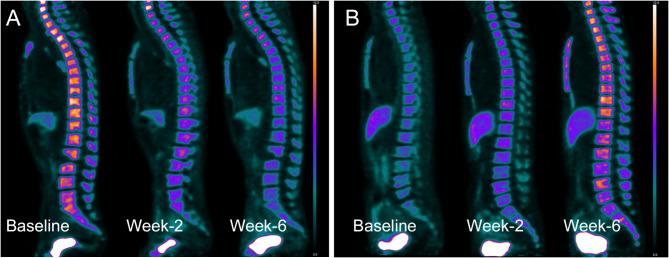
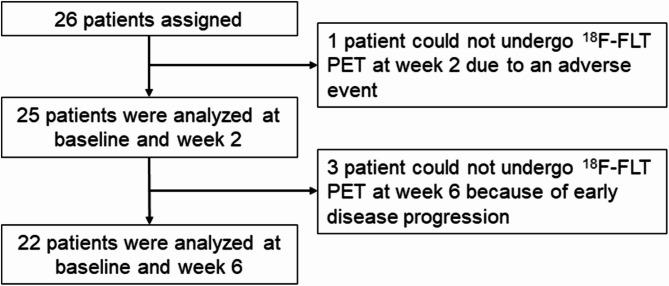
Anti-programmed cell death-1 (anti-PD-1) therapy has become the standard immunotherapy for patients with advanced non-small cell lung cancer (NSCLC). However, little is known about the organs influenced by PD-1 inhibitors on a patient's tumor immunity. We examined the changes in lymphoid tissue proliferation before and after PD-1 inhibitor treatment using 3'-deoxy-3'-[F]-fluorothymidine (F-FLT) positron emission tomography (PET). This study included 25 patients with advanced NSCLC who underwent F-FLT PET before and 2 and 6 weeks after the initiation of PD-1 inhibitor treatment. We determined the average standardized uptake value (SUV) in the spleen, maximum SUV (SUV) in the lymph nodes, and the SUV, SUV, proliferative vertebral volume (PVV), and total vertebral proliferation (TVP) in the thoracolumbar vertebral bodies using F-FLT PET and blood test data. The relationship between the rate of change in these parameters before and after treatment and the tumor response was evaluated.
RESULTS
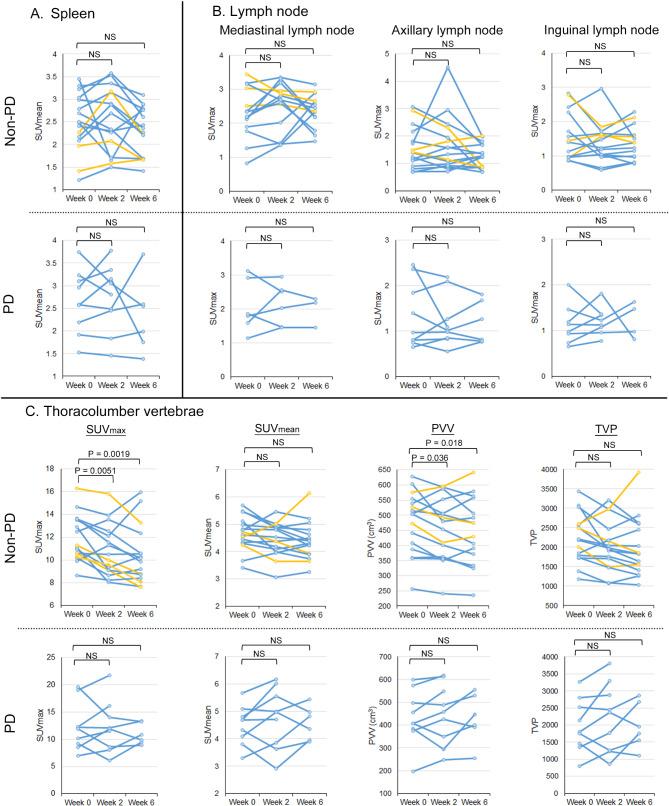
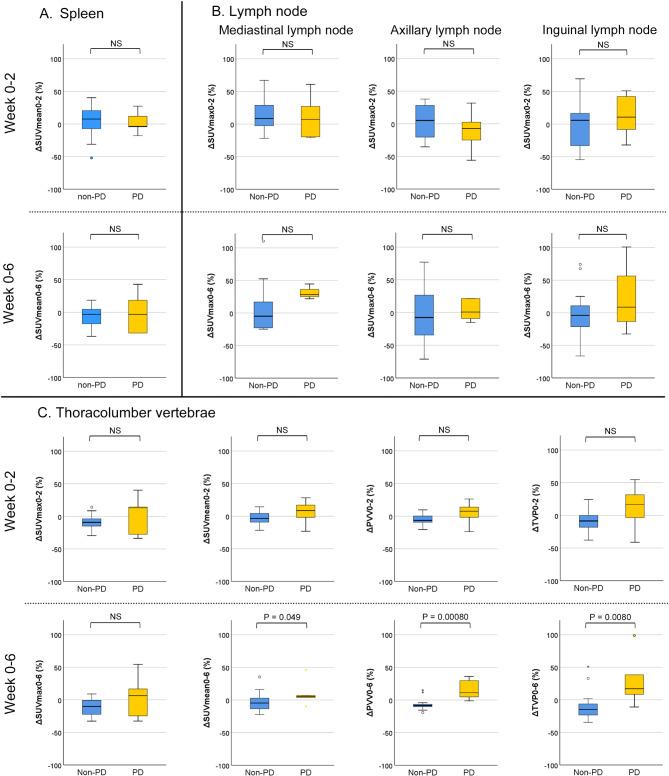
The baseline F-FLT accumulation in the lymphoid tissues or blood test data between the progressive disease (PD) and non-PD groups were not significantly different. In the spleen and lymph nodes, changes in F-FLT accumulation from baseline to 2 or 6 weeks did not differ between the non-PD and PD groups. However, mediastinal lymph node accumulation tended to increase transiently at week 2 compared to that before treatment initiation (median SUV 2.19 vs. 2.64, P = 0.073). Regarding changes in vertebral accumulation in the non-PD group, the SUV, and PVV were significantly lower at weeks 2 and 6. In the percent changes in F-FLT accumulation of the vertebrae after the treatment initiation, the PD group was significantly higher than the non-PD group at the 6-week evaluation (median ΔTVP0-6, 17.0% vs. -13.0%, P = 0.0080).
CONCLUSIONS
In patients with advanced NSCLC who achieved a tumor response, proliferation decreased in the bone marrow, but not in the spleen or lymph nodes, 6 weeks after treatment initiation. F-FLT PET can help monitor changes in tumor immunity in each lymphoid tissue and may serve as a biomarker for the response to immune checkpoint inhibitor therapy.
背景
抗程序性细胞死亡蛋白1(anti-PD-1)疗法已成为晚期非小细胞肺癌(NSCLC)患者的标准免疫疗法。然而,关于PD-1抑制剂对患者肿瘤免疫影响的器官知之甚少。我们使用3'-脱氧-3'-[F]-氟胸腺嘧啶核苷(F-FLT)正电子发射断层扫描(PET)检查了PD-1抑制剂治疗前后淋巴组织增殖的变化。本研究纳入了25例晚期NSCLC患者,这些患者在开始PD-1抑制剂治疗前、治疗后2周和6周接受了F-FLT PET检查。我们使用F-FLT PET和血液检测数据确定了脾脏的平均标准化摄取值(SUV)、淋巴结的最大SUV(SUV)以及胸腰椎椎体的SUV、SUV、增殖椎体体积(PVV)和总椎体增殖(TVP)。评估了这些参数治疗前后变化率与肿瘤反应之间的关系。
结果
疾病进展(PD)组和非PD组之间,淋巴组织中的基线F-FLT蓄积或血液检测数据无显著差异。在脾脏和淋巴结中,非PD组和PD组从基线到2周或6周的F-FLT蓄积变化无差异。然而,与治疗开始前相比,纵隔淋巴结蓄积在第2周时有短暂增加的趋势(中位SUV 2.19对2.64,P = 0.073)。关于非PD组椎体蓄积的变化,SUV和PVV在第2周和第6周时显著降低。在治疗开始后椎体F-FLT蓄积的百分比变化中,在6周评估时PD组显著高于非PD组(中位ΔTVP0-6,17.0%对-13.0%,P = 0.0080)。
结论
在肿瘤有反应的晚期NSCLC患者中,治疗开始6周后,骨髓中的增殖减少,但脾脏或淋巴结中的增殖未减少。F-FLT PET有助于监测各淋巴组织中肿瘤免疫的变化,并可能作为免疫检查点抑制剂治疗反应的生物标志物。
 Zotero 插件