
鼻腔一氧化氮作为慢性鼻炎治疗反应的客观评估工具
Nasal Nitric Oxide as an Objective Evaluation Tool for Treatment Response in Chronic Rhinitis.
作者信息
Lee Sangeun, Seong Su Mi, Oh Hyeop, Yoon Jihun, Kim Bo Hae, Park Joo Hyun, Lim Yun-Sung, Cho Chang Gun, Park Seok-Won, Kim Jin Youp
机构信息
Department of Otorhinolaryngology-Head and Neck Surgery, Ilsan Hospital, Dongguk University, Goyang, Republic of Korea.
Sensory Organ Research Institute, College of Medicine, Dongguk University, Gyeongju, Republic of Korea.
出版信息
J Rhinol. 2025 Mar;32(1):40-47. doi: 10.18787/jr.2025.00009. Epub 2025 Mar 21.
BACKGROUND AND OBJECTIVES
Inconsistencies in nasal nitric oxide (nNO) values, due to anatomical variations and comorbidities, challenge the accurate assessment of upper airway inflammation severity. We hypothesized that changes in nNO levels following treatment for chronic rhinitis would be consistent and provide relative value. This study aimed to evaluate the correlation between changes in nNO levels and symptomatic improvements following treatment for chronic rhinitis.
METHODS
This prospective observational study included 46 participants diagnosed with chronic rhinitis between December 2021 and November 2023. nNO measurements, evaluations of four nasal and two ocular symptoms, and quality of life questionnaires were conducted at baseline and after one month of treatment. Baseline laboratory tests included serum total immunoglobulin E levels, blood eosinophil percentages, and skin prick tests.
RESULTS
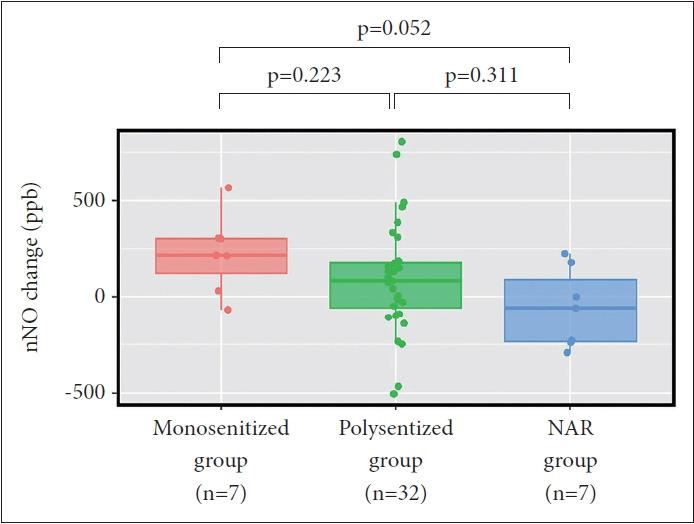
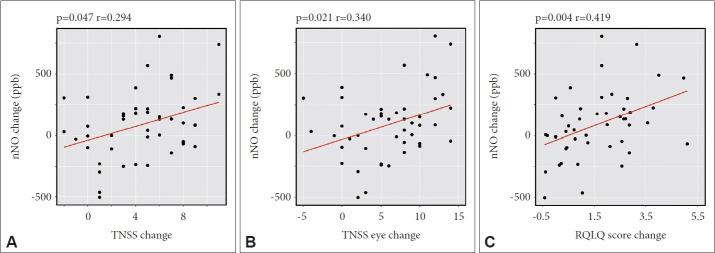
The Total Nasal Symptom Score (TNSS), TNSS with ocular symptoms (TNSS eye), and Rhinoconjunctivitis Quality of Life Questionnaire (RQLQ) scores significantly decreased following treatment (all p<0.001). nNO levels also decreased significantly after treatment (p=0.036). Moreover, changes in nNO were significantly correlated with changes in TNSS, TNSS eye, and RQLQ scores (p=0.047, r=0.294; p=0.021, r=0.340; and p=0.004, r=0.419, respectively).
CONCLUSION
In patients with chronic rhinitis, changes in TNSS, TNSS eye, and RQLQ scores were correlated with changes in nNO levels after treatment. nNO may serve as a potential objective evaluation tool for chronic rhinitis, particularly in patients who have difficulty reporting symptoms.
背景与目的
由于解剖结构变异和合并症,鼻一氧化氮(nNO)值存在不一致性,这对准确评估上呼吸道炎症严重程度构成挑战。我们假设慢性鼻炎治疗后nNO水平的变化将是一致的,并能提供相对价值。本研究旨在评估慢性鼻炎治疗后nNO水平变化与症状改善之间的相关性。
方法
这项前瞻性观察性研究纳入了2021年12月至2023年11月期间诊断为慢性鼻炎的46名参与者。在基线和治疗1个月后进行nNO测量、四项鼻部和两项眼部症状评估以及生活质量问卷调查。基线实验室检查包括血清总免疫球蛋白E水平、血液嗜酸性粒细胞百分比和皮肤点刺试验。
结果
治疗后总鼻症状评分(TNSS)、伴有眼部症状的TNSS(TNSS eye)和变应性鼻炎生活质量问卷(RQLQ)评分均显著降低(均p<0.001)。治疗后nNO水平也显著降低(p=0.036)。此外,nNO的变化与TNSS、TNSS eye和RQLQ评分的变化显著相关(分别为p=0.047,r=0.294;p=0.立021,r=0.340;p=0.004,r=0.419)。
结论
在慢性鼻炎患者中,TNSS、TNSS eye和RQLQ评分的变化与治疗后nNO水平的变化相关。nNO可能作为慢性鼻炎的潜在客观评估工具,尤其是在症状报告困难的患者中。


 Zotero 插件