
通过多器官方法对暴露于新型内分泌干扰物的鲿科鱼进行慢性毒性处理时免疫基因表达谱的调节
Modulation of immune gene expression profile in Labeo catla with chronic toxicity to emerging endocrine disruptors through a multiorgan approach.
作者信息
Das Basanta Kumar, Roy Suvra, Kumar Vikash, Adhikari Anupam, Ganguly Satabdi, Bisai Kampan
机构信息
ICAR-Central Inland Fisheries Research Institute (ICAR-CIFRI), Barrackpore, India.
Aquatic Environmental Biotechnology (AEB) Division, ICAR-Central Inland Fisheries Research Institute (CIFRI), Barrackpore, India.
出版信息
Sci Rep. 2025 Apr 2;15(1):11244. doi: 10.1038/s41598-025-95996-7.
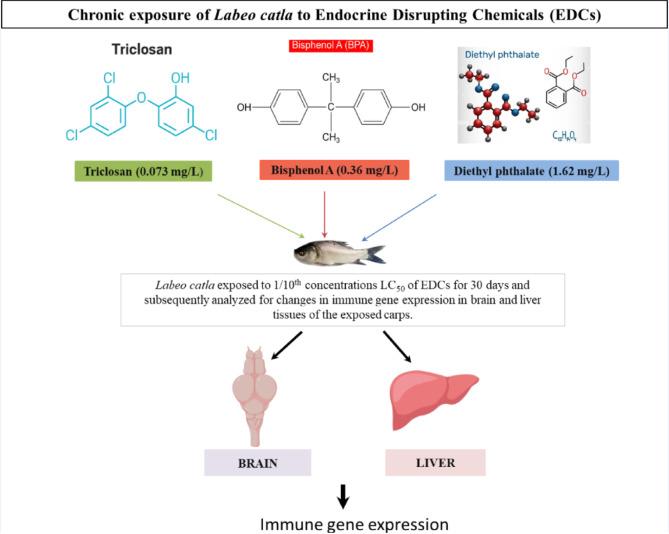
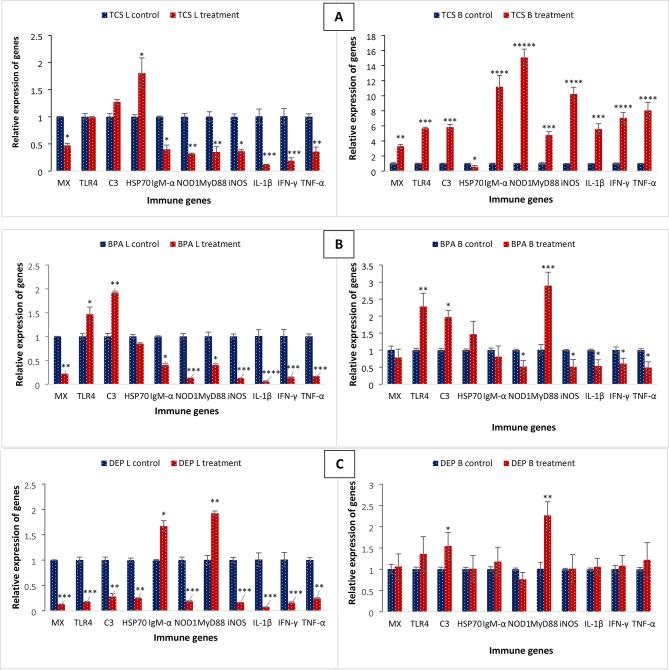
Endocrine-disrupting chemicals (EDCs) in the aquatic environment are an emerging concern and can lead to adverse health effects on humans and aquatic life. EDCsare ubiquitous in several daily use and personal care products and ubiquitous in aquatic ecosystems. The aquatic ecosystems also serve as major sinks of EDCs and have even been found to accumulate in aquatic organisms. Fish are an important sentinel species in the aquatic system and are a reliable indication of environmental water pollution. In the present study, we have assessed the immunotoxicity effects of three important EDCs, i.e., triclosan (TCS), bisphenol A (BPA), and diethyl phthalate (DEP). There is mounting evidence that EDCs impact several physiological systems, including fish immune systems. Hence, to better understand the immune system's complexity, we have investigated how EDCs alter the immune responses and can aggravate immunotoxicity using Labeo catla as a model fish species. The results showed significant upregulation of immune gene expression; exposure to EDCs differentially modulates immunity across the different organs (liver and brain) of Labeo catla. The present study highlighted that endocrine-disrupting compounds (TCS, BPA, and DEP) have a significant immunotoxicity effect in fish and activate several immunological pathways to control the toxic effect and maintain homeostasis. The results also indicate that immune genes can be used as a biomarker for EDC toxicity. However, further studies need to see how immune-disrupting effects happen at actual exposure levels in the environment to EDCs.
水生环境中的内分泌干扰化学物质(EDCs)是一个新出现的问题,可能会对人类和水生生物的健康产生不利影响。EDCs在多种日常用品和个人护理产品中普遍存在,在水生生态系统中也无处不在。水生生态系统还是EDCs的主要汇,甚至已被发现会在水生生物体内积累。鱼类是水生系统中的重要指示物种,是环境水污染的可靠指标。在本研究中,我们评估了三种重要的EDCs,即三氯生(TCS)、双酚A(BPA)和邻苯二甲酸二乙酯(DEP)的免疫毒性作用。越来越多的证据表明,EDCs会影响包括鱼类免疫系统在内的多个生理系统。因此,为了更好地理解免疫系统的复杂性,我们以印度野鲮作为模式鱼类,研究了EDCs如何改变免疫反应并加剧免疫毒性。结果显示免疫基因表达显著上调;暴露于EDCs会对印度野鲮不同器官(肝脏和大脑)的免疫产生不同的调节作用。本研究强调,内分泌干扰化合物(TCS、BPA和DEP)对鱼类具有显著的免疫毒性作用,并激活多种免疫途径以控制毒性作用并维持体内平衡。结果还表明,免疫基因可作为EDCs毒性的生物标志物。然而,还需要进一步研究在环境中实际接触EDCs的水平下,免疫干扰效应是如何发生的。

 Zotero 插件