
循环自然杀伤细胞上免疫检查点TIM-3、LAG-3、TIGIT和Siglec-7的差异表达——来自健康供体与胃癌患者对比的见解
Differential Expression of Immune Checkpoints TIM-3, LAG-3, TIGIT, and Siglec-7 on Circulating Natural Killer Cells - Insights from Healthy Donors Compared to Gastric Cancer Patients.
作者信息
Seiffert Sabine, Blaudszun André-René, Shibru Benjamin, Körfer Justus, Köhl Ulrike, Fricke Stephan, Sack Ulrich, Boldt Andreas
机构信息
Institute of Clinical Immunology, University of Leipzig, Leipzig, Germany.
Fraunhofer Institute for Cell Therapy and Immunology (IZI), Leipzig, Germany.
出版信息
Oncol Res Treat. 2025 Apr 3:1-16. doi: 10.1159/000545429.
INTRODUCTION
The complex, multifactorial nature of gastric cancer presents significant challenges in the development of effective immunotherapies. Targeting immune checkpoints has emerged as a promising strategy, with blockade therapies demonstrating clinical success. However, resistance in a subset of patients emphasizes the need for alternative approaches. Exploration of novel immune checkpoints, particularly on natural killer (NK) cells, could enhance the efficacy and potency of immunotherapy, offering new avenues for overcoming resistance and improving patient outcomes. NK cells are crucial in the primary defense against viral infections, tumor development, and metastasis. The cytotoxic function of NK cells is finely regulated by a complex array of activating and inhibitory receptors, including checkpoint receptors. Malignantly transformed cells can impair NK-cell activity by expressing soluble or membrane-bound checkpoint ligands, thereby modulating immune responses to support tumor progression.
METHODS
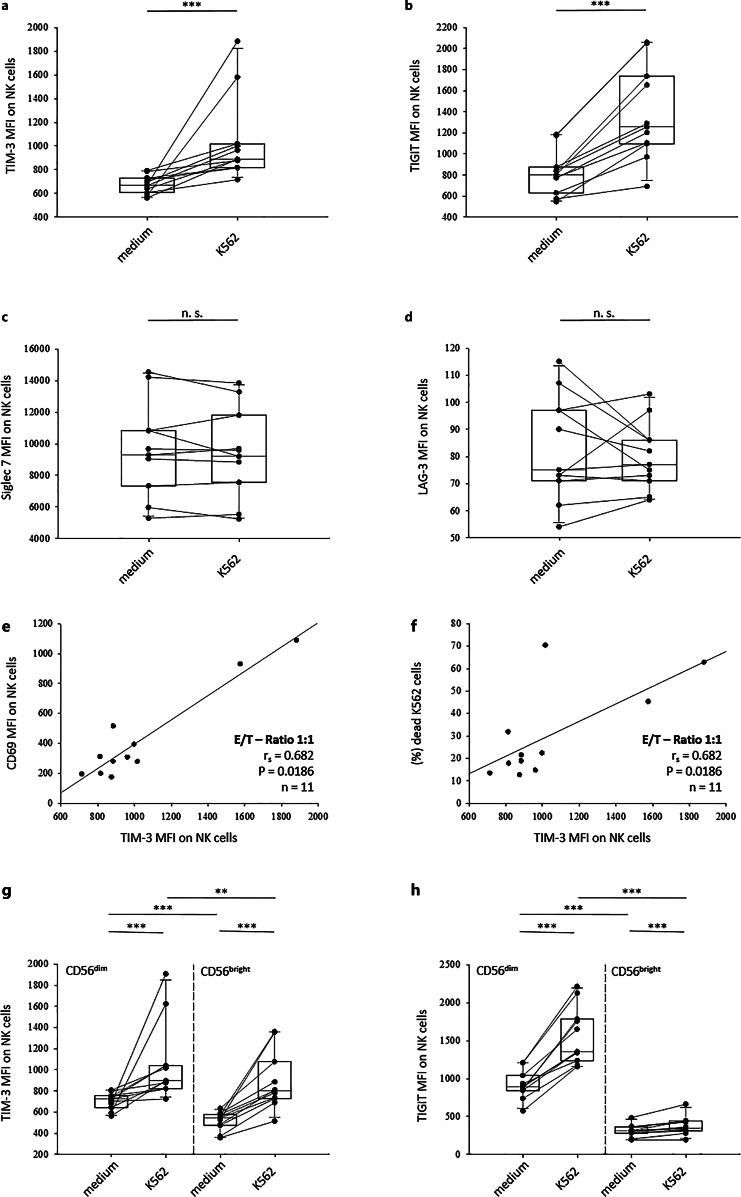
To investigate this dilemma, we simulated in vitro activation by NK-cell co-incubation with K562 cells and analyzed expression of TIM-3, LAG-3, TIGIT, and Siglec-7. After that, we analyzed the checkpoint expression of circulating NK cells from 35 healthy donors and compared it to their expression in patients with gastric cancer (n = 21) using flow cytometry.
RESULTS
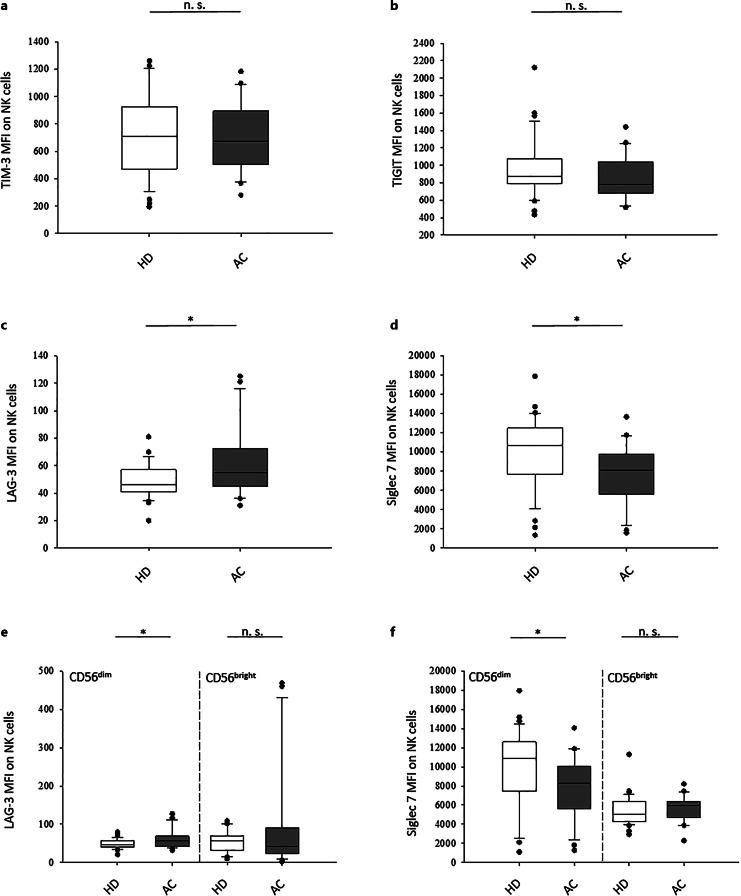
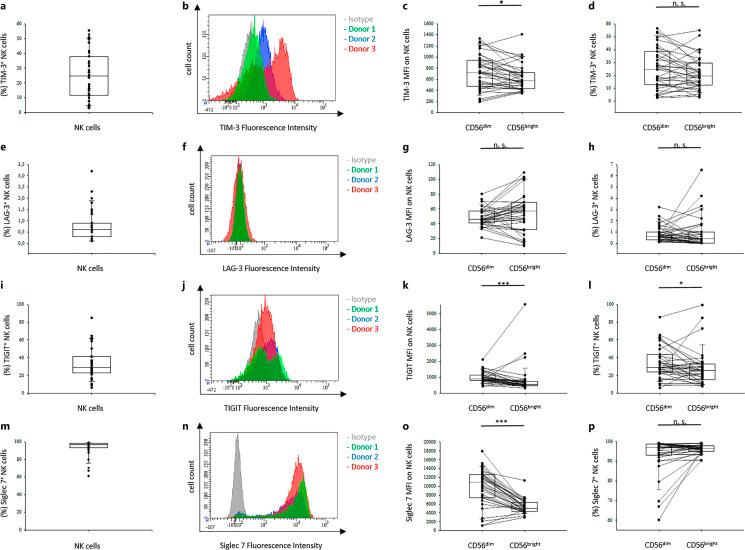
In healthy donors, we observed that 25-97% of all circulating NK cells expressed TIM-3, TIGIT and Siglec-7, while only a small fraction of 0.6% expressed LAG-3. Co-incubation of peripheral blood mononuclear cells from healthy donors with K562 cells resulted in heightened expression levels of TIM-3 and TIGIT on NK cells. Conversely, NK cells in patients with gastric cancer showed an increased LAG-3 and reduced Siglec-7 expression.
CONCLUSION
Our findings suggest the potential of LAG-3 as a next-generation checkpoint molecule, alongside Siglec-7. Especially targeting the sialic acid-Siglec-7 axis may offer promising therapeutic strategies for various cancer types in the future.
引言
胃癌具有复杂的多因素性质,这给有效免疫疗法的开发带来了重大挑战。靶向免疫检查点已成为一种有前景的策略,阻断疗法已取得临床成功。然而,一部分患者出现的耐药性凸显了采用替代方法的必要性。探索新型免疫检查点,特别是在自然杀伤(NK)细胞上的检查点,可能会提高免疫疗法的疗效和效力,为克服耐药性和改善患者预后提供新途径。NK细胞在抵御病毒感染、肿瘤发生和转移的初级防御中至关重要。NK细胞的细胞毒性功能受到一系列复杂的激活和抑制受体(包括检查点受体)的精细调节。恶性转化细胞可通过表达可溶性或膜结合的检查点配体来损害NK细胞活性,从而调节免疫反应以支持肿瘤进展。
方法
为了研究这一困境,我们通过将NK细胞与K562细胞共孵育来模拟体外激活,并分析T细胞免疫球蛋白和粘蛋白结构域3(TIM-3)、淋巴细胞活化基因3蛋白(LAG-3)、T细胞免疫球蛋白和免疫受体酪氨酸抑制基序结构域(TIGIT)和唾液酸结合免疫球蛋白样凝集素7(Siglec-7)的表达。之后,我们使用流式细胞术分析了35名健康供体循环NK细胞的检查点表达,并将其与胃癌患者(n = 21)的表达进行比较。
结果
在健康供体中,我们观察到所有循环NK细胞中有25% - 97%表达TIM-3、TIGIT和Siglec-7,而只有0.6%的一小部分表达LAG-3。健康供体的外周血单核细胞与K562细胞共孵育导致NK细胞上TIM-3和TIGIT的表达水平升高。相反,胃癌患者的NK细胞显示LAG-3表达增加,Siglec-7表达降低。
结论
我们的研究结果表明,LAG-3与Siglec-7一样,有潜力成为下一代检查点分子。特别是靶向唾液酸 - Siglec-7轴可能在未来为各种癌症类型提供有前景的治疗策略。

 Zotero 插件