
氯胺酮作为多模式镇痛的一部分,可能会减少心脏手术后的阿片类药物用量:一项回顾性观察队列研究。
Ketamine as part of multi-modal analgesia may reduce opioid requirements following cardiac surgery: a retrospective observational cohort study.
作者信息
Hall James, Chung Juri, Khilkin Michael, Elkomos-Botros George
机构信息
Cardiothoracic Critical Care, Department of Cardiac Surgery, NYU Langone, Long Island Hospital, 259 1st Street, Mineola, New York, 11501, USA.
Critical Care Pharmacy, NYU Langone, Long Island Hospital, 259 1st Street, Mineola, New York, 11501, USA.
出版信息
J Cardiothorac Surg. 2025 Apr 3;20(1):178. doi: 10.1186/s13019-025-03405-x.
BACKGROUND
Postoperative pain control in cardiac surgery is often managed with opioid medications. Insufficient analgesia can result in complications including splinting, pneumonia, and delay of appropriate rehabilitation. Given the risks and adverse effects of opioids including sedation, respiratory depression, delirium, and decreased gastrointestinal motility, hyperalgesia and potential for addiction, strategies for opioid reduction are likely to improve outcomes, therefore multimodal opioid sparing pain regimens are preferred. Recently, there is increased evidence that low dose Ketamine, an N-methyl-D-Aspartate (NMDA) receptor antagonist, is safe and effective for analgesia in postoperative patients and may be appropriate to this setting.
METHODS
This is a single center, retrospective, observational, cohort study over a one year period involving postoperative adult cardiac surgery comparing those who received a single dose of postoperative ketamine, 0.3 mg/kg over 30 min, with those who did not receive any ketamine. Other analgesic protocols were similar between groups and did not include additional ketamine. A total of 120 patient charts were reviewed, of which 96 met inclusion criteria, 32 in the ketamine group and 64 in the standard care group. Charts were reviewed for opioid and other pain medication requirements during the postoperative period and on discharge, and for secondary outcomes: hospital length of stay, ICU length of stay, in-hospital and 30-day mortality, 30-day readmission, and rates of delirium, emergence reactions, and need for escalated respiratory support.
RESULTS
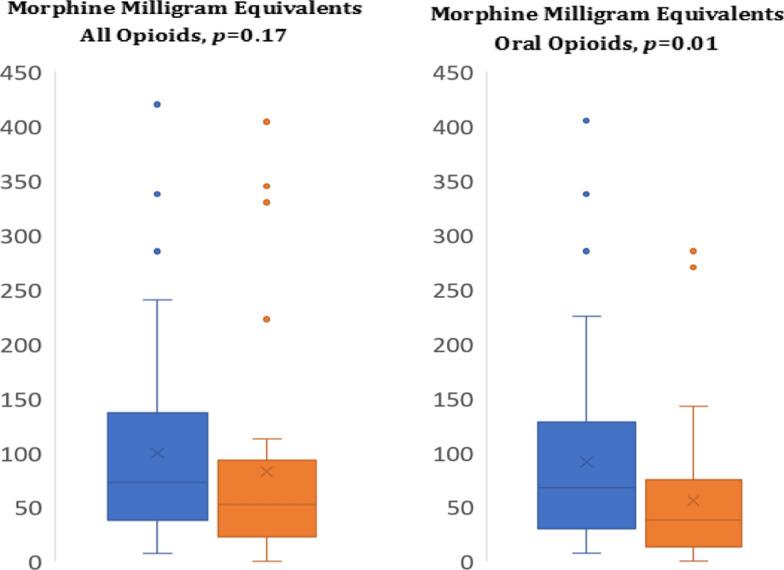
The group who received postoperative ketamine required 28.8 morphine milligram equivalents (MME) less postoperative opioid (90.1 mg vs 118.9 mg, p = 0.167), and was prescribed an average of 15.8 MME less on discharge (p < 0.001). Intraoperatively, both groups received 1000 mg acetaminophen, 2 mg intravenous morphine and 100 mcg fentanyl, 26 MME, by protocol. No ketamine was administered intraoperatively or preoperatively. The groups differed in respect to operation type and controlling for this parameter failed to achieve significance in needs during admission (p = 0.215), but remained significant on discharge (p = 0.02). The non-ketamine group received more ketorolac (15.5 vs 10.1, p = 0.06). The ketamine group required less acetaminophen but more gabapentin. There was no difference in hospital or ICU length of stay. There was no delirium or mortality in either group. Respiratory depression occurred in 15 patients who all subsequently received ketamine. No patient developed respiratory depression after ketamine.
CONCLUSIONS
Ketamine may be a reasonable choice for postoperative cardiac surgery analgesia and may reduce the need for opioids on discharge, and possibly during admission.
背景
心脏手术术后疼痛控制通常使用阿片类药物。镇痛不足会导致包括呼吸抑制、肺炎和适当康复延迟等并发症。鉴于阿片类药物的风险和不良反应,包括镇静、呼吸抑制、谵妄、胃肠蠕动减慢、痛觉过敏和成瘾可能性,减少阿片类药物使用的策略可能会改善预后,因此多模式阿片类药物节省方案更受青睐。最近,越来越多的证据表明,低剂量氯胺酮,一种N-甲基-D-天冬氨酸(NMDA)受体拮抗剂,对术后患者镇痛是安全有效的,可能适用于这种情况。
方法
这是一项单中心、回顾性、观察性队列研究,为期一年,涉及成年心脏手术术后患者,比较接受单次术后氯胺酮剂量(0.3mg/kg,30分钟内)的患者与未接受任何氯胺酮的患者。两组之间的其他镇痛方案相似,且不包括额外的氯胺酮。共审查了120份患者病历,其中96份符合纳入标准,氯胺酮组32份,标准护理组64份。审查病历以了解术后期间和出院时的阿片类药物及其他疼痛药物需求,以及次要结局:住院时间、重症监护病房(ICU)住院时间、住院期间和30天死亡率、30天再入院率以及谵妄、苏醒反应和升级呼吸支持需求率。
结果
接受术后氯胺酮的组术后所需阿片类药物少28.8吗啡毫克当量(MME)(90.1mg对118.9mg,p = 0.167),出院时平均处方量少15.8 MME(p < 0.001)。术中,两组均按方案接受1000mg对乙酰氨基酚、2mg静脉注射吗啡和100mcg芬太尼,共26 MME。术中或术前未给予氯胺酮。两组在手术类型方面存在差异,控制该参数后,入院期间的需求差异未达到显著水平(p = 0.215),但出院时仍具有显著性(p = 0.02)。非氯胺酮组接受了更多的酮咯酸(15.5对10.1,p = 0.06)。氯胺酮组需要的对乙酰氨基酚较少,但加巴喷丁较多。住院时间或ICU住院时间无差异。两组均无谵妄或死亡。15例患者发生呼吸抑制,随后均接受了氯胺酮治疗。氯胺酮治疗后无患者发生呼吸抑制。
结论
氯胺酮可能是心脏手术术后镇痛的合理选择,可能会减少出院时以及可能在入院期间对阿片类药物的需求。

 Zotero 插件