
探针捕获宏基因组学在脓毒症患者中的临床应用:一项多中心前瞻性研究。
Clinical implement of Probe-Capture Metagenomics in sepsis patients: A multicentre and prospective study.
作者信息
Sun Qin, Teng Ran, Shi Qiankun, Liu Yun, Cai Xing, Yang Bin, Cao Quan, Shu Chang, Mei Xu, Zeng Weiqi, Hu Bingxue, Zhang Junyi, Qiu Haibo, Liu Ling
机构信息
Jiangsu Provincial Key Laboratory of Critical Care Medicine, Department of Critical Care Medicine, Zhongda Hospital, School of Medicine, Southeast University, Nanjing, China.
Department of Intensive Care Unit, Nanjing First Hospital, Nanjing Medical University, Nanjing, China.
出版信息
Clin Transl Med. 2025 Apr;15(4):e70297. doi: 10.1002/ctm2.70297.
BACKGROUND
Accurate pathogen identification is critical for managing sepsis. However, traditional microbiological methods are time-consuming and exhibit limited sensitivity, particularly with blood samples. Metagenomic sequencing of plasma or whole blood was highly affected by the proportion of host nucleic acid.
METHODS
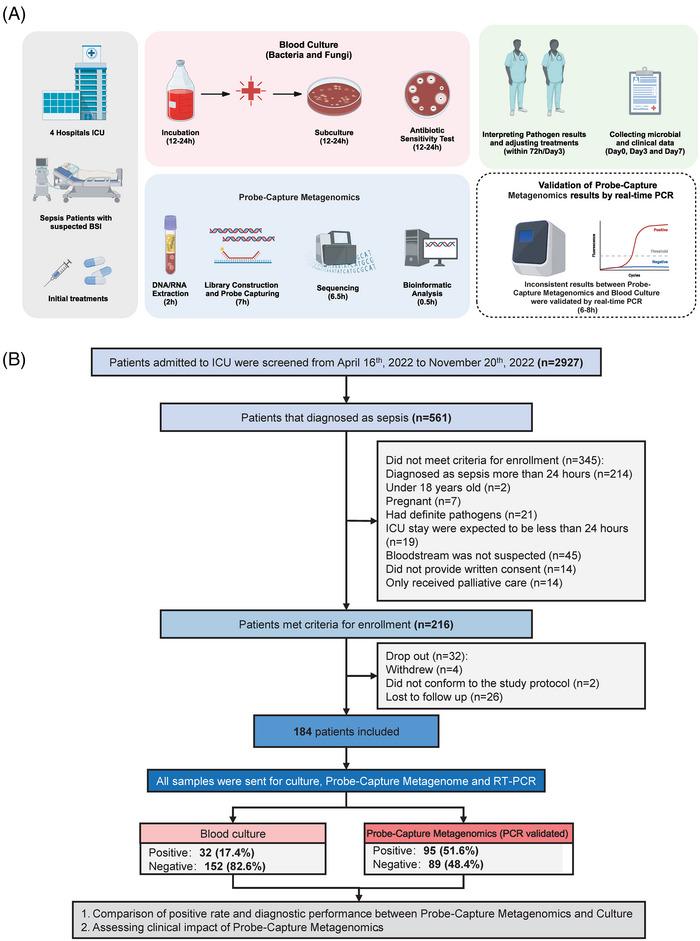
We developed a Probe-Capture Metagenomic assay and established a multicentre prospective cohort to assess its clinical utility. In this study, 184 blood samples from patients suspected of sepsis were sent for blood culture and Probe-Capture Metagenomic sequencing before using antibiotics. The pathogen-positive rate and auxiliary abilities in diagnosis were compared among Probe-Capture Metagenomics, blood culture and real-time PCR (RT-PCR). Antibiotic therapy adjustments were based on the identification of pathogens, and changes in the Sequential Organ Failure Assessment (SOFA) score were monitored on days 0, 3 and 7 of admission.
RESULTS
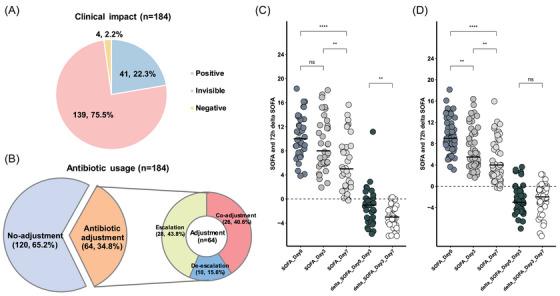
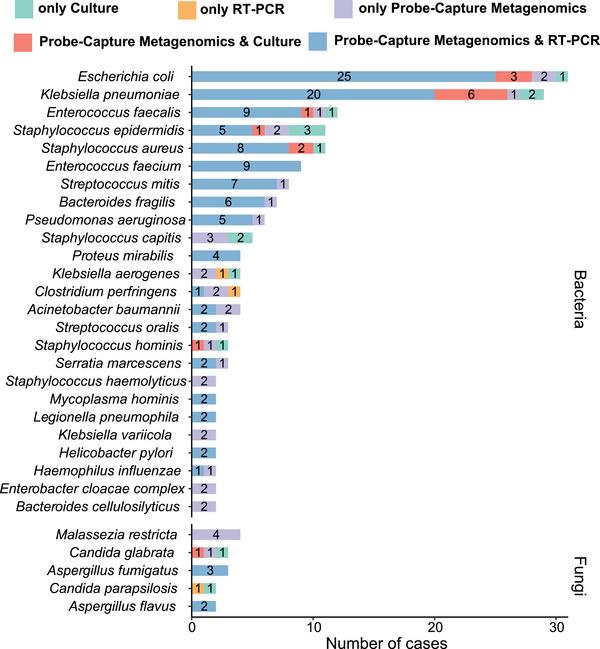
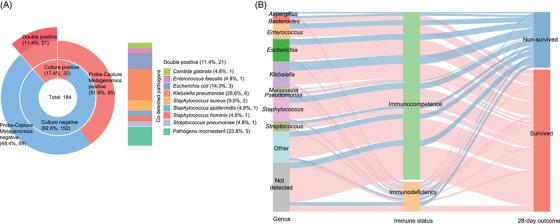
A total of 184 sepsis patients were enrolled, with a mean age of 66 years (range 56-74). The Probe-Capture Metagenomics method, confirmed by RT-PCR, demonstrated a significantly higher pathogen detection rate than blood culture alone (51.6% vs. 17.4%, p < .001). When combining the results of blood culture and RT-PCR, Probe-Capture Metagenomics achieved a concordance rate of 91.8% (169/184), with a sensitivity of 100% and specificity of 87.1%. In terms of clinical impact, antibiotic therapy was adjusted for 64 patients (34.8%) based on the results from Probe-Capture Metagenomics, and 41 patients (22.3%) showed a > 2-point decrease in SOFA score following antibiotic adjustments.
CONCLUSION
Probe-Capture Metagenomics significantly enhances the ability of pathogen detection compared with traditional metagenomics. Compared to blood culture and RT-PCR in sepsis patients, it leads to improved antibiotic treatment and better patient outcomes. This study, for the first time, evaluates the clinical impact of metagenomic sequencing by integrating antibiotic adjustments and SOFA score changes, indicating that approximately one-fifth of sepsis patients benefit from this advanced diagnostic approach.
TRIAL REGISTRATION
This study has been registered in clinical trials (clinicaltrials.gov) on 30 November 2018, and the registration number is NCT03760315.
KEY POINTS
Probe-Capture Metagenome had a significantly higher positive rate than blood culture (51.6% vs. 17.4%, p < .001). Combining blood culture and RT-PCR results, Probe-Capture Metagenome achieved a consistency rate of 91.8%. Antibiotics were adjusted in 34.8% of patients based on Probe-Capture Metagenome results, and 22.3% of patients experienced a more than 2-point decrease in SOFA score.
背景
准确的病原体鉴定对于脓毒症的管理至关重要。然而,传统的微生物学方法耗时且灵敏度有限,尤其是对于血液样本。血浆或全血的宏基因组测序受到宿主核酸比例的高度影响。
方法
我们开发了一种探针捕获宏基因组检测方法,并建立了一个多中心前瞻性队列以评估其临床效用。在本研究中,184例疑似脓毒症患者的血液样本在使用抗生素前被送去进行血培养和探针捕获宏基因组测序。比较了探针捕获宏基因组学、血培养和实时荧光定量聚合酶链反应(RT-PCR)的病原体阳性率及诊断辅助能力。抗生素治疗调整基于病原体鉴定,并在入院第0、3和7天监测序贯器官衰竭评估(SOFA)评分的变化。
结果
共纳入184例脓毒症患者,平均年龄66岁(范围56 - 74岁)。经RT-PCR验证,探针捕获宏基因组学方法显示出比单独血培养显著更高的病原体检测率(51.6%对17.4%,p <.001)。当结合血培养和RT-PCR结果时,探针捕获宏基因组学的一致性率达到91.8%(169/184),灵敏度为100%,特异性为87.1%。在临床影响方面,基于探针捕获宏基因组学的结果,64例患者(34.8%)的抗生素治疗得到调整,41例患者(22.3%)在抗生素调整后SOFA评分下降超过2分。
结论
与传统宏基因组学相比,探针捕获宏基因组学显著提高了病原体检测能力。与脓毒症患者的血培养和RT-PCR相比,它能改善抗生素治疗并带来更好的患者预后。本研究首次通过整合抗生素调整和SOFA评分变化来评估宏基因组测序的临床影响,表明约五分之一的脓毒症患者受益于这种先进的诊断方法。
试验注册
本研究于2018年11月30日在临床试验(clinicaltrials.gov)注册,注册号为NCT03760315。
关键点
探针捕获宏基因组的阳性率显著高于血培养(51.6%对17.4%,p <.001)。结合血培养和RT-PCR结果,探针捕获宏基因组的一致性率为91.8%。基于探针捕获宏基因组结果,34.8%的患者调整了抗生素,22.3%的患者SOFA评分下降超过2分。


 Zotero 插件