
通过肠-肝轴探讨肠道微生物群在结直肠癌肝转移中的作用。
Exploring the role of gut microbiota in colorectal liver metastasis through the gut-liver axis.
作者信息
Liu Qiu-Luo, Zhou Huijie, Wang Ziqiang, Chen Yan
机构信息
Colorectal Cancer Center, Department of General Surgery, West China Hospital, Sichuan University, Chengdu, China.
Institute of Digestive Surgery, Institute of General Surgery, West China Hospital, Sichuan University, Chengdu, China.
出版信息
Front Cell Dev Biol. 2025 Mar 13;13:1563184. doi: 10.3389/fcell.2025.1563184. eCollection 2025.
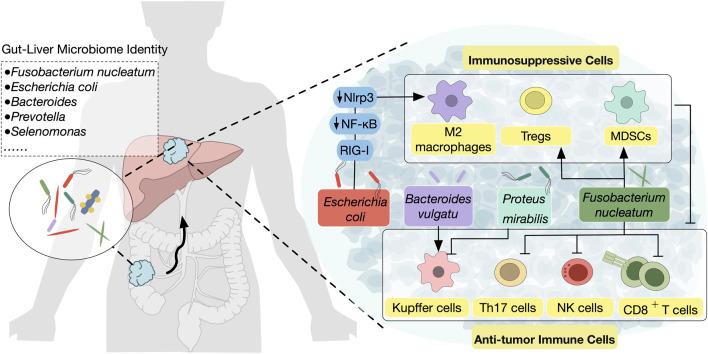
Colorectal liver metastasis (CRLM) represents a major therapeutic challenge in colorectal cancer (CRC), with complex interactions between the gut microbiota and the liver tumor microenvironment (TME) playing a crucial role in disease progression via the gut-liver axis. The gut barrier serves as a gatekeeper, regulating microbial translocation, which influences liver colonization and metastasis. Through the gut-liver axis, the microbiota actively shapes the TME, where specific microbial species and their metabolites exert dual roles in immune modulation. The immunologically "cold" nature of the liver, combined with the influence of the gut microbiota on liver immunity, complicates effective immunotherapy. However, microbiota-targeted interventions present promising strategies to enhance immunotherapy outcomes by modulating the gut-liver axis. Overall, this review highlights the emerging evidence on the role of the gut microbiota in CRLM and provides insights into the molecular mechanisms driving the dynamic interactions within the gut-liver axis.
结直肠癌肝转移(CRLM)是结直肠癌(CRC)治疗中的一项重大挑战,肠道微生物群与肝脏肿瘤微环境(TME)之间的复杂相互作用通过肠-肝轴在疾病进展中起着关键作用。肠道屏障作为守门人,调节微生物易位,这会影响肝脏定植和转移。通过肠-肝轴,微生物群积极塑造TME,其中特定的微生物种类及其代谢产物在免疫调节中发挥双重作用。肝脏的免疫“冷”特性,加上肠道微生物群对肝脏免疫的影响,使有效的免疫治疗变得复杂。然而,以微生物群为靶点的干预措施提出了通过调节肠-肝轴来提高免疫治疗效果的有前景的策略。总体而言,本综述强调了关于肠道微生物群在CRLM中的作用的新证据,并深入探讨了驱动肠-肝轴内动态相互作用的分子机制。


 Zotero 插件