
利用二氧化钛和硒掺杂氧化石墨烯纳米颗粒增强迷迭香酸对PC3和LNCaP前列腺癌细胞的抗癌作用。
Enhancing the anticancer effects of rosmarinic acid in PC3 and LNCaP prostate cancer cells using titanium oxide and selenium-doped graphene oxide nanoparticles.
作者信息
Hosseinzadeh Ranjbar Maryam, Einafshar Elham, Javid Hossein, Jafari Niloufar, Sajjadi Seyedeh Sara, Assaran Darban Reza, Hashemy Seyed Isaac
机构信息
Department of Biology, Faculty of Sciences, Mashhad Branch, Islamic Azad University, Mashhad, Iran.
Pharmacological Research Center of Medicinal Plants, Mashhad University of Medical Sciences, Mashhad, Iran.
出版信息
Sci Rep. 2025 Apr 4;15(1):11568. doi: 10.1038/s41598-025-96707-y.
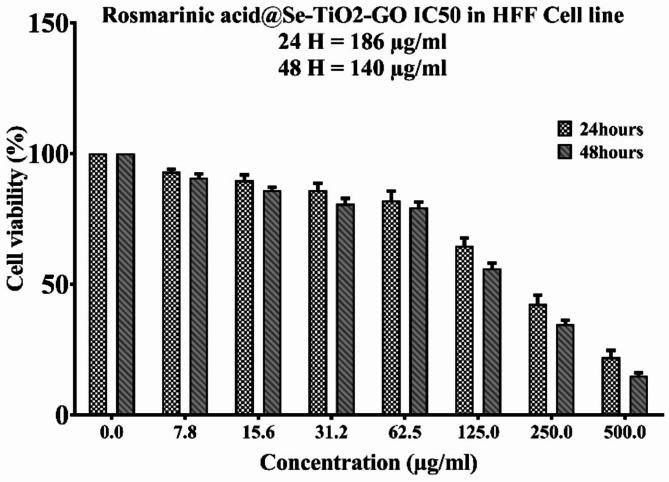
Prostate cancer remains a significant health concern due to its high mortality rate, emphasizing the need for innovative therapeutic approaches. This study aims to explore the potential anticancer effects of a drug nanocomplex containing rosmarinic acid in the treatment of prostate cancer, aiming to contribute to the development of safer and more effective treatment options for cancer patients. Nanocomposite Graphene Oxide was synthesized following the Hummers' method. The resulted product dissolved in deionized water with rosmarinic acid to prepare the final product. To investigate the effects of rosmarinic acid@Se-TiO-GO, PC3, LNCaP, and normal (HFF-1) cell lines were treated with varying concentrations (7.8, 15.6, 31.2, 62.5, 125, 250, and 500 µg/ml) of the nanocomplex. Cell viability was assessed using the Resazurin test, while levels of reactive oxygen species (ROS), gene expression (Bcl-2 and Bax), and total antioxidant capacity were measured in both cancerous and normal cells. The Se-TiO-GO nanoparticles demonstrated high entrapment efficiency and loading capacity for rosmarinic acid. The IC50 values after 24 and 48 h of RA treatment were significantly greater than those recorded for treatments involving rosmarinic acid@Se-TiO-GO. Treatment with rosmarinic acid@Se-TiO-GO resulted in decreased cell viability and increased apoptosis in PC3 and LNCaP cells, while showing no inhibitory effects on the normal cell line (HFF-1) at concentrations toxic to cancer cells. Additionally, a dose-dependent increase in ROS levels, a decrease in total antioxidant capacity, elevated Bax gene expression, and reduced Bcl-2 expression were observed in the cancer cells following treatment with the nanocomplex. The cytotoxic effects of rosmarinic acid@Se-TiO-GO nanoparticles on prostate cancer cells appear to be mediated through the generation of oxidative stress and induction of apoptosis. The unique formulation of these nanoparticles holds promise for future prostate cancer treatment strategies.
由于前列腺癌的高死亡率,它仍然是一个重大的健康问题,这凸显了创新治疗方法的必要性。本研究旨在探索一种含有迷迭香酸的药物纳米复合物在前列腺癌治疗中的潜在抗癌作用,旨在为癌症患者开发更安全、更有效的治疗方案做出贡献。采用Hummers法合成了氧化石墨烯纳米复合材料。将所得产物与迷迭香酸溶解在去离子水中以制备最终产物。为了研究迷迭香酸@硒-二氧化钛-氧化石墨烯的作用效果,用不同浓度(7.8、15.6、31.2、62.5、125、250和500µg/ml)的纳米复合物处理PC3、LNCaP和正常(HFF-1)细胞系。使用刃天青试验评估细胞活力,同时在癌细胞和正常细胞中测量活性氧(ROS)水平、基因表达(Bcl-2和Bax)以及总抗氧化能力。硒-二氧化钛-氧化石墨烯纳米颗粒对迷迭香酸表现出高包封率和载药量。迷迭香酸处理24小时和48小时后的半数抑制浓度(IC50)值显著高于迷迭香酸@硒-二氧化钛-氧化石墨烯处理组。用迷迭香酸@硒-二氧化钛-氧化石墨烯处理导致PC3和LNCaP细胞的细胞活力降低和凋亡增加,而在对癌细胞有毒的浓度下对正常细胞系(HFF-1)没有抑制作用。此外,用纳米复合物处理后,癌细胞中ROS水平呈剂量依赖性增加,总抗氧化能力降低,Bax基因表达升高,Bcl-2表达降低。迷迭香酸@硒-二氧化钛-氧化石墨烯纳米颗粒对前列腺癌细胞的细胞毒性作用似乎是通过产生氧化应激和诱导凋亡介导的。这些纳米颗粒的独特配方为未来的前列腺癌治疗策略带来了希望。




 Zotero 插件