
颗粒物暴露对全球及特定领域认知功能的影响:来自中国广场舞者研究的证据。
The impact of particulate matter exposure on global and domain-specific cognitive function: evidence from the Chinese Square Dancer Study.
作者信息
Zhu Jingyi, Wang Shuaibo, Li Peizheng, Li Fengping, Li Benchao, Ma Lu, Rong Shuang, Liao Jingling
机构信息
Academy of Nutrition and Health, Hubei Province Key Laboratory of Occupational Hazard Identification and Control, School of Public Health, Wuhan University of Science and Technology, Wuhan, 430065, China.
Department of Epidemiology and Health Statistics, School of Health Sciences, Wuhan University, Wuhan, 430071, China.
出版信息
BMC Public Health. 2025 Apr 5;25(1):1289. doi: 10.1186/s12889-025-22126-3.
BACKGROUND
There is growing evidence that exposure to particulate matter (PM) is associated with impaired cognitive function. However, limited studies have specifically examined the relationship between PM exposure and domain-specific cognitive function.
METHODS
This study involved 2,668 female participants from the Lifestyle and Healthy Aging of Chinese Square Dancer Study. Global cognitive function was assessed using a composite Z-score derived from four tests: the Auditory Verbal Learning Test (AVLT), Verbal Fluency Test (VFT), Digit Symbol Substitution Test (DSST), and Trail Making Test-B (TMT-B). These tests evaluated specific cognitive subdomains: memory (AVLT), language (VFT), attention (DSST), and executive function (TMT-B). PM concentrations were estimated using a Random Forest (RF) model, which calculated the average concentrations over 1-year and 3-year periods at a high grid resolution of 1 × 1 km. Mixed linear regression was employed to explore the association between PM exposure and cognitive function.
RESULTS
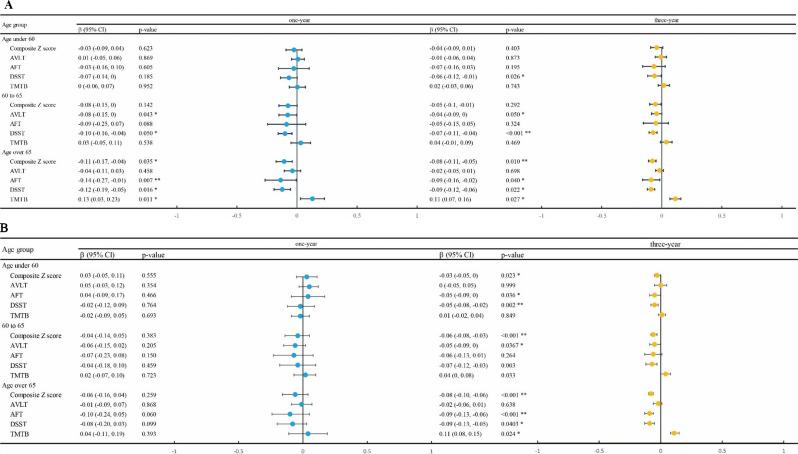
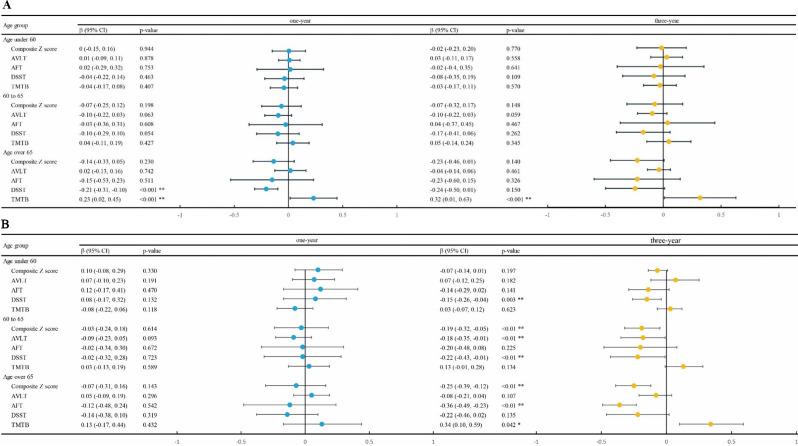
After adjusting for basic socio-demographic factors, a 10 mg/m increase in 3-year exposure to PM was significantly associated with a decrease in the DSST score by -0.05 (95% confidence interval [CI]: -0.11, 0) and an increase in the TMT-B score by 0.05 (95% CI: 0.01, 0.1). When further adjusting for gaseous pollutants (SO₂, NO₂, and O₃), even stronger associations were observed between 3-year exposure to either PM or PM and performance in both global cognition and specific cognitive subdomains. Specifically, in the DSST subdomain, a 10 µg/m³ increase in 1-year PM exposure was associated with a decrease in the score by -0.10 (95% CI: -0.15, -0.04). Age-stratified analyses further indicated that older participants were consistently more vulnerable to PM exposure. Notably, 3-year exposure to both PM and PM was linked to declines in DSST scores across both middle-aged and older age groups.
CONCLUSION
Ambient PM exposure was significantly associated with performance in global cognitive function and specific cognitive domains among Chinese females. Female populations over 65 years old were more susceptible to the adverse effects of PM and PM. Among the four subdomains, the DSST showed the strongest association with PM exposure, even at earlier ages, suggesting that impaired attention may serve as an early warning sign of cognitive decline.
CLINICAL TRIAL NUMBER
Not applicable.
背景
越来越多的证据表明,接触颗粒物(PM)与认知功能受损有关。然而,专门研究PM暴露与特定领域认知功能之间关系的研究有限。
方法
本研究纳入了来自中国广场舞者生活方式与健康老龄化研究的2668名女性参与者。使用由四项测试得出的综合Z分数评估总体认知功能:听觉言语学习测试(AVLT)、言语流畅性测试(VFT)、数字符号替换测试(DSST)和连线测验B(TMT-B)。这些测试评估了特定的认知子领域:记忆(AVLT)、语言(VFT)、注意力(DSST)和执行功能(TMT-B)。使用随机森林(RF)模型估算PM浓度,该模型以1×1千米的高分辨率网格计算1年和3年期间的平均浓度。采用混合线性回归来探讨PM暴露与认知功能之间的关联。
结果
在调整基本社会人口学因素后,3年PM暴露每增加10微克/立方米,与DSST分数显著降低0.05(95%置信区间[CI]:-0.11,0)以及TMT-B分数增加0.05(95%CI:0.01,0.1)相关。在进一步调整气态污染物(SO₂、NO₂和O₃)后,观察到3年PM或PM暴露与总体认知和特定认知子领域的表现之间存在更强的关联。具体而言,在DSST子领域,1年PM暴露每增加10微克/立方米,与分数降低0.10(95%CI:-0.15,-0.04)相关。年龄分层分析进一步表明,老年参与者始终更容易受到PM暴露的影响。值得注意的是,3年PM和PM暴露均与中年和老年组的DSST分数下降有关。
结论
环境PM暴露与中国女性的总体认知功能和特定认知领域的表现显著相关。65岁以上的女性人群更容易受到PM和PM的不利影响。在四个子领域中,DSST与PM暴露的关联最强,即使在较早年龄段也是如此,这表明注意力受损可能是认知衰退的早期预警信号。
临床试验编号
不适用。

 Zotero 插件