
嵌合抗原受体T细胞(CAR-T)治疗后复发/难治性B细胞恶性肿瘤患者的病毒感染预测模型:一项回顾性分析
A viral infection prediction model for patients with r/r B-cell malignancies after CAR-T therapy: a retrospective analysis.
作者信息
Guo Shujing, Liu Jile, Wang Bing, Zhang Xiaomei, Zhao Yifan, Xu Jianmei, Cao Xinping, Zhao Mohan, Xiao Xia, Zhao Mingfeng
机构信息
First Center Clinical College, Tianjin Medical University, Tianjin, China.
Department of Hematology, Tianjin First Central Hospital, Tianjin, China.
出版信息
Front Oncol. 2025 Mar 21;15:1549809. doi: 10.3389/fonc.2025.1549809. eCollection 2025.
BACKGROUND
Chimeric antigen receptor T cell (CAR-T) therapy for relapsed/refractory (r/r) B cell acute lymphoblastic leukemia (B-ALL) and B cell non-Hodgkin lymphoma (B-NHL) patients has shown promising effects, but side effects such as viral infections have been observed.
METHODS
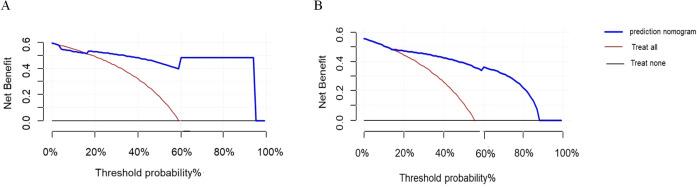
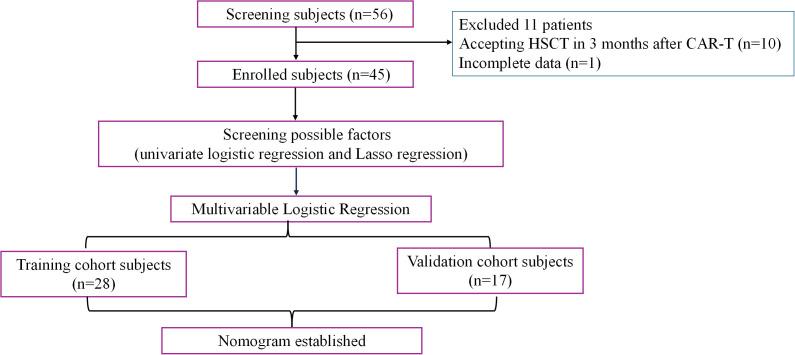
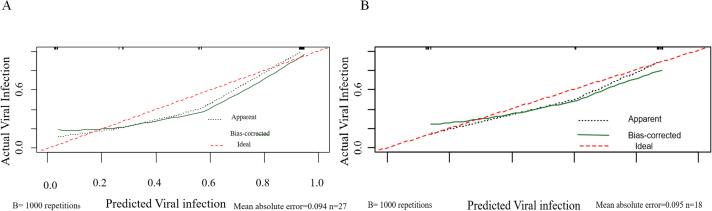
A total of 45 patients with r/r B-ALL and r/r B-NHL were included in this retrospective study. Patient demographics were recorded, with the primary endpoint being viral infection within 3 months post CAR-T treatment. Univariate and multivariate logistic regression analyses and least absolute shrinkage and selection operator (LASSO) regression analysis were used to analyze independent factors. The patients were divided into a training cohort of 28 and a validation cohort of 17 to construct a prediction model based on determined independent factors. The model's discrimination and calibration were assessed using the receiver operating characteristic curve (ROC), calibration plot, and decision curve analysis (DCA curve).
RESULTS
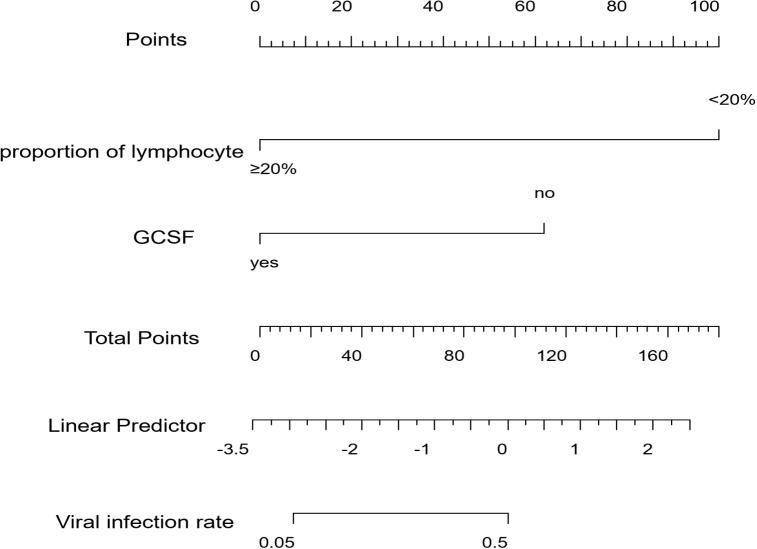
The univariate and multivariate logistic regression analyses of the 43 patients showed that low baseline lymphocyte ratio was an independent risk factor and using granulocyte colony-stimulating factor (G-CSF) early was a protective factor for viral infection after CAR-T therapy in patients with B-ALL and B-NHL. Based on that, the area under the ROC curve (AUC) of the training cohort and validation cohort was 0.935 (95% CI 0.837-1.000) and 0.869 (95%CI 0.696-1.000), respectively, showing excellent predictive value.
CONCLUSIONS
We established a nomogram to predict the factors' influence on viral infection after CAR-T therapy and found that the ratio of baseline lymphocytes and using G-CSF early or lately were able to predict viral infection after CAR-T therapy in r/r B-ALL and B-NHL.
背景
嵌合抗原受体T细胞(CAR-T)疗法对复发/难治性(r/r)B细胞急性淋巴细胞白血病(B-ALL)和B细胞非霍奇金淋巴瘤(B-NHL)患者显示出有前景的疗效,但已观察到诸如病毒感染等副作用。
方法
本回顾性研究共纳入45例r/r B-ALL和r/r B-NHL患者。记录患者人口统计学数据,主要终点为CAR-T治疗后3个月内的病毒感染情况。采用单因素和多因素逻辑回归分析以及最小绝对收缩和选择算子(LASSO)回归分析来分析独立因素。将患者分为28例的训练队列和17例的验证队列,基于确定的独立因素构建预测模型。使用受试者工作特征曲线(ROC)、校准图和决策曲线分析(DCA曲线)评估模型的辨别力和校准度。
结果
对43例患者的单因素和多因素逻辑回归分析表明,低基线淋巴细胞比例是独立危险因素,早期使用粒细胞集落刺激因子(G-CSF)是B-ALL和B-NHL患者CAR-T治疗后病毒感染的保护因素。基于此,训练队列和验证队列的ROC曲线下面积(AUC)分别为0.935(95%CI 0.837 - 1.000)和0.869(95%CI 0.696 - 1.000),显示出优异的预测价值。
结论
我们建立了一个列线图来预测CAR-T治疗后各因素对病毒感染的影响,发现基线淋巴细胞比例以及早期或晚期使用G-CSF能够预测r/r B-ALL和B-NHL患者CAR-T治疗后的病毒感染情况。


 Zotero 插件